Showing posts with label Conflict Resolution. Show all posts
Showing posts with label Conflict Resolution. Show all posts
Monday, October 17, 2022
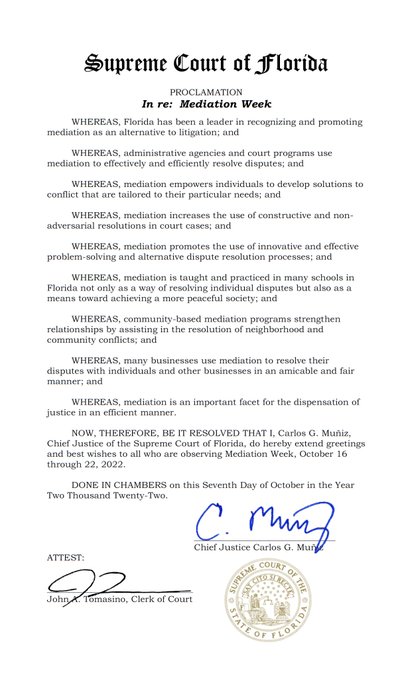
Mediation Week 2022
Every October, we celebrate the impact of the mediation process and its professionals on the many disputes in the world. Mediation Week in Florida and elsewhere marks the importance of dispute resolution as an effective substitute to litigation. In fact, mediation has helped litigants get through our recent challenges, evolving to widely accepted remote attendance allowing parties to resolve disputes without trial in a still backed-up court system. Alternative Dispute Resolution (ADR) has been used by Florida courts for more than 30 years. Online Dispute Resolution (ODR) will now serve as an official option following the pandemic through sessions conducted with readily available technology. Florida's Dispute Resolution Center continues to require specific standards set by the Florida Supreme Court in the areas of county, family, circuit, dependency, and appellate mediation during these virtual sessions. Mediation week brings annual focus on ADR work and highlights how individuals, administrative agencies, and businesses can use mediation to develop efficient and customized solutions to conflicts. Just by searching #mediationweek online, you may find a variety of resources from venerable organizations like the American Bar Association (ABA) or the Federal Mediation and Concilliation Service (FMCS) which is celebrating its 75th anniversary with free programs on cutting-edge topics, practices, and examinations on conflict prevention, management, and resolution this week. See more here-- https://fmcs.zoomgov.com/webinar/register/WN_b03eGSkmQ_uK2CiCk0U1vQ


Monday, February 12, 2018
Biblical Origins of Mediation
Today, I attended a Cardozo Legal Society lunch featuring Rabbi David Kay of Congregation Ohev Shalom which just celebrated its 100th anniversary in Orlando. The topic focused on secrecy in Jewish Law or Halaka. Keeping secrets is the stuff of modern common law and is specifically directed in our own oath of attorney in Florida as keeping the secrets of clients inviolate. Given the tendency of human nature to engage in conflict, it is not surprising that mediation is rooted in the history and tradition of many lands and cultures. We find in the Old Testament that Aaron, the first priest of ancient Israel, was the older brother of Moses. While Moses was mediator between God and Aaron, Aaron served as mediator between Moses and the people. Aaron believed in keeping shalom and caused peace to reign between man and his fellow man. While the details of Aaron’s approach are not revealed in Torah or Talmud, there is reference to Aaron which appears to signal biblical legitimacy for an alternative approach to the resolution of disputes outside of the judicial system. Law today still reflects Rabbinic and Talmudic views on dispute resolution. An aggrieved individual has access to the courts and a right to application of the law by a trier of fact. There is also the ability to have a professional neutral facilitate the resolution of those disputes through private caucuses that often reveal things the other side will never learn due to confidentiality which can be crucial to self-determined outcomes at mediation. We take solace in knowing questions we face every day in the field of dispute resolution were also faced by Rabbis and Hebrew sages thousands of years ago. See more here-- http://bit.ly/2CfGiYd
Monday, November 21, 2016
An opportunity for mediation
Republishing this mediator's column from Vail Daily as I think it best sums up what I have felt since the election a couple of weeks ago:
As we adjust to the new paradigm resulting from the election, we are still struggling to balance the poles whose swing ushered in such change. We are subsumed by violent protests, physical and verbal attacks — the immature reactions of those who reside in the extremes. Negativity is the dominant theme as it hovers menacingly over our words and actions. Immersed in the present, worried about the future, we forget that our past is full of much greater hardships that were not only endured, but conquered. Any shift, seismic or minuscule, affords opportunities to evolve and prosper in the newly-created landscape. Typically, this is viewed pejoratively, as when financiers reap huge profits during recessions. But, exploitation need not be construed as negative. The forces of cooperation and compromise must be predatory, need to swoop in as a falcon would to take advantage of the opportunity to bridge our current gulf. Now is the opportune time for mediation to rise. We have proven that we are adept at fraction. Entire industries are devoted to furthering the divides that reside within our population; legal and media chief among them. We have mechanized the process of conflict, have given hate more than enough venues. Consequently and inevitably, our society has become so intensely stratified and segmented that it is nigh impossible to spot a cohesive whole. We are not united, we are untied. To again coalesce, we need guidance from those who have been trained to bring about cohesion. Mediators have devoted their lives to that cause and no time seems more apt for their ascendancy. Mediators are used to dealing with pessimism. Almost every mediation starts with declarations from the adverse parties that there is no way that the problem will be solved. As a litigator salivates over the thought of vanquishing the opposition, the mediator relishes the chance to bring two people together who are doing their utmost to stay apart. He does not shy away from a difficult situation, knowing that hardened hearts can soften with the right dialogue and the appropriate empathy. Mediators are used to dealing with fear. Because of the voluntary, non-binding nature of the mediation process, the fear of failure is absent, or at least should be. This fearlessness imbues the mediator with the ability to be more bold, more creative, more inspirational with his approach. The more seemingly intractable the problem, such as in our current national crisis, the more that the mediator can and must risk in order to close the gap. With the stakes at their highest, the potential for life-altering outcomes is within the mediator’s grasp. Mediators are used to dealing with pettiness. The mediator’s ears have heard levels of name-calling that would shame a second-grader. The mediator witnesses the most inconsequential details forming the basis for the most intense disagreements. He has seen people stand on principles so flimsy that they should be doused in marinara. He has been unable to prevent a person from walking away from an excellent compromise because of nothing but pure, unadulterated spite. The lack of grace is dispiriting, but it does not dissuade the mediator from his chosen endeavor. Mediators are used to dealing with rage. To remain placidly in the middle while each side stokes its emotional wildfire is the ideal to which every mediator is devoted. The fisticuffs are not always figurative. There are times when bodily harm is attempted, if hopefully not achieved. Mediators should carry umbrellas to shield themselves from the spittle that flies from those whose bellicosity leaves their minds and jaws unhinged. But, even in the face of this venom, a volatile environment is the mediator’s preferred habitat. Mediators are used to dealing with errors. The mediator does not operate in a world where the prevailing fiction is that perfection is possible. He is comfortable with flaws, his own and those of the people that surround him. The mediator intuitively understands that facts are relative to one’s perspective, that there are no absolute truths. It is the recognition of mutual culpability and vulnerability that allows the mediator to construct positive solutions. The mediator’s experience prepares him perfectly for this new, fractured epoch. It is not the litigators who will kill their golden goose of conflict. It is not the bankers who will preach abnegation. It is not the doctors who will stitch our psychic wounds, their hands being restrained by the overlords of insurance. No, it is the mediators who must assume the mantle of leadership to deliver us from a misaligned destiny.-T.J. Voboril http://www.vaildaily.com/opinion/vail-daily-column-an-opportunity-for-mediation/
Thursday, July 21, 2016
Primate Proclivity for Peace?
I recently read with great interest about Frans de Waal's work studying primate behavior in The New York Times Book Review of Are We Smart Enough To Know How Smart Animals Are? Empathy, cooperation and fairness seem like distinctly human traits, but biologist Frans de Waal explains why animals might share those same qualities. He maintains that for centuries, our understanding of animal intelligence was obscured in a cloud of false assumptions and human egotism. A primatologist examining boundary lines between our species and others for thirty years, he is said to painstakingly untangle the confusion through research, revealing a wide range of animal capabilities. He studied prosocial choices in apes, showing yawn contagion, synchronization, consolation behavior, and altrusim. Even after fighting viciously, Chimpanzees reportedly reconcile due to saving a valuable relationship damaged by conflict. In a Ted Talk, he shows video of Capuchin monkeys which demonstrated empathy when there was clear inequity in being rewarded. Evolved morality exists in his opinion, rather than believing our bodies may have evolved from monkeys, but that our brains are their own miraculous and discrete inventions. He argues cognition must be understood as an evolutionary product with what he calls “cognitive ripples.” We tend to notice intelligence in primates because it’s most conspicuous. It looks the most like our intelligence. However, “after the apes break down the dam between the humans and the rest of the animal kingdom, the floodgates often open to include species after species.” See book review here-- http://nyti.ms/1XVmBu0 and Ted Talk here-- http://n.pr/1qksDWZ
Friday, July 8, 2016
Why Can't We All Just Get Along?
Recent shootings by law enforcement caught on video and now snipers taking out police officers have me thinking of the refrain from Rodney King, "Can we all get along?" Though now almost a quarter century ago, it seems like the LA riot events was last time we really had a national debate about police brutality and racial injustice. Peacemakers such as Doug Noll, with whom I've taken courses at the National Academy of Distinguished Neutrals, remind us that neuroscience has established an irrefutable fact: human beings are emotional, not rational. Still, we have a belief that humans are distinguished from all other creatures because of their rationality. To be irrational is to be something less than human. People engaged in peacemaking long assumed that despite the emotions of conflict, people are fundamentally rational. The truth is, we are ninety-eight percent emotional and about two percent rational. Research demonstrates that we must strive to be far more aware of neuropsychological factors of human conflict. Noll believes these factors explain much about conflict behaviors. They also provide insights about new interventions in intractable conflicts. Conflict starts with a problem serious enough to cause anxiety, reflected in a feeling of insecurity. When anxiety or insecurity is first experienced, he says we have a choice between reactivity and reflection. If we do not make a choice, Noll says our default mode is to be reactive. By being reactive, we might reject the problem, give up, or feel inadequate to deal with the problem. If the problem is persistent, we might struggle or exit. As the conflict develops, we perceive it as a threat, and we may blame, attack or withdraw. These behaviors constitute our fear reaction system. If the choice for reflection is made, we have learned to reflect, relate, and relax. The insecurity arising from a conflict situation is recognized as pointing to a pathway of growth towards greater peace and self-realization. The brain's altruistic, cooperative social attachment systems actually allow us to be compassionate, tolerant, and exhibit loving-kindness. Perhaps through this, we can engage in conflict resolution and achieve peace. See more here-- http://bit.ly/29zdOwA and http://timelines.latimes.com/los-angeles-riots/
Tuesday, October 13, 2015
Mediation Week 2015
Since 2011, the American Bar Association (ABA) has declared the third week of October “ABA Mediation Week.” The ABA events bolster efforts of many other national, state, and local organizations, including the Association for Conflict Resolution (ACR), which have traditionally celebrated conflict resolution during October. According to the ABA, Mediation Week celebrates strides made in institutionalizing mediation as one of several dispute resolution processes. For many years, Florida has led the field of alternative dispute resolution which has grown in acceptance, especially as litigation has become more costly and lengthy with electronic discovery. There is certainly wide recognition that the majority of cases are resolved outside of the traditional adversarial process. Litigants, their attorneys and the judges they appear before routinely embrace multiple paths to settling lawsuits out of court, including mediation. The theme for this year’s ABA Mediation Week is: Mediation: Successes, Challenges, Trends and the Next Generation: Looking to the past, present and future. "As lawyers and mediators, we understand both the challenges and rewards of helping parties in conflict reach an agreement by getting past differences in positions, by understanding each other’s perspectives better, and by finding ways to get their important interests met while staying true to their values and belief systems." Programs held during ABA Mediation Week provide neutrals, advocates and policy makers with inspiration and tools necessary to bridge the gap that often prevents amicable resolution of disputes. This year’s theme seeks to recognize the past, present and future of mediation. Read more here-- http://www.americanbar.org/groups/dispute_resolution/resources/mediation_week_toolkit.html
Subscribe to:
Posts (Atom)