
Showing posts with label Florida Supreme Court. Show all posts
Showing posts with label Florida Supreme Court. Show all posts
Tuesday, September 1, 2026
OA on Civil Rule 1.820 Nonbinding Arb 10/8
The Supreme Court of Florida has scheduled oral argument for October 8, 2026 in a pending civil procedure rules case following submission and comment period on The Florida Bar Civil Procedure Rules Committee's proposed amendments regarding outcome of cases under Florida Rule of Civil Procedure 1.820. The standing Civil Rules Committee of The Florida Bar seeks to amend Florida Rule of Civil Procedure 1.820 after confusion arising from People’s Trust Ins. Co. v. Hernandez, 413 So. 3d 127 (Fla. 4th DCA 2025) where the Fourth District Court of Appeal interpreted nonbinding arbitration notice language as requiring a party to state both that it was “rejecting” the arbitration decision and that it was “requesting a trial” in the written filing. In Hernandez, while the party filed a request for trial de novo, the request did not include language that the party was “rejecting” the arbitration award. The court said the request for trial de novo did not strictly comply with Rule 1.820 (h) and was therefore ineffective. When the Civil Rules Committee last proposed amending Rule 1.820, it was not their intention to create a requirement to use “magic words” to reject an arbitration award-- it was to create a requirement that a request for trial de novo be accomplished by a written filing. Members of the committee now agree that it is duplicative and unnecessary for a party to say both that the arbitration award is being rejected and that a trial de novo is being requested. Rather, it is implicit that a request for a trial de novo is a rejection of the arbitration award. There was also a concern that Article I, Section 22 of the Florida Constitution states “[t]he right of trial by jury shall be secure to all and remain inviolate” and a procedural rule should not invade that right by creating a trap for the unwary. To address the Hernandez decision’s interpretation, Civil Rules proposes amending subdivision (h) to clarify that only a written request for trial need be filed; the filing does not have to be a “notice of rejection of the arbitration decision and request for trial.” Just decided by the 6th DCA while this change is pending was a similar case, The Waterfront in Naples Condominium Association, Inc. v. Reynolds, Consolidated Case Nos. 6D2025-0624, 6D2025-0623 on August 21, 2026. In that opinion, the court found the goal of interpretation is to arrive at a fair reading of the rule text on the basis of how a reasobable reader would understand it at the time of issue. They declined a magic words test, such that a timely filed document (not a specific form) served as enough notice required for the trial court to conclude the award was rejected because a trial de novo was requested in compliance with the statute, FS 44.103. See official rules amendment petition case pending before the Florida Supreme Court docketed here-- https://acis.flcourts.gov/portal/court/68f021c4-6a44-4735-9a76-5360b2e8af13/case/14463DCF-4E3D-428D-B801-B5BC1DC7570A and case that brought about the need for clarification-- https://law.justia.com/cases/florida/fourth-district-court-of-appeal/2025/4d2024-3274.html and most recent case from which a conflict was certified-- https://flcourts-media.flcourts.gov/content/download/2494192/opinion/Opinion_2025-0623.pdf


Thursday, January 15, 2026
FL Nonbinding Arbitration Rules Clarification
The standing Civil Rules Committee of The Florida Bar seeks to amend Florida Rule of Civil Procedure 1.820 after confusion arising from People’s Trust Ins. Co. v. Hernandez, 413 So. 3d 127 (Fla. 4th DCA 2025) where the Fourth District Court of Appeal interpreted nonbinding arbitration notice language as requiring a party to state both that it was “rejecting” the arbitration decision and that it was “requesting a trial” in the written filing. In Hernandez, while the party filed a request for trial de novo, the request did not include language that the party was “rejecting” the arbitration award. The court said the request for trial de novo did not strictly comply with Rule 1.820 (h) and was therefore ineffective. When the Civil Rules Committee last proposed amending Rule 1.820, it was not their intention to create a requirement to use “magic words” to reject an arbitration award-- it was to create a requirement that a request for trial de novo be accomplished by a written filing. Members of the committee now agree that it is duplicative and unnecessary for a party to say both that the arbitration award is being rejected and that a trial de novo is being requested. Rather, it is implicit that a request for a trial de novo is a rejection of the arbitration award. There was also a concern that article I, section 22, Florida Constitution states “[t]he right of trial by jury shall be secure to all and remain inviolate” and a procedural rule should not invade that right by creating a trap for the unwary. To address the Hernandez decision’s interpretation, Civil Rules proposes amending subdivision (h) to clarify that only a written request for trial need be filed; the filing does not have to be a “notice of rejection of the arbitration decision and request for trial.” This is now an official rules amendment petition case pending before the Florida Supreme Court found here-- https://acis.flcourts.gov/portal/court/68f021c4-6a44-4735-9a76-5360b2e8af13/case/14463DCF-4E3D-428D-B801-B5BC1DC7570A and case that brought about the need for clarification-- https://law.justia.com/cases/florida/fourth-district-court-of-appeal/2025/4d2024-3274.html


Saturday, March 1, 2025
Florida Mediation Reporting Rule Comments Due 3/31
The Supreme Court of Florida's Committee on Alternative Dispute Resolution (ADR) Rules and Policy is seeking comments on proposed revisions to the Florida Rules of Civil Procedure, the Florida Small Claims Rules, the Florida Rules of Juvenile Procedure, the Florida Rules of Appellate Procedure, and the Florida Family Law Rules of Procedure. These rules are revised to include subdivisions entitled Report of Mediation and Adjournment for Further Mediation, which are intended to compliment and clarify the scope of Rule 10.360(e), Reporting Outcome, and Rule 10.360(f), Presence, Florida Rules for Certified and Court-Appointed Mediators. With these changes, after an initial mediation session, a mediator could report agreement, no agreement, partial agreement, or adjournment for further mediation. No other descriptors, modifiers, comments, or recommendations may be included in the report unless all parties consent in writing. However, nothing in the amendment prohibits the mediator from identifying the parties, counsel, and participants present at the mediation and whether present physically or by communication technology. In a mediation involving more than two parties, a mediator may now report agreement or partial agreement as to any parties who agree and no agreement as to the other parties. The proposed revisions to the Florida Rules of Civil Procedure, the Florida Small Claims Rules, and the Florida Rules of Appellate Procedure also contain a subdivision entitled Status Reports in response to recent civil case management rules adopted by the Florida Supreme Court that have changed the way lawsuits are handled in state court with more of a federal-style scheduling track. Comments to the ADR Rules and Policy Committee should be made care of the Florida Dispute Resolution Center at: drcmail@flcourts.org on or before Monday, March 31, 2025, at 5:00 p.m. EDT. See more on the proposed language here-- https://tinyurl.com/4yj3cv5x


Friday, November 1, 2024
Florida Arbitrator Rule Changes
The Supreme Court of Florida just issued an opinion on its Alternative Dispute Resolution Rules and Policy Committee's petition to amend the Florida Rule for Court-Appointed Arbitrators 11.010, entitled Qualification. The amendments to Rule 11.010 are intended to clarify the qualifications for Florida court-appointed arbitrators. Effective immediately, the court modified the rules such that a sole or chief court-appointed arbitrator must be a member in good standing of The Florida Bar for the preceding five years, unless the parties agree in writing that the sole or chief court-appointed arbitrator may be an individual who has been for the preceding five years a member in good standing and eligible to practice law in any United States jurisdiction, which includes the District of Columbia and any state, commonwealth, territory, or possession of the United States. In addition, the rule is amended to clarify that a non-licensed individual who is not currently disbarred or suspended from practice in any jurisdiction may serve as a non-chair arbitrator on an arbitration panel with the written agreement of all parties. This change enables parties to select from a wide variety of neutrals to be utilized in the arbitration process with some safeguards particularly focused on the chair, but allowing for wings such a non-lawyers with related expertise that may not have been otherwise qualified. See more from Florida Supreme Court case number SC24-0442 here-- https://tinyurl.com/fv45n4p6


Tuesday, October 15, 2024
It's Mediation er, um rather ADR Week!
Each October, we celebrate Mediation Week which has officially changed to Alternative Dispute Resolution or "ADR Week" in recognition of the importance of all forms of dispute resolution utilized in Florida. Chief Justice of the Florida Supreme Court, Carlos G. Muñiz, recognized October 13-19th as ADR Week in Florida’s courts, and the members of Florida’s Dispute Resolution Center and The Florida Bar ADR Section are excited to take this time to celebrate Florida’s leadership over the past 35 years in successfully utilizing ADR practices. Of course, these practices include mediation, arbitration, parenting coordination, eldercaring coordination, and other restorative and evaluative processes that encourage joint problem solving and effective resolution of disputes outside of the courtroom. All forms of ADR strive to assist parties to resolve their own disputes through self-determination, without the need for a trial. ADR is quite effective and efficient for the attorneys and litigants involved, and it also conserves resources in Florida’s trial and appellate courts. Florida’s skilled ADR practitioners empower individuals, families, schools, and businesses to foster communication, create solutions, and develop lasting solutions to difficult issues. Locally, the ADR Section is celebrating by having a mixer on 10/22 from 5:30-7:30 PM at Eola Wine Company, 430 E. Central Blvd., Orlando. Please RSVP to alicia@rtmediation.com See more here-- https://tinyurl.com/28pmjrpu and here-- https://tinyurl.com/yxv72eky


Tuesday, September 10, 2024
Comments on Attorneys Signing Settlement Agreements Due 10/1
The Supreme Court of Florida has received a petition from The Florida Bar Civil Rules Committee stemming from a case reported a couple of years ago, Parkland Condominium Association, Inc. v. Henderson, 350 So. 3d 484 (Fla. 2d DCA 2022) where the court did not enforce a deal when the attorneys signed a mediated settlement agreement, but the parties never did. The proposed rule change to Fla. R. Civ. P. 1.730 will no longer require signature of counsel to the parties on mediation settlement agreements and will permit the signature of a party representative (e.g., insurer) if they have full authority to settle. Many cases we see referred to mediation have no Certificates of Authority despite the civil rules saying they must be timely filed before mediation. Mediators compromise their neutrality when they are asked by counsel and their clients to police such compliance. The Civil Rules Committee notes that in reviewing Rule 1.730, it requires, "erroneously," a lawyer's signature on a mediation agreement as Florida law does not otherwise require it. The applicable statute merely requires that a mediated settlement agreement be "signed by the parties and, if required by law, approved by the court." See § 44.404(1)(a), Fla. Stat. Attorneys signing at the end gives a certain gravity to the mediation process and evidences they have read over it and advised the parties signing. I never saw counsel complain in decades of doing this. Comments are due by October 1,2024. Find more on case number SC2024-0774 here--https://tinyurl.com/mrxuxcmj


Tuesday, May 21, 2024
Florida Arbitrator Rule Comments Due 6/4!
The Supreme Court of Florida's Committee on Alternative Dispute Resolution Rules and Policy has filed a petition with the Florida Supreme Court to amend the qualifications for court-appointed arbitrators to clarify the language of Rule 11.010, Florida Rules for Court Appointed Arbitrators, entitled Qualification, which provides the requirements for qualification as a non-binding arbitrator. Apparently, the impetus is that the current rule is internally contradictory, or at best confusing. The first sentence basically nullifies itself– “Arbitrators shall be members of The Florida Bar, except where otherwise agreed by the parties.” So, the parties can decide an arbitrator is anyone off the street despite the first clause in the sentence requiring them to be members of The Florida Bar. The second sentence of the current rule is vague or ambiguous. It says, “The chief arbitrator shall have been a member of The Florida Bar for at least five years” with no reference to good standing or whether the “five years” are immediately preceding or even consecutive. The third and final sentence then says, “Individuals who are not members of The Florida Bar may serve as arbitrators only on an arbitration panel and then only upon the written agreement of all parties.” By its terms, this sentence limits the seemingly absolute ”where otherwise agreed by the parties” in the first sentence of the rule and allows individuals who are not members of The Florida Bar to serve as arbitrators only on panels even “where otherwise agreed by the parties [from the first sentence].” Some members of the Arbitration Committee of the Alternative Dispute Resolution Section of The Florida Bar are considering a comment with concern for out of state lawyers. The proposed rule only adds permission for them to be the chief or sole arbirator “if agreed to by the parties.” Otherwise, they have the same opportunity to be arbitrators as under the first sentence of the current rule. The new language purports to maintain the protection of the qualification requirement for arbitrators, but allows the parties to continue to select arbitrators from a broad field. The petition is styled In Re: Amendments to the Florida Rules for Court-Appointed Arbitrators, and the court has assigned case number SC2024-0442. The court has announced a public comment period through June 4, 2024. See more here-- https://tinyurl.com/2p9mcx8r and https://tinyurl.com/bdhc43c4


Friday, March 22, 2024
ADR Rules & Policy Approves Language
This week, the Florida Supreme Court's ADR Rules and Policy Committee approved in its response regarding rule amendments (by a vote of 16 to 0) my suggested change submitted through the ADR Section Executive Council comment regarding revisions to Rule 10.340(d)(2) on conflicts of interest as follows: “(2) the mediator previously provided services (other than mediation services) for, or represented one or more of the mediation participants in, the matters current case or dispute at issue in the mediation; or…" The ADR Rules and Policy Committee found this narrows the scope of the proposed language. They agree since this provision addresses “clear” conflicts of interest, which are not waivable, the scope should only be broad enough to address the harm to be avoided. The Committee’s language, “matters at issue in the mediation,” is broader than my suggested language. The broader scope would require a mediator to decline serving as a mediator even if the potentially conflicting interests are not directly related to the case or dispute being mediated. For non-waivable conflicts of interest, a narrower scope may be preferable in order to ensure that parties have the widest latitude in selecting a mediator, while still ensuring mediator impartiality. Therefore, the Committee supported narrowing the scope through alternate language and has asked the court to adopt it and other changes pending a decision to grant oral argument. See more here-- http://tinyurl.com/eedckhhj


Sunday, February 11, 2024
FL Mediator Rule Comments Due 3/4
The ADR Rules and Policy Committee of The Supreme Court of Florida has proposed revisions to the rules governing certified and court-appointed mediators. While the changes are outlined in the links below and mostly consist of revisions to form such as "shall" being replaced with "must," they do have some substantive changes as requirements in becoming a certified mediator and in the conflict rules, so please consider weighing in on these amendments by March 4th. You may comment by sending your correspondence to the ADR Committee Chair, Honorable Michael S. Orfinger, Seventh Judicial Circuit, Volusia County Courthouse, 101 N. Alabama Avenue, Ste. C-443, DeLand, FL 32724, morfinger@circuit7.org, and the OSCA Staff Liaison to the Committee, Thomas A. David, 500 South Duval Street, Tallahassee, Florida 32399-1927, davidt@flcourts.org, as well as a separate request for oral argument if the person filing the comment wishes to participate in oral argument, which may be scheduled in this case. The ADR Committee then has until March 25th to respond to commments. It is always important to participate in rulemaking as a member of the bar and the ADR profession so that the Committee can get proper feedback for what is actutally going on in the trenches. See more here-- http://tinyurl.com/395rat8k and http://tinyurl.com/eedckhhj


Friday, June 9, 2023
Comments Sought for Non-Binding Arb Changes
The Supreme Court of Florida governed Florida Dispute Resolution Center (DRC) Committee on Alternative Dispute Resolution (ADR) Rules and Policy has put forth proposals in Case No. SC2023-0810. The court is now considering amendments to Florida Rule of Civil Procedure 1.820 (Hearing Procedures for Non-Binding Arbitration) that would provide a non-exclusive list of factors for a judge to consider when deciding whether to refer a contested civil action to non-binding arbitration. The amendments would also provide minimum hearing procedures that must be included in an order of referral to non-binding arbitration, absent agreement of the parties, among other things. The court has placed the proposals online and any comments should be filed with the Florida Supreme Court on or before July 31, 2023. If filed by an attorney in good standing with The Florida Bar, the comment must be electronically filed via the Florida Courts E-Filing Portal. If filed by a nonlawyer or a lawyer not licensed to practice, the comment may be, but is not required to be, filed via the Portal. Any person unable to submit a comment electronically must mail or hand-deliver the originally signed comment to the Florida Supreme Court, Office of the Clerk, 500 South Duval Street, Tallahassee, Florida 32399-1927 See more here-- https://www.floridasupremecourt.org/Case-Information/Rules-Cases-Proposed-Amendments and https://acis.flcourts.gov/portal/search/case


Saturday, April 22, 2023
ADR Rules and Policy Needs You!
The Supreme Court of Florida governed Florida Dispute Resolution Center (DRC) Committee on Alternative Dispute Resolution (ADR) Rules and Policy is currently accepting applications for six member appointments to the Committee on ADR Rules and Policy. The Committee on ADR Rules and Policy provides the Supreme Court with recommendations relating to ADR legislation, and all aspects of ADR policy and rules including, but not limited to, ADR practices, mediator certification and renewal requirements, continuing education requirements, and mediation training program requirements. All seats are three year terms that commence on July 1, 2023. Of the appointments, two appointees must be non-lawyer mediators who have been Florida Supreme Court certified for more than five years. The remaining four appointees may be either lawyer mediators or non-lawyer mediators who have been Florida Supreme Court certified for more than five years. All mediator appointees must be Florida Supreme Court certified mediators. All lawyer appointees must be members in good standing of The Florida Bar and have practiced law for a minimum of five years and conducted or attended 15 mediations. Appointments will be made by the Chief Justice of the Supreme Court of Florida. Please see AOSC20-59PDF Download for more information. To be considered for appointment, please submit a letter of interest and current résumé on or before April 25, 2023, to:
Florida Dispute Resolution Center
Supreme Court Building
500 S. Duval Street
Tallahassee, Florida 32399
Fax: (850) 922-9290
mail: DRCmail@flcourts.org


Thursday, December 8, 2022
FL S. Ct. Improved Resolution Workgroup Rules OA
The Supreme Court of Florida heard oral argument today on a package of rules proposed by their appointed Workgroup on Improved Resolution of Civil Cases that might forever impact our state court system in a major way. These amendments are proposed as a paradigm shift to change the legal community and the perceived problems such as that current rules engender delay culture and firmer deadlines move cases. Firm trial dates, dates for discovery cutoffs and dispositive motions that are enforced by active case management can promote efficient resolution of cases according to the judges creating these proposed rules. Hearing time is a precious commodity that is often wasted with cancellation as are trial weeks according to Chief Judge Morris of the 2d DCA who reports that a mere 0.04% of cases end up in trial. Some judges appearing advocated the integration of county clerks' computer systems and the judicial case systems to alleviate duplication and promote standardization such as PACER in the federal system. The Civil Rules Committee chair said the adoption of the federal summary judgment rule brought the case law relied on in that system for clarity, but cautioned that the wide swath of changes to aggressive case management would shock the system and create growing pains with litigation on those changes. Justice Canady, who oversaw the Covid-19 crisis in the courts, said serving the litigants was the reason emergency procedures were ordered and now the court wants to see how to institutionalize those changes that proved successful in getting cases at issue during the pandemic. Justice Polston expressed concern with cases that are falling far behind or that just plain languish. He was also concerned parties should be exempt from the case management rubric in cases that are subject to Arbitration. Justice Labarga said when he was a trial judge, lawyers did not adhere to deadlines, especially with experts. Justice Muniz questioned why not implement proportionality in discovery like federal court and was told by a sophisticated commenter that our state system was just not ready to address that. The bar's Business Law Section is in favor of proportionality and also agreed with imposing track rules on cases except for presumptive streamlining of bench trials. The Appellate Rules Committee did not like substantive standards of review found in a few of these procedural rules. Probate practitioners were concerned about the disparity in dockets around the state and increased judicial decisionmaking versus routine uncontested proceedings. Critics of the sweeping package took issue with the lack of resources to implement these changes and technical irreconcilable differences between some of the rules. Others feared increased sanctions and less continuances. Judge Bailey responded on behalf of her workgroup arguing that because civil justice costs too much and takes too long, the public has lost faith and these case management changes are needed. While there were concerns over standardizing hearing procedures, everyone agreed an educational effort is needed in conjunction with the rollout of these rules. See more here-- https://www.youtube.com/watch?v=Hq8gHr2FQP8 and Case No. SC22-122 https://bit.ly/3UGns4K


Monday, October 17, 2022
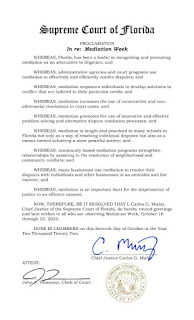
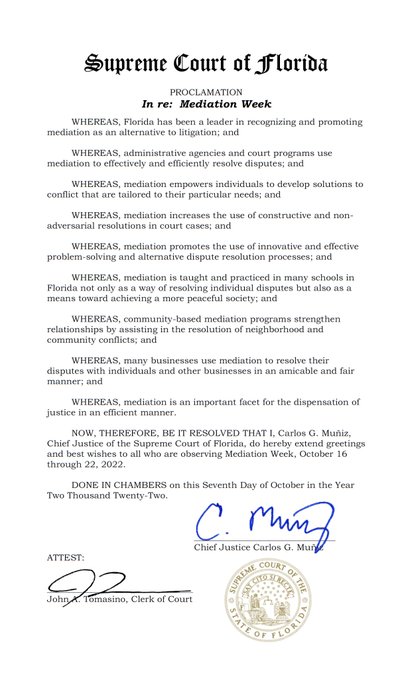
Mediation Week 2022
Every October, we celebrate the impact of the mediation process and its professionals on the many disputes in the world. Mediation Week in Florida and elsewhere marks the importance of dispute resolution as an effective substitute to litigation. In fact, mediation has helped litigants get through our recent challenges, evolving to widely accepted remote attendance allowing parties to resolve disputes without trial in a still backed-up court system. Alternative Dispute Resolution (ADR) has been used by Florida courts for more than 30 years. Online Dispute Resolution (ODR) will now serve as an official option following the pandemic through sessions conducted with readily available technology. Florida's Dispute Resolution Center continues to require specific standards set by the Florida Supreme Court in the areas of county, family, circuit, dependency, and appellate mediation during these virtual sessions. Mediation week brings annual focus on ADR work and highlights how individuals, administrative agencies, and businesses can use mediation to develop efficient and customized solutions to conflicts. Just by searching #mediationweek online, you may find a variety of resources from venerable organizations like the American Bar Association (ABA) or the Federal Mediation and Concilliation Service (FMCS) which is celebrating its 75th anniversary with free programs on cutting-edge topics, practices, and examinations on conflict prevention, management, and resolution this week. See more here-- https://fmcs.zoomgov.com/webinar/register/WN_b03eGSkmQ_uK2CiCk0U1vQ
Monday, August 1, 2022
Permanent Remote Mediation Authorized By Fla. S. Ct.
This summer, the Florida Supreme Court provided permanent civil rule changes authorizing the remote conduct of certain court proceedings including mediation, appellate mediation and arbitration. The court's Workgroup on Continuity of Court Operations and Proceedings During and After COVID-19 was directed to identify whether certain proceedings, due to efficiencies beneficial to stakeholders, could continue to be conducted remotely when COVID-19 no longer presents a significant risk to public health and safety. The Workgroup determined that permanent, broader authorization for remote proceedings was warranted based on the positive outcomes and efficiencies observed during the pandemic. Beginning with Rule 1.700, Florida Rules of Civil Procedure, common to mediation and arbitration, the amended language now provides for use of communication technology (as that term is defined in Florida Rule of General Practice and Judicial Administration 2.530) authorized in mediation and arbitration by stipulation of the parties or by court order. Absent direction in the order of referral, mediation or arbitration must be conducted in person, unless the parties stipulate or the court, on its own motion or on motion by a party, otherwise orders that the proceeding be conducted by communication technology or by a combination of communication technology and in-person participation. Also of note, is that Rule 1.720 now states a party is deemed to appear at a mediation conference if physically present or, if authorized, participating through the use of communication technology. Please note under Rule 1.730, if an agreement is reached, it must be reduced to writing and signed by the parties and their counsel, by original signature, electronic signature, or facsimile and may be in counterparts. Importantly, the parties may not object to the enforceability of an agreement on the ground that communication technology was used for participation in the mediation conference if such use was authorized. Similar language is found in Rule 1.750 in regard to county court mediation. The communication technology provisions also apply to appellate mediation and are found in revised Florida Rules of Appellate Procedure 9.700, 9.720 and 9.740. These amendments become effective October 1, 2022 and recognize the sea change that took place during court closures. The shift to remote proceedings helped ease a backlog of cases by litigants being able to access hearings and alternative dispute resolution though Zoom and other available online platforms to resolve matters. See complete opinion here-- https://www.floridasupremecourt.org/content/download/843197/opinion/sc21-990.pdf


Wednesday, April 20, 2022
Comments on Non-Binding Arbitration due 5/6
The Supreme Court of Florida's Standing Committee on Alternative Dispute Resolution Rules and Policy is charged with monitoring and making recommendations to improve and expand the use of court-connected Alternative Dispute Resolution (ADR) not limited to mediation through the recommendation of the adoption of statutes, rules, policies, and procedures. This Committee is seeking feedback on two proposed amendments related to statutory non-binding arbitration. Specifically, they are considering revisions to Rule 1.820, Florida Rules of Civil Procedure (Hearing Procedures for Non-Binding Arbitration) and Section 44.103, Florida Statutes (Court-ordered, nonbinding arbitration). While the ADR Section of the Florida Bar whose Executive Council on which I serve will be commenting on behalf of its almost one thousand members, please consider individually responding to these proposals. The Florida State Court System consists of 20 judicial circuits that encompass Florida’s 67 counties and so practice in this area of ADR varies widely under local administrative orders. Comments are due to the Florida Dispute Resolution Center on or before Friday, May 6, 2022, via drcmail@flcourts.org. The proposed revisions can be found here-- https://tinyurl.com/3r986y25 and https://tinyurl.com/4w2tfuje


Wednesday, December 22, 2021
Fla. S. Ct. Extends Previous Covid Mediator Measures
The Supreme Court of Florida issued an Administrative Order (AO) relating to several Alternative Dispute Resolution (ADR) items that continue addressing operational issues from the pandemic and allowing for things like mediation training by remote electronic means. The order extends a limited number of provisions that were first authorized in April 2020 and December 2020 due to the impact of COVID-19 on the judicial system. Highlights of the order include suspending the Rules for Certified and Court-Appointed Mediators by eliminating the required points for mentorship activities through June 30, 2022. According to the Dispute Resolution Center which just advised of this new order, there are few important items to note in the AO: mentoring activities may still be needed for applicants to reach the required points for mediator certification (except for county); extending the ability of parenting coordination training to be conducted online through December 31, 2022; and waiving certain disciplinary requirements for certified mediators and qualified parenting coordinators. See more in AOSC20-24 Amendment 2 here-- https://bit.ly/3qgLaar

Friday, October 15, 2021
Certified Mediator Procedures Change
A new operating procedures policy was issued today by the Florida Dispute Resolution Center (DRC). Pursuant to rule 10.140, Rules for Certified and Court-Appointed Mediators, Operating Procedures and Authority, the Committee on Alternative Dispute Resolution Rules and Policy, new procedures are effective November 1, 2021, and supersede any conflicting provisions. Numerous revisions to the certification and renewal processes include:

The 50% continuing mediator education (CME) live format requirement has been rescinded. - Mediators will only be required to complete 16 hours of CME regardless of how many certifications are held. - Mediators may begin earning CME hours for next cycle upon submission their renewal for previous cycle. - Inactive status allows a mediator’s certification to remain inactive for up to five years. - Lapsed certifications are eligible to renew their certifications up to a maximum of five years.See more here-- https://bit.ly/3FTcRgq

Sunday, October 3, 2021
ADR Section Supports ODR
The Florida Supreme Court last month extended the public comment deadline on a rules petition designed to promote greater use of remote technology or online dispute resolution (ODR) in court proceedings, including mediation. Specifically, the COVID-19 Workgroup’s proposed rules changes begin with Florida Rule of General Practice and Judicial Administration 2.530, Communications Technology. The Alternative Dispute Resolution (ADR) Section's Executive Council has now filed a comment on behalf of its members in support of the continued use of remote technology. This was done after surveying members about personal experiences with remote proceedings over the past eighteen months of the coronavirus pandemic and their opinions regarding the proposed rules changes. The Florida Bar ADR Section favors enhancing the dispute resolution process through modernization while also increasing efficiency and lowering costs for the participants. It appears the Proposed Rules will assist to meet that goal, and as such the ADR Section supports the Workgroup proposed changes to Rules 1.700, 1.720, 1.730, 1.750, 9.700, 9.720, and 9.740 with the changes suggested through an official comment filed. The use of communication technology and remote participation at mediation and arbitration provides ready access to these proceedings by adding an additional means to attend and often lowers barriers to participation. Scheduling is easier when travel time is eliminated. The cost of attending is less when there are no lodging and parking costs either. Any early concerns as to communication technology and security have been addressed to the satisfaction of most practitioners and participants. The ADR Section also anticipates that these systems will continue to evolve and improve over time. See more here-- https://bit.ly/2V1hGll


Wednesday, September 1, 2021
Comments on Remote Rule Changes Due 9/30
The Supreme Court of Florida is extending a public comment period for a rules petition submitted by its COVID-19 Workgroup that is designed to promote greater use of tech due to courts, counsel and parties having experienced great efficiency during the pandemic. Changes to Florida Rule of General Practice and Judicial Administration 2.530, Communications Technology, also impact six other rule sets — Civil Procedure, Criminal Procedure, Probate Rules, Traffic Court, Small Claims, and Appellate Procedure. The amendments focus on ways to permit virtual proceedings under many circumstances, including mediation. The so-called Workgroup on the Continuity of Court Operations and Proceedings During and After COVID-19 found Court and Bar leaders embraced remote technology to navigate the COVID-19 pandemic. After months of deliberation, the members determined that permanent, broader authorization for the remote conduct of court proceedings after the pandemic was warranted based on the positive outcomes and efficiencies being observed during the pandemic. The Workgroup noted significant cost and time savings for litigants, lawyers and other stakeholders, while recognizing that remote proceedings are not appropriate in all circumstances. The proposed amendments to Rule 2.530 still require a court official to consider any objections to the use of remote technology and to ultimately approve all use of communication technology. Chief Judge Munyon of Orlando who chairs the effort said remote mediations are here to stay, along with remote hearings and depositions. “Whether a particular hearing is so complex that it needs to be in person, or the evidence is such that it needs to be in person, will be treated on a case-by-case basis,” she said as reported by The Florida Bar News. This morning, the Executive Council of ADR Section of The Florida Bar contemplated filing a comment in support of the continued use of remote mediation attendance which has proved quite effective in the past eighteen months. See more here-- https://bit.ly/2V1hGll and https://bit.ly/3yL2syZ


Monday, April 5, 2021
FL S. Ct. ADR & MEAC Vacancies
For those inclined to stay up on the very latest in our profession, the Florida Dispute Resolution Center (DRC) is currently accepting applications for six member appointments to the Florida Supreme Court's Alternative Dispute Resolution (ADR) Rules and Policy Committee. The committee provides the court with recommendations relating to ADR legislation, and all aspects of ADR policy and rules including, but not limited to, model ADR practices, mediator certification and renewal requirements, continuing education requirements, and mediation training program requirements. The committee consists of 17 volunteer members and may include mediation trainers, Florida Supreme Court certified mediators, arbitrators, trial court administrators, parenting coordinators, attorneys, and judges. Terms are staggered and no member shall serve more than nine years. Additionally, the Mediator Ethics Advisory Committee (MEAC) is a nine member body that issues written advisory ethics opinions for mediators subject to the Florida Rules for Certified and Court-Appointed Mediators. MEAC is accepting applications for three vacancies of four year terms as follows: One certified mediator from the Northern Division encompassing the First, Second, Third, Eighth and Fourteenth judicial circuits; One certified mediator from the Central Division encompassing the Fifth, Seventh, Ninth, Tenth, Eighteenth and Nineteenth judicial circuits; and One certified mediator from the Southwest encompassing the Sixth, Twelfth, Thirteenth, and Twentieth judicial circuits. Applicants shall not also serve on the Mediator Qualifications and Discipline Review Board. These appointments are made by the Chief Justice of the Supreme Court of Florida based upon competence, specialized knowledge, experience in ADR processes, and a commitment to the time necessary to be an active contributor. If interested in serving on either committee, a letter of interest with current résumé should be submitted by April 15, 2021 to DRCmail@flcourts.org

Subscribe to:
Posts (Atom)