
Showing posts with label Florida mediation. Show all posts
Showing posts with label Florida mediation. Show all posts
Saturday, May 30, 2026
Celebrating 25 Years of Mediating!
Hard to believe this month marks my 25th year serving lawyers and litigants as a Florida Supreme Court Certified Circuit Civil Mediator, an Appellate mediator (since the 2001 pilot program with our 5th DCA) and as a federal district court mediator. Back in the day, you had to be a Florida lawyer for at least five years before even becoming certified (much like a judge). I fondly recall my excellent training with former judge David Strawn, a pioneer in the field of mediation. I am still in touch with my mediation training classmates, some of whom are also mediating full-time, and one who took the bench and presided over our business court in Orange County. Through the years, this special field in the law has evolved and some rules have changed, but by and large the basics are the same, proving that our 3,000 year-old tradition of human dispute resolution still very much has a place as really the principal means to dipose of cases in the modern court system. Even with the seismic shift in our technique due to mediating lawsuits mostly online since the pandemic, online platforms are now second nature to judicial officers, practicing lawyers, parties and mediators. Courts continue using technology for online hearings, even though some are requiring physical attendance. This profession of attorney-mediators is now strongly represented by the Florida Bar ADR Section that has supported practitioners of mediation and arbitration for over fifteen years. At the time of state section formation in 2010, I also founded the Orange County Bar Association ADR Committee to deal with local issues in dispute resolution. The discourse among members of both organizations has never been higher, with committed practitioners engaged in changing the role of neutrals for the better through training and rules commentary. While I look forward to continued advances in online dispute resolution-- which does enjoy just as high a success rate in producing settlements-- I also enjoy good old-fashioned face-to-face negotiation! Schedule with me to settle something online or in person here-- https://www.nadn.org/lawrence-kolin


Monday, October 17, 2022
Mediation Week 2022
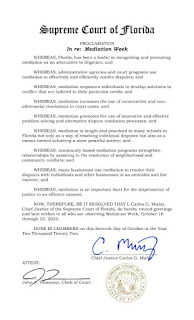
Every October, we celebrate the impact of the mediation process and its professionals on the many disputes in the world. Mediation Week in Florida and elsewhere marks the importance of dispute resolution as an effective substitute to litigation. In fact, mediation has helped litigants get through our recent challenges, evolving to widely accepted remote attendance allowing parties to resolve disputes without trial in a still backed-up court system. Alternative Dispute Resolution (ADR) has been used by Florida courts for more than 30 years. Online Dispute Resolution (ODR) will now serve as an official option following the pandemic through sessions conducted with readily available technology. Florida's Dispute Resolution Center continues to require specific standards set by the Florida Supreme Court in the areas of county, family, circuit, dependency, and appellate mediation during these virtual sessions. Mediation week brings annual focus on ADR work and highlights how individuals, administrative agencies, and businesses can use mediation to develop efficient and customized solutions to conflicts. Just by searching #mediationweek online, you may find a variety of resources from venerable organizations like the American Bar Association (ABA) or the Federal Mediation and Concilliation Service (FMCS) which is celebrating its 75th anniversary with free programs on cutting-edge topics, practices, and examinations on conflict prevention, management, and resolution this week. See more here-- https://fmcs.zoomgov.com/webinar/register/WN_b03eGSkmQ_uK2CiCk0U1vQ
Saturday, February 27, 2021
DRC Call for CME Presentations
The Florida Dispute Resolution Center (DRC) is calling for proposals for this summer's annual mediator conference. The conference will be held virtually on August 11 - 13, 2021. If your workshop submission is selected, you may be asked to present twice during the conference. You and your second presenter, if applicable, will receive a conference registration waiver. By submitting a workshop proposal, you agree to allow your presentation to be recorded and agree to submit to the DRC prior to the conference any materials you intend to distribute in conjunction with the conference. The recording and materials will become public records. If you believe copyright or trademark interests exist, you must notify DRC upon submission of your proposal. If no copyright or trademark interests exists when you submit your proposal, all such rights are otherwise waived upon submission of the proposal. Presenters should be familiar with virtual conference software (such as Swoogo, Pathable or Zoom) and have experience presenting their session during a virtual conference. See more info here-- https://bit.ly/2ZX0IUk

Monday, February 1, 2021
Fla. S. Ct. Declines to Adopt New Mediator Rules
Last month, the Supreme Court of Florida quietly rejected a multi-year rules proposal effort by its own ADR Rules & Policy Committee attempting to ensure that the mediation process operates in accordance with mediator rules and standards already adopted. The proposed revisions pertained to the practice and procedures of mediation in the court system and added requirements that those who mediate court connected cases as part of the machinery of the judicial process must observe the existing rules of mediators, regardless of certification. The committee found it inconsistent and illogical to have one group of professionals in the court process who are subject to no ethical standards involving the vitally important mediation service they provide the public. Florida certified court mediators are already obligated to follow rules related to mediation in the court system. However, the court chose to leave existing rules in place such that parties are still free to choose whomever they want (clergy, rabbi, spiritual advisor) to mediate their case without the beneficial boundaries of mediator ethics and a system of enforcement. While the committee made clear it does not believe the creation of an exempt group of compensated court professionals was the intent of the court for mediation in Florida, the court left it alone with only a dissent from Justice Polston emphasizing the need for instilling public confidence through principled ethical protections in mediation of pending state court cases. See more in Case Number: SC20-565 here-- http://onlinedocketssc.flcourts.org

Wednesday, July 1, 2020
Orlando Mediator's 400th Post! Standard of Review for Settlements De Novo
A District Court of Appeal (DCA) in Florida has concluded the standard of review of a trial court’s decision under section 44.405(4)(a)5. of the Mediation Confidentiality and Privilege Act, regarding whether a confidentiality or privilege attaches to a mediation communication “[o]ffered for the limited purpose of establishing or refuting legally recognized grounds for voiding or reforming a settlement agreement reached during a mediation,” is de novo. In the recent decision of Brickell Financial Services - Motor Club, Inc. v. Road Transportation, LLC, on remand the trial court was instructed by the Fourth DCA to weigh the settlement accounting, along with the parties’ mediation communications, and any other admissible evidence, in determining whether a meeting of the minds occurred regarding the dollar amount to which the term “Settlement Sum” referred and, if so, what that amount was. They cited a prior decision in DR Lakes Inc. v. Brandsmart U.S.A. of West Palm Beach, Inc., 819 So. 2d 971 (Fla. 4th DCA 2002), which pre-dated the legislature’s enactment of section 44.405 in 2004, but interpreted section 44.405’s predecessor, section 44.102(3), Florida Statutes (2001). That was after initially stating “all mediation communications shall be confidential,” the legislature created an exception in section 44.405(4)(a)5. for any mediation communication “[o]ffered for the limited purpose of establishing or refuting legally recognized grounds for voiding or reforming a settlement agreement reached during a mediation.” The Fourth DCA reminded parties and the trial court that a party seeking to enforce a settlement agreement bears the burden of showing the opposing party assented to the terms of the agreement. See more here-- https://bit.ly/3eyYP5I
Tuesday, May 5, 2020
Florida Courts Remain Closed
This week, the Chief Justice of the Supreme Court of Florida acted on the recommendations of a statewide Court Continuity Workgroup, issuing an amended administrative emergency order increasing the list of proceedings state courts will accomplish by remote technology during the Coronavirus pandemic. As such, jury trials in Florida are suspended until July 2nd and other deadlines are pushed back until following the July 4th holiday weekend. The court recognized that in-person jury trials pose a special hazard because they can expose jurors and other courtroom participants to a risk of infection. Future extensions will be considered, if needed. Of interest to followers of this blog, the order especially focuses on increasing the resolution of cases by shifting as many of them as possible into a virtual environment with remote technology, and specifically "Alternative Dispute Resolution proceedings." Case types listed in the order will be held by telephone or other electronic means. Of course, online ADR or ODR has been in full effect since this all started using various existing commercial platforms like WebEx, Zoom and GotoMeeting. Additionally, the Continuity Workgroup that I blogged about last month was asked to submit recommendations as they are developed to guide a phased return to full court operations. The expanded list of essential proceedings adds to earlier efforts to mitigate the impact of Coronavirus while letting courts operate in a way consistent with public safety. Florida’s courts have followed emergency guidelines since a March 13th order, when jury trials were first suspended and actions restricting in-person proceedings were implemented to enforce social distancing. Subsequent orders extended these limits through the end of May, subject to future orders made necessary by the pandemic. Chaired by Orlando Circuit Judge Lisa Munyon, the Court Continuity Workgroup’s mission includes examining the current status of all court proceedings statewide and proposing methods for resolving cases with remote technology and other new procedures that may remain when all this is over. According to the court, the move toward more virtual proceedings is a major historical shift in state court operations, which have relied heavily on in-person hearings in the 175 years Florida has been a state. See more in the latest Administrative Order here-- https://tinyurl.com/yb7jypo9


Friday, March 13, 2020
Order Curtails Courts in Florida, So Mediate!
The Chief Justice of the Supreme Court of Florida today ordered most in person legal proceedings in the state courts be suspended for a minimum of two weeks due to the COVID-19 virus. The order takes effect Monday. Local judges will use remote electronic means of conducting legal proceedings whenever possible. The order will be extended or modified as needed in the future and is subject to existing constitutional requirements. Under Florida's Constitution, the Chief Justice is the chief administrative officer of the state court system and can issue orders with statewide effect. This is the first time a limit on face-to-face proceedings has been ordered since Florida’s state courts system was unified by a constitutional amendment approved by voters in 1972. The court found these measures are needed because a public health emergency exists, requiring social distancing to reduce transmission of the Coronavirus which is now a pandemic. The order is designed to slow the spread of infectious disease by eliminating gatherings of the public such as jury duty and trials. However, mediation remains available to litigants in the absence of court proceedings and can be conducted by remote attendance or online dispute resolution (ODR), which my firm offers. We expect the business of dispute resolution will go on with the help of technology, allowing attendees the opportunity to participate without spreading infection. See more on our ODR options here-- https://tinyurl.com/twd4nl4 and the court's full order here-- https://tinyurl.com/wrt7hug 
Wednesday, October 2, 2019
ADR Section Mentoring Academy
Take your mediation practice to the next level with the Alternative Dispute Resolution (ADR) Section of The Florida Bar's inaugural Mentoring Academy later this month. Some of the state’s most experienced mediators, including some with whom I serve on the ADR Section Executive Council, will conduct this advanced-level Continuing Mediator Education (CME) and Continuing Legal Education (CLE) workshop. You will be coached on mediation strategies and receive instructive feedback on techniques. Also, increase your statewide network with a reception following the Friday evening panel discussion. Saturday’s sessions include lunch. This first-ever Mentoring Academy will be held October 25 – 26 at the University of South Florida’s Center for Advanced Medical Learning and Simulation (CAMLS) in downtown Tampa. The Florida Bar course is approved for 10 CLE/CME, 1 Ethics CLE/CME and 9 Professionalism CLE credits. The $425 tuition includes an annual membership in The Florida Bar ADR Section and those that are already section members can register for only $390. The Florida Bar ADR Section developed the Mentoring Academy in part because mediators have ethical obligations to advance the mediation profession. We are providing an opportunity for succeeding generations of mediators to have the benefit of experienced instruction from more seasoned mediators. Meaningful interaction between the mediator participants and workshop instructors is a key element of the academy. Don't miss out! Learn more here-- FlaBarADR.com/mentoring-academy
Friday, December 15, 2017
FL Senate Mediation Authority Bill
A new bill for the 2018 Florida legislative session has been introduced requiring that insurance carrier representatives who attend circuit court mediations have specified settlement authority and the ability to immediately consult by specified means with persons having certain additional settlement authority and to be available by telephone. Senate Bill SB 1034 would create Section 44.407, Florida Statutes, which would allow sanctions for insurance carriers that fail to comply with good faith requirements of mediation (a term never truly defined). Additionally, Section 44.408 would compel certain third parties to attend mediation upon the request of the mediator or be available to teleconference, though not required to pay any mediation fees by participating. Also, Section 44.409 would limit information that may be included in the mediator’s report to the court. The new law would allow only the following reporting: (a) A complete agreement was reached (b) A partial agreement was reached (c) No agreement was reached. If a partial agreement was reached which eliminates claims or parties from the litigation, a list of such claims and parties may be provided, but no additional information may be disclosed. If passed, and signed by the governor, this act would take effect July 1, 2018. The Executive Council of The Florida Bar Alternative Dispute Resolution Section on which I serve is looking at this legislative development and will take up the issue at its January, 2018 meeting in Orlando. See proposed language filed here-- http://bit.ly/2zgh9hN and ADR Section info at www.FlaAdr.org
Sunday, November 5, 2017
MEAC's Latest on Reporting Settlements
Florida's Mediator Ethics Advisory Council (MEAC) recently considered an inquiry on reporting partial settlements. A mediator writes in that the inability to differentiate between a final and partial agreement on the face of the report as permitted by the mediation procedural rules has created an ethical dilemma in the need to report to the court the actual outcome of the mediation and the status of the case. The practitioner complains it is not only misleading to the court to report only "agreement" or "no agreement," it is also time consuming for the judges, judicial assistants or case managers to read every agreement to determine if it is final or partial agreement as opposed to being able to look at the report. MEAC found that in civil and family law cases only, with the consent of the parties, the mediator's report may also identify any pending motions or outstanding legal issues, discovery process, or other action by any party which, if resolved or completed, would facilitate the possibility of a settlement. To report anything additional without agreement of the parties, or add descriptors or modifiers to "agreement," "no agreement," or "partial agreement," would be providing information to the court, an action which is prohibited by the Mediation Confidentiality and Privilege Act, Sections 44.401-405, Florida Statutes. They did say, however, the rules do not restrict the parties from including in the written agreement their consent to the inclusion of additional language, descriptors, or modifiers in the mediator's report. See full advisory opinion here-- http://bit.ly/2j4YkZr
Friday, January 27, 2017
FL Bar ADR Section Supports Mandatory Certification
Yesterday, the Executive Council of the ADR Section of The Florida Bar convened in Orlando at its winter meeting. Among the topics for discussion were proposed rules that will ultimately be considered by the ADR Rules & Policy Committee of The Supreme Court of Florida which asked for the section's input on the matter of mandatory certification for mediators in court cases. Two recommendations were made to ADR Rules & Policy that is likely to have its own language changes and submit for public comment before the Florida Supreme Court passes them. This effort was brought about after a survey of the ADR Section's members indicated the majority preferred using certified mediators and felt all people in Florida mediating cases for the courts should be required to follow the ethical rules. The rules address things like conflicts of interest, confidentiality, coercion, self-determination and other traditional hallmarks of the mediation process. The first proposal requires that professional standards would apply to non-certified mediators voluntarily selected or retained by the parties in the absence of a court order and applies to circuit and family cases. A second motion passed for requiring mandatory certification of mediators in filed cases retained or appointed by the court in the same divisions, with the exception of dependency. While these proposals are perhaps controversial in some circles, it was thought the ADR Rules & Policy Committee would act on this with or without the ADR Section's input. Therefore, the preference for rulemaking reflected by the section survey was formally expressed through these resolutions. Stay tuned for next steps. See court committee link here-- http://bit.ly/2jmRTv0 and section link here-- http://bit.ly/2jmPlxa
Tuesday, August 2, 2016
Secret Water Wars Mediator
A Special Master whose ruling could influence an eventual U.S. Supreme Court decision to turn down Georgia’s water spigot has set a trial in his home state of Maine, where attorneys for Georgia and Florida agreed to begin arguments on Halloween. In the meantime, each side stated they continue to pursue settlement of the federal lawsuit Florida filed under the Supreme Court's original jurisdiction, seeking to push Georgia’s water consumption from the Apalachicola-Chattahoochee-Flint River Basin including Lake Lanier, back to 1992 levels and to get reparations for alleged economic and environmental harm to Apalachicola's oyster fisheries from drought. Ralph I. Lancaster, Jr., the 86-year-old veteran Supreme Court appointee, has repeatedly advised the states to settle out of court rather than live with a costly decision he stresses neither will like. The states chose a nationally known mediator whose name, oddly enough, has been kept secret by Master Lancaster’s order. Recent status reports filed by the attorneys indicate meetings between the mediator and high level state officials were continuing before trial. The parties reportedly participated in multiple one-on-one telephonic discussions with the mediator; exchanged further confidential mediation proposals; and met face-to-face in Atlanta with the mediator. Except to hear progress reports, Master Lancaster wants no part of the mediation process. He denied Florida’s suggestion to talk with the mediator, saying “'I have no intention of invading (the process) or influencing or discussing with the mediator anything that's going on.'" See news item here-- http://bit.ly/2apC4l5 and docket here-- http://bit.ly/2aMQVJH
Thursday, February 25, 2016
Sanctions for Shaq Skipping and Skyping into Mediation
In a Florida federal case, lawyers were sanctioned for advising their client, former NBA All-Star Shaquille O’Neal, that he didn’t need to personally attend court-ordered mediation. United States District Judge James Cohn of the Southern District of Florida ordered lawyers to pay $13,000 to cover mediation costs for a plaintiff who sued Shaq for allegedly ridiculing his appearance. Plaintiff has a rare genetic disorder that causes tooth loss and facial deformities and has since started an anti-bullying campaign on Facebook that attracted 20,000 members. Shaq posted a photo of himself on Instagram and Twitter stating "smile people" and imitating plaintiff's facial expressions. The lawsuit alleges defamation and invasion of privacy, though Shaq maintains there was no right to privacy because the photos were already on Instagram. He also said his conduct wasn’t so outrageous or extreme as to establish liability. Shaq reportedly attended via Skype and sent a representative to participate on his behalf, due to a television appearance conflict on the day of the mediation. The mediation order stated pursuant to Local Rule 16.2.E, the appearance of counsel and each party or a representative of each party with full authority to enter into a full and complete compromise and settlement is mandatory. The local rule says all parties shall be physically present at the mediation conference “unless excused in writing by the presiding judge.” Counsel argued unsuccessfully that the magistrate judge’s mediation order superseded the local rule, but local rule requires a federal district judge, not a magistrate judge, to excuse a party’s attendance in writing. See stories here-- http://bit.ly/1oLnNos and http://bit.ly/1oLnNos and local rule for court annexed mediation in the Southern District of Florida here-- http://1.usa.gov/1SYVSxx
Friday, August 21, 2015
The Evolution of the Joint Session
Recently, Kim Taylor, COO of JAMS, questioned the survival of the long-held practice of commencing mediation conferences with a joint session of all parties and their counsel. Usually, that provides an opportunity for each viewpoint of the case to be expressed to the other side and to outline the settlement process with participants, before breaking into individual caucuses. Over eighty percent of mediators surveyed earlier this year used such sessions twenty years ago. Lately, a resistance to joint sessions is reported to have arisen. That survey of neutrals revealed a decline in the use of the joint sessions. Regionally, some seventy percent of neutrals based in the east said they still regularly use joint sessions. I find them to be helpful and estimate that I start that way over ninety percent of the time. However, the report from Southern California is that joint sessions are held merely a quarter of the time. Perhaps the process has become confrontational or maybe both sides already understand the positions and everyone just wants to get down to the business of negotiating, supposedly saving costs. Of course, there are certain cases where a joint session is not productive and could actually prove detrimental to the process. Ms. Taylor suggests that because of self-determination, most mediators will not insist on a joint session if the parties do not want one. However, to skip an initial joint session could impact the process that follows, limiting options for settlement or finding common ground and the path to a deal. I try to use it regularly, as our rules require disclosures and I find it assists in laying some foundation for the process and expectations. Caucuses can remain confidential and the parties retain control over information to be shared. Using the open ended question in joint session to get positive responses from the parties at the outset on areas where there already may be overlap in agreement on facts or damages is essential to reaching a successful outcome. See more here-- http://bit.ly/1KajjyN
Friday, June 12, 2015
Medicaid Mediation
In an unusual move, a federal judge denied the Florida Governor's request to order mediation with President Obama's administration over federal hospital funds for the Low Income Pool or LIP. Rick Scott is suing the Obama administration, alleging it is withholding federal hospital funds because Florida won't expand Medicaid. He asked a judge this week to compel mediation, but the Obama administration responded that they have been engaged in ongoing and productive discussions and that mediation could delay a final decision. It is alleged that the Obama Administration violated the U.S. Constitution by threatening to withhold Low Income Pool dollars if Florida did not expand Medicaid under the new federal healthcare law. Gov. Scott, Florida Attorney General, Pam Bondi, and the Agency for Health Care Administration are the plaintiffs in the lawsuit. Secretary of the U.S. Department of Health and Human Services and the acting administrator of the Centers for Medicare and Medicaid Services, are the defendants. The Low Income Pool program is a supplemental Medicaid financing program. The federal government initially approved an extension for three years, but the Centers for Medicare and Medicaid Services then announced it would not extend the Low Income Pool beyond June 30, 2015. Florida's legislature is in special session because it was unable to pass a budget during the regular session over whether LIP dollars should be included. The Florida Senate budget is $4 billion more than the House’s, including both LIP and Medicaid expansion that the House didn’t in its own proposed budget. The federal government advised Florida that it can expect to receive $1 billion in LIP funding for the 2015-16 year and $600,000 in the 2016-17 year. Gov. Scott claims the legislature has no final approval figure and that such delay is preventing lawmakers from completing the budget. The administration has reportedly given Gov. Scott a tentative decision to extend the funds for two more years at a much lower price. Gov. Scott wants to finalize the state budget by June 30th to avoid a state government shutdown. See stories here-- http://bit.ly/1GC9PME and http://bit.ly/1C31Qky
Saturday, November 1, 2014
Orlando Mediator Lawrence Kolin Joins Upchurch Watson White & Max
Just a moment of personal privilege-- I'm pleased to announce moving my dispute resolution practice to Upchurch Watson White & Max, a nationally leading mediation firm known for facilitating reasonable agreements to resolve complex civil litigation. As a UWWM neutral panelist in Florida in exclusive practice in Alternative Dispute Resolution, I'll continue to offer my wide-ranging experience in settling disputes, including serving as a Mediator, Arbitrator, E-Neutral and Special Master. In this role, I'll keep writing on implementing innovative methods of ADR to resolve cases, such as Early Neutral Evaluation of lawsuits. You can also get the latest trends on this, my officially ABA listed "Blawg." For more complete information and to schedule, see-- http://www.uww-adr.com/biography/lawrence-h-kolin (800) 863-1462 For the press release regarding my joining this prestigious group of dispute resolvers, see-- http://www.prweb.com/releases/mediator/lawrence_kolin/prweb12283619.htm
Tuesday, October 21, 2014
Ten Years Later: Florida Mediation Privilege
Success of mediation surely rests with confidentiality, allowing parties to share information, solve issues, build trust, and self-determine whether to resolve a dispute-- all without fear of subsequent disclosure of candid statements shared during the conference. A decade ago, Florida amended Chapter 44, Florida Statutes to create the Mediation Confidentiality and Privilege Act, § 44.401 et seq. Prior to 2004, it was unclear to what extent any privilege applied and when it could be asserted. Under the Act, all mediations, including both court-ordered and other types (like pre-suit and voluntary) were granted confidentiality protections. This made all mediation communications confidential and applies to all mediation participants. The use of mediation has grown significantly in Florida since these protections were codified. The assurance of confidentiality continues to be essential to the integrity and success of mediation. It still encourages candor between the parties and on the part of the mediator. In order for cases to have a chance of settling, the parties must have faith in the fundamental elements of neutrality and confidentiality with limited exceptions to the privilege outlined here-- http://www.flsenate.gov/Laws/Statutes/2014/44.405
Monday, March 3, 2014
Breach of Confidentiality on Facebook Voids Deal
News of Facebook and the court system has been limited to juror misconduct and claimants deleting profiles. However, Florida's Third District Court of Appeal recently threw out an $80,000 age discrimination settlement between a Dade prep school and its former headmaster due to a social media status post. Apparently, the ex-employee through his daughter breached the terms of a confidential settlement agreement when she bragged about the money paying for her summer vacation on Facebook to her 1,200 "friends." The post, seen by current and former students, made its way back to the school’s attorneys, who claimed Plaintiff violated the clear and unambiguous language of the parties’ mediation deal. Plaintiff initially won a Circuit Court ruling to enforce the deal, but an appellate panel overturned that decision last week. Central to the settlement agreement was a detailed confidentiality provision, which provided that the existence and terms were to be kept strictly confidential and that should Plaintiff breach the confidentiality provision, a portion of the settlement proceeds would be disgorged. Plaintiff told his daughter that he was happy with the results, claiming he had to say something because she had suffered during her enrollment at the school and was aware of the mediation. The reviewing court said the Plaintiff's daughter did precisely what the confidentiality agreement was designed to prevent. See article here-- http://hrld.us/1pWtbB9 and court decision here-- http://www.3dca.flcourts.org/Opinions/3D13-1952.rh.pdf
Tuesday, December 17, 2013
Mediated Settlement Agreement Enforced Despite Second Thoughts
When a settlement is reached, parties typically sign a binding settlement agreement before they leave-- often to prevent buyer's remorse. At the conclusion of a long mediation, litigants are sometimes physically and emotionally exhausted. Recently in Florida, a trial court let one party out of a mediated settlement agreement after she claimed coercion. In that case, the mediator allegedly denied her request to take the agreement home over the weekend. The lower court judge believed a request for additional time to review the document was warranted, due to fatigue from the extensive negotiation. After reflecting upon the settlement terms, the litigant apparently requested the agreement be rescinded, instructing her attorney to file a Motion to Vacate. When her attorney suggested he could not file such a motion, she then filed pro se. The trial court erroneously concluded she did not freely, knowingly and intelligently enter into the agreement. The district court of appeal, upon reversing, found the record devoid of evidence that the agreement was signed as a result of fraud, misrepresentation, coercion, or overreaching, and ordered the settlement agreement to be enforced. To void the agreement, the presence of fraud, misrepresentation, coercion, or overreaching is needed. Fatigue, distress, and second thoughts are not enough. The court reasoned though appellee may have been fatigued and distressed-- and later suffered second thoughts-- without more, these facts do not provide grounds for setting aside an otherwise valid agreement. See First DCA Opinion Case No. 1D13-1546 http://opinions.1dca.org/written/opinions2013/12-10-2013/13-1546.pdf
Monday, April 23, 2012
Appellate Mediation Frustration
Florida led the way in the establishment of alternative dispute resolution procedures to accommodate resolution without trials or the use of the judiciary. In the late 1980s, Florida passed comprehensive court-annexed mediation statutes and the past quarter century has seen enormous growth in the use of mediation as a practical, efficient alternative to traditional litigation for conflict resolution. In addition to the retention of self-determination and capability for creative settlements-- not to mention decreased costs-- courts celebrate reduced dockets, as well as increased levels of satisfaction. As such, appellate courts got into the game, initially with the U.S. Eleventh Circuit Court of Appeals, and then a pilot program by Florida's Fifth District Court of Appeal (DCA) over a decade ago. There was also a program at the First DCA which was dismantled for budgetary reasons and other programs that have since gone. However, recent Florida Rules of Appellate Procedure (found beginning at 9.700) now provide the parties with the option to mediate if not already referred to mediation by the appellate court. These procedures account for tolling and other deadlines and deal with appearance and authority of parties at mediation. Today, at the Orange County Bar Association, we had the privilege of listening to Judge Thomas Sculco, Barbara Eagan and Stacy Ford for a CME on the frustration the process can bring about. Though the success rates are still around 35% for cases settling through mediation after a notice of appeal is filed, there are more challenges to the process given the posture post-trial than in cases that have not yet tried. Appellees are difficult to motivate, but there are some tools appellate mediators can use to move the parties' positions beyond discussions involving splits of authority and the proverbial "careful what you wish for" new trial. A hallmark to successful appellate mediation can be as simple as the ability of the parties to avoid precedent and craft a solution to the conflict that is built around their unique interests and needs. With the advent of Certification of Appellate Mediators by the Supreme Court of Florida, more mediation in the DCAs should be taking place. However, it is up to practitioners and dispute resolvers to educate the judiciary and promote the process beyond courts that have traditionally recognized its benefits.
Subscribe to:
Posts (Atom)