
Showing posts with label Employment Arbitration. Show all posts
Showing posts with label Employment Arbitration. Show all posts
Wednesday, March 1, 2023
Arb Going Back To Cali
The U.S. Court of Appeals for the Ninth Circuit recently blocked a California law that prohibited employers from requiring their workers to resolve legal disputes in private arbitration, ruling that it conflicts with federal law. A panel affirmed the district court’s grant of a preliminary injunction barring enforcement of California’s Assembly Bill (AB) 51 with respect to arbitration agreements governed by the Federal Arbitration Act (FAA). Since 2020, California was first to ban mandatory arbitration of all employment-related disputes in the wake of the #MeToo movement. New York and New Jersey similarly passed laws prohibiting mandatory arbitration of sexual harassment and discrimination claims, but California's statute was much broader. Employers were prohibited from requiring individuals to sign as a condition of employment or employment-related benefits arbitration agreements concerning disputes arising under the California Fair Employment and Housing Act or Labor Code. In affirming the district court’s grant of a preliminary injunction, a majority of the Ninth Circuit panel used U.S. Supreme Court precedent that states rules burdening the formation of arbitration agreements are an obstacle to legislative intent of and preempted by the FAA. The court also noted the U.S. Court of Appeals for the First and Fourth Circuits reached similar conclusions when confronted with state laws that attempted to prevent parties from entering arbitration agreements. The court rejected arguments from the State of California that it should sever clauses that were deemed preempted by the FAA and leave the remainder of the law intact. The court found AB 51 could not be dissected as the statute’s provisions all work together to burden the formation of arbitration agreements and there was no authority in the legislation to sever the penalty portions of the law. If the State of California does not get a rehearing en banc or pursue further appeal, the matter will return to the district court to proceed for a final determination on the legality of AB 51. See reporting here-- https://bit.ly/3ZtxpoU and https://tinyurl.com/mvvfn6um and latest decision here-- https://tinyurl.com/54u4jukp


Friday, July 1, 2022
SCOTUS Arbitration Decisions
As this tumultous term comes to a close, a pair of recent employment case rulings has given some to insight into the future of the U.S. Supreme Court's direction on arbitration which has been pretty firm as of late. Traditionally, the Court has relied upon precendent and the Federal Arbitration Act (FAA) in enforcing the right to arbitrate as contractual in nature and upholding those agreements. More recently, the Court is reversing decisions that apply even-handed rules to the FAA. In Morgan v. Sundance, a unanimous Court rejected the two-part test applied by most federal circuits in evaluating whether a party has waived its right to compel enforcement of an arbitration agreement. Under that test, waiver would be found only if a party acted in a manner inconsistent with its arbitration rights and that inconsistency caused prejudice to the other side. The principal justification for requiring prejudice was federal policy favoring arbitration. Finding that the usual test for contractual waiver typically requires only inconsistent conduct, the Court held it improper to add a prejudice requirement onto the waiver analysis just for arbitration agreements. The text of the FAA makes clear that courts are not to create arbitration-specific procedural rules. In Viking River Cruises v. Moriana, eight of nine justices agreed with the result relying in part on a severability provision in the arbitration agreement to narrow an otherwise invalid wholesale waiver of state Private Attorneys General Act (PAGA) claims. This suggests that whether courts will compel arbitration of individual PAGA claims may turn on the specific language of the arbitration agreement at issue. The lone dissent came from Justice Thomas, who long has viewed the Federal Arbitration Act does not apply to cases in state courts. The FAA also can preempt rules “that are generally applicable as a formal matter” but have the effect of making arbitration agreements ineffective because they are inherently inconsistent with arbitration. Such rules would include those that would require a party to arbitrate on a class basis or not at all. See decisions-- http://tinyurl.com/3e6hbek9 and http://tinyurl.com/57r87jzc and more here-- http://tinyurl.com/yeaw7sdd and http://tinyurl.com/yc4ktrmv


Friday, April 1, 2022
FAA Jurisdiction Case Decided by SCOTUS
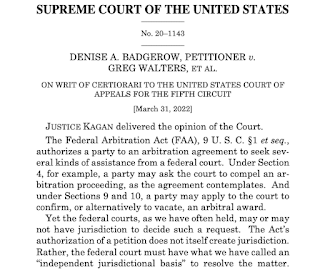
The Supreme Court of the United States yesterday issued an important ruling on federal court jurisdiction in matters governed by the Federal Arbitration Act (FAA) saying it does not allow federal courts to “look through” to the dispute underlying an arbitration to establish jurisdiction to confirm or vacate an arbitration award. The FAA authorizes a party to an arbitration agreement to petition a federal court for various forms of relief. The Act’s authorization of such petitions does not itself create the subject matter jurisdiction necessary for a federal court to resolve them. Previously, in Vaden v. Discover Bank, the Court assessed whether there was a jurisdictional basis to decide an FAA Section 4 petition to compel arbitration by means of examining the parties’ underlying dispute. Specific language in Section 4 instructed a federal court to “look through” the petition to the “underlying substantive controversy.” If the dispute underlying a Section 4 petition falls within the court’s jurisdiction for example, by presenting a federal question, then the court may rule on the petition to compel arbitration. In this case, Badgerow v. Walters, the question presented was whether that “look-through” approach to jurisdiction applies to applications to confirm or vacate arbitral awards under Sections 9 and 10 of the FAA. The majority ruled Congress chose to respect the capacity of state courts to properly enforce arbitral awards. Justice Kagan writes "the look-through rule is a highly unusual one: It locates jurisdiction not in the action actually before the court, but in another controversy neither there nor ever meant to be." This application in an employment termination case should go to state, rather than federal, court raising claims between non-diverse parties involving state law. See opinion here-- https://bit.ly/3DyArhT

Monday, June 21, 2021
No Prime Day For Amazon and Arbitration
The U.S. Supreme Court decided today not to consider whether drivers for Amazon’s Flex delivery service are interstate transportation workers who can avoid arbitration as part of a proposed class claim. Amazon.com Inc. had urged the high Court to review a federal appellate decision allowing a Flex driver to avoid arbitrating proposed class claims that he and others are misclassified as independent contractors because they’re interstate transportation workers exempt from the Federal Arbitration Act (FAA). The First Circuit Court of Appeals held last summer that those workers making local deliveries to Amazon customers qualify for the FAA exemption, even though they don’t cross state lines, because their work involves transporting goods in the flow of interstate commerce. Flex drivers, therefore, aren’t bound by arbitration agreements that would prevent them from litigating their state law wage claims. In recent years, Amazon used independent contractors to deliver goods through its Flex smartphone app. Flex contractors could sign up for shifts and use their own car while adhering to Amazon’s standards to deliver packages. However, if a contractor takes longer than their shift to complete their deliveries, they are not compensated for extra time, nor reimbursed for gas, vehicle maintenance, or cell phone data costs for the job. Working with Flex, an individual agrees to its terms of service, which requires settling disputes through arbitration governed by the FAA. Interestingly, earlier this month, the company changed its terms allowing people to bring individual or class action lawsuits against it. Amazon made the change in response to more than 75,000 pending arbitration demands on behalf of its Echo device users that would have required it to ante up tens of millions of dollars in filing fees in those cases. It now faces several class actions, including one alleging that it improperly recorded and preserved conversations through its Echo Dot Kids devices. See more here-- https://bit.ly/3vRYhzW and https://bit.ly/3qgc95x and https://bit.ly/2SKw54w


Thursday, February 13, 2020
Dash for Arbitration
DoorDash delivery workers filed thousands of individual claims at once as initial fees approach $12 million for the company. Under District Judge William Alsup’s order this week in Abernathy v. DoorDash pending in the Northern District of California, DoorDash must arbitrate over 5,000 individual disputes with various workers who claim that they were misclassified as independent contractors, when they should be treated as employees. It also must pay a $1,900 fee for each of these individual arbitration proceedings. As with other gig economy platforms, DoorDash includes an arbitration agreement in its contracts with couriers, who deliver food orders. But after facing a flood of claims, DoorDash balked at the costs of going into arbitration administered by the American Arbitration Association (AAA) where couriers themselves paid more than $1.2 million in filing fees. After Uber imposed arbitration and a class action ban, more than 60,000 of those drivers sought to arbitrate claims against the company. Faced with legal costs of at least $600 million, Uber settled the a majority of these claims last spring. Could the same happen in this case? Another California federal judge similarly compelled arbitration in a case with thousands of claims against Postmates, asking the attorneys to explain how the company’s refusal to pay arbitration fees didn’t amount to contempt. A ruling is pending on that issue. DoorDash had asked to suspend the court proceedings until the approval of a settlement could be reached in a separate class-action case, given the potential for overlap. The company reportedly stands ready and willing to defend legitimate arbitration demands, but maintains it should only be responsible for arbitrating legitimate claims. See more here-- https://bit.ly/39uUehT and https://bit.ly/38qRDWa and https://bit.ly/2OSRQcW
Friday, January 10, 2020
Judge Blocks CA Arb Ban
Today, there's a hearing on a Temporary Restraining Order (TRO) against the State of California where a federal district judge is blocking implementation of the state’s new ban on arbitration of cases involving sexual harassment. The court will hear a request by the California Chamber of Commerce and other business groups for a preliminary injunction. This is a big test that will have national impact. The ban was signed into law in October 2019. It prohibits California employers from requiring employees to waive any right to or opt out of any legal forum or procedure established by the California Fair Employment or Labor Code. The new law applies to contracts for employment entered into, modified or extended on or after January 1, 2020-- the effective date of the new law. If an employer violates the act by forcing arbitration, they would commit a misdemeanor. The National Retail Federation filed suit in federal court seeking to prevent the law from going into effect by arguing the Federal Arbitration Act (FAA) and recent U.S. Supreme Court cases created a federal policy of using arbitration as a legitimate alternative to court litigation. Further, the FAA preempts state law to the contrary. A final ruling regarding primacy of the FAA over state law will serve as a bellwether on employer use of arbitration and may thwart other states from passing similar laws. See more here-- https://bit.ly/2R1oWrz and https://bit.ly/2RafHWa UPDATE: Following oral argument during which recent SCOTUS cases involving the FAA such as Epic Systems and Kindred Nursing were cited, the court requested supplemental briefing regarding the state's suggestion that the court lacks jurisdiction. The TRO will remain in effect until January 31, 2020.
Wednesday, October 30, 2019
California's Arbitration Ban
This month, a California bill prohibiting workplace arbitration was signed into law. Effective January 1, 2020, the new law criminalizes the use of mandatory arbitration agreements by making such a practice a misdemeanor offense. It prevents allegations of discrimination, harassment, and retaliation arising under that state’s Fair Employment and Housing Act from being subject to mandatory arbitration. This action sets up a direct conflict with the Federal Arbitration Act (FAA) and clear federal policy favoring arbitration. Challenges to constitutionality of this and other states' laws of this nature are coming. In recent terms, the U.S. Supreme Court reminded states of the predominance of federal policy regarding arbitration, striking down efforts to undermine the use of arbitration. States will likely argue that an arbitration agreement covering such claims is effectively a contract that is void as a matter of public policy. It will be argued such provisions fall within the FAA’s savings language, which preserves traditional state law defenses to arbitration agreements arising out of contract formation. At least one attorney commentator recognizes the problem with this argument-- that the underlying state policy established by the statute appears to directly conflict with the FAA’s underlying purposes, making the policy itself unconstitutional. As such, an unconstitutional policy should not void a contract whose terms are consistent with federal policy regarding dispute resolution. See more here-- https://tinyurl.com/y5yld9x4 and https://tinyurl.com/y37n4pxn
Wednesday, January 30, 2019
SCOTUS - Second Unanimous Arbitration Opinion
This month, the Supreme Court of the United States handed down its second unanimous opinion on arbitration. In New Prime Inc. v. Oliveira, which arose out of an employment dispute between a trucking company and driver, the Court found while the Federal Arbitration Act (FAA) authorizes a court to compel arbitration if parties agreed to arbitrate, the statute also defines the agreements to which it applies. Before a court enforces an agreement to arbitrate, it must first ensure the agreement is one the FAA authorizes courts to enforce. Specifically at issue was whether an exception to the rule in the FAA that obligates courts to enforce arbitration agreements that involve interstate commerce applied. Section I of the FAA exempts contracts of employment of seamen, railroad employees, or any other class of workers engaged in foreign or interstate commerce from arbitration. The opinion explains while a private agreement may be crystal clear and require arbitration of every question under the sun, that does not necessarily mean the FAA authorizes courts to stay litigation and send the parties to an arbitral forum. In this instance, companies engaged in interstate or foreign transportation should take notice that a trucker’s status as an independent contractor no longer protects the company’s arbitration agreement with him or her under the FAA. Interestingly, despite a conservative majority, the justices chose to interpret the FAA in a way that likely expands worker’s rights. Justice Gorsuch, who authored the opinion, did not deny the vigor of the court’s embrace of a liberal federal policy favoring arbitration agreements. However, in this case, the text seemed clear enough to persuade all of the justices to reject the claim for arbitration. See commentaries here-- https://bit.ly/2Gdqhb2 and https://bit.ly/2CvAxro and opinion here-- https://bit.ly/2CyEpbd
Thursday, May 31, 2018
SCOTUS Upholds Employer Arbitration Requirement
This month, in a 5-4 decision, the U.S. Supreme Court ruled that an employer can lawfully require employees to arbitrate as a condition of employment any related disputes on an individual basis and to waive their right to participate in a class action suit or class arbitration. The case involved an effort by workers to file a class action suit against an employer for violating the federal minimum wage law. The employer sought to dismiss the case because it insisted as a condition of employment that the employees waive their ability to go to court or be part of any class action. Rather, any dispute had to be resolved out of court in a private arbitration. The case, Epic Systems v. Lewis, arose from the U.S. Court of Appeals for the Seventh Circuit. Companion cases, Ernst & Young v. Morris, from the Ninth Circuit and National Labor Relations Board v. Murphy Oil, from the Fifth Circuit were argued as a trio before the Supreme Court which decided they differed only in detail, not substance. The Federal Arbitration Act (FAA) requires courts to enforce arbitration agreements between employers and employees according to their terms, even when the agreements provide only for arbitration through “individualized proceedings” rather than a class. In this holding, the Court refused to read the National Labor Relations Act (NLRA) to prohibit arbitration agreements requiring individualized arbitration as an impermissible restriction on employee rights under the NLRA to “engage in … concerted activities for the purpose of … mutual aid or protection,” 29 U.S.C. § 157, holding that Section 7 of the act “focuses on the right to organize unions and bargain collectively” and “does not even hint at a wish to displace" the FAA. The Court stated the FAA and the NLRA have long coexisted (since 1925 and 1935 respectively) and found the suggestion they might conflict something quite new. The Court reasoned that the employees’ theory ran “afoul of the usual rule that Congress does not alter the fundamental details of a regulatory scheme in vague terms or ancillary provisions..." See more in article here-- https://bit.ly/2Jk3e04 and read full opinion here-- https://bit.ly/2rWzAE8
Friday, October 6, 2017
Divided Supreme Court Considers Workplace Arbitration
This week, the Supreme Court attempted to determine how far companies can go in insisting that disputes be resolved in individual arbitrations, rather than in court. The Court considered whether to give employers a powerful tool to bar class actions over workplace issues. The decision on this matter could affect some 25 million employment contracts according to the New York Times. A ruling in favor of employers, Justice Breyer said, could cut out “the entire heart of the New Deal” and undo an understanding of labor relations since the administration of FDR. Earlier cases ruled that companies doing business with consumers may require arbitration and forbid class actions in their contracts. Arbitration clauses with class-action waivers are commonplace in contracts for things like smartphones, credit cards, rental cars and nursing homes. Prior arbitration decisions have been closely divided, with conservative members in the majority. The justices now consider whether they should use a different approach for employment contracts. The answer depends on the interaction of two federal laws: the Federal Arbitration Act, which favors arbitration and the National Labor Relations Act, which protects workers’ rights to engage in “concerted activities.” Workers seeking to sue their employers for overtime pay and the like say the second law prohibits arbitration clauses that require class-action waivers. Reportedly, Justice Kennedy seemed ready to side with employers. Justice Gorsuch asked no questions. Justice Ginsburg said arbitration law was concerned with agreements between merchants of relatively equal bargaining power. The employment contracts at issue in the case, she said, have been forced on workers with "no true liberty of contract." In an unusual fashion, many cases were consolidated for a single oral argument and lawyers for the federal government actually appeared on both sides. Some justices suggested that workers could band together in a limited sense by hiring the same lawyer and filing individual arbitration cases. Justice Kagan suggested that was not good enough. See full article here-- http://nyti.ms/2yTgLUa Watch for decisions in: Epic Systems Corporation v. Lewis, No. 16-285, Ernst & Young v. Morris, No. 16-300 and National Labor Relations Board v. Murphy Oil USA, No. 16-307 which will be available this term here-- http://bit.ly/2yuxv7k
Subscribe to:
Posts (Atom)