
Showing posts with label Arbitral awards. Show all posts
Showing posts with label Arbitral awards. Show all posts
Friday, April 1, 2022
FAA Jurisdiction Case Decided by SCOTUS
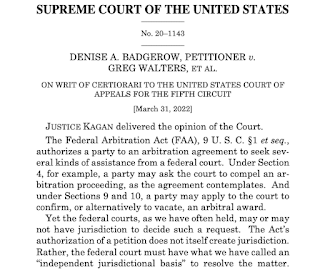
The Supreme Court of the United States yesterday issued an important ruling on federal court jurisdiction in matters governed by the Federal Arbitration Act (FAA) saying it does not allow federal courts to “look through” to the dispute underlying an arbitration to establish jurisdiction to confirm or vacate an arbitration award. The FAA authorizes a party to an arbitration agreement to petition a federal court for various forms of relief. The Act’s authorization of such petitions does not itself create the subject matter jurisdiction necessary for a federal court to resolve them. Previously, in Vaden v. Discover Bank, the Court assessed whether there was a jurisdictional basis to decide an FAA Section 4 petition to compel arbitration by means of examining the parties’ underlying dispute. Specific language in Section 4 instructed a federal court to “look through” the petition to the “underlying substantive controversy.” If the dispute underlying a Section 4 petition falls within the court’s jurisdiction for example, by presenting a federal question, then the court may rule on the petition to compel arbitration. In this case, Badgerow v. Walters, the question presented was whether that “look-through” approach to jurisdiction applies to applications to confirm or vacate arbitral awards under Sections 9 and 10 of the FAA. The majority ruled Congress chose to respect the capacity of state courts to properly enforce arbitral awards. Justice Kagan writes "the look-through rule is a highly unusual one: It locates jurisdiction not in the action actually before the court, but in another controversy neither there nor ever meant to be." This application in an employment termination case should go to state, rather than federal, court raising claims between non-diverse parties involving state law. See opinion here-- https://bit.ly/3DyArhT


Wednesday, October 26, 2016
America's Cup Arbitration
This month, America's Cup officials released the 2017 regatta schedule for Bermuda while continuing to remain silent about an arbitration panel decision that reportedly went against organizers and could cost them several million dollars. Team New Zealand is in line to receive a seven figure pay-out after winning a bitter dispute over a breach of contract with the America's Cup Events Authority (ACEA) that reportedly reneged on an agreement awarding Auckland hosting rights of the America's Cup qualifier. After delays of more than a year, an arbitration panel finally assembled last summer to hear the case. It is believed the panel, the make-up of which is still unknown, ruled in Team New Zealand's favor. With blanket confidentiality clauses in place around arbitration, the decision was not publicly released. Since the dispute was lodged, teams have been working on a new timetable which prevents them from launching their boats until the end of this year, making it impossible to reinstate the regatta in Auckland. The competitors voted that all and any detail surrounding any arbitration remain confidential. The decision prohibits teams and individuals from discussing or even confirming the existence of a dispute before the arbitration panel. Doing so could draw sanctions including censure and a fine of up to $1 million. In past America's Cups, quasi-judicial proceedings were conducted with a high degree of transparency as to issues, when they were being heard, and the outcome. Unlike today, previous America's Cup Arbitration Panels even adopted the practice of going a step further and allowed a couple of members of the media to observe the proceedings and report back to a general pool. The defender, Oracle Team USA, will compete in the America's Cup match next summer. The qualifiers will eliminate one of the five challengers. The remaining four will then go into a playoff to determine which team will face two-time defending champion USA. See more here-- http://bit.ly/2fhjikF and http://es.pn/2ecE3tr and http://bit.ly/2fhku7I
Sunday, September 18, 2016
Bruce Willis's Yippee Ki-Yay Arbitration Award
Last week, Bruce Willis asked a Superior Court judge to affirm an arbitrator's award and enter it as a formal judgment against Benaroya Pictures in the amount of $5.8 million. An arbitrator found the head of a movie production company thoroughly non-credible after his misrepresentation about a film that died a week into shooting. The award found that the company and its alter ego breached a contract to pay Willis $8 million to star in an action thriller called Wake. Willis was to play a sociopath with a violent history attempting to reconnect with his estranged family at his brother's wake. Reportedly, Willis typically earns $6 million to $8 million to lead a feature film and as much as $3 million for a one or two-day cameo role. The defendant was a producer in more than 20 films, including a 2011 crime thriller called Catch .44 that starred Willis. In the deal for Wake, an escrow agreement was created under which the film company was to place payment in an escrow account before principal photography began. The account holder was to pay Willis a portion of the fee each week over the planned seven-week shooting schedule. The producer failed to find full financing for the $25 million project and managed to put only $3 million into escrow by the time production was abandoned. By that point, Willis already spent two days in front of the camera. Willis took the dispute to arbitration, claiming breach of the escrow agreement. The arbitrator found the producer negligently misrepresented the film was fully funded, but denied remaining tort claims and counterclaims. The producer asked the Superior Court to vacate the award because the arbitrator had gone too far in adding him personally as a defendant, despite being a non-signatory. See more in stories here-- http://bit.ly/2cM7i7y and http://bit.ly/2cInisa and http://bit.ly/2bHVJNW
Sunday, April 24, 2016
Deflategate and latest NFL vs. NFLPA arbitration ruling
In a decision that might impact the ongoing Deflategate saga, this month an Arbitrator ruled that NFL Commissioner Roger Goodell is acting within his rights when he places a player on the exempt list for violating the league’s Personal Conduct Policy:
“The Article 46.1(a) ‘action’ that is embodied in the notice to a player and that will be at issue in the Article 46.2(a) appeal (heard either by a hearing officer or the Commissioner himself) must be an ‘action’ of the Commissioner...[T]here is no basis either in the contractual documents or the past practices of the Parties to conclude that the Commissioner may completely delegate to a disciplinary officer or anyone else...”
If applied to the Brady case, this ruling could make it improper for Goodell to have delegated his powers to football operations executive Troy Vincent who imposed the punishment. Reportedly, the reason Goodell had Vincent “impose” the discipline was clear-- the commissioner wanted to serve as the arbitrator at the inevitable appeal hearing, because actual independent arbitrators had ruled against him too many times in recent cases-- a role he could not play if he were to be ruling on his own ruling. By delegating the power to Vincent, Goodell remained “impartial” in the process. Apparently, the NFLPA objected in a letter just days after the ruling, stating Vincent had no authority to impose discipline on Brady so it must be set aside.
Though an arbitrator can’t force the NFL to re-do the disciplinary process, if the Brady case gets remanded to Judge Richard Berman to examine this issue, it may impact the case of Tom Brady and the NFL. Judge Berman previously used Article 46 to favor Brady’s side over the NFL’s last year, but did not reach Brady’s other claims which included improperly delegating authority to discipline players for conduct detrimental to the NFL. Evidently, NFL precedent demonstrates that, in Article 46 arbitration appeals, players must be afforded the opportunity to confront their investigators.
The Deflategate case is currently being decided by a three-judge panel in the United States Court of Appeals for the Second Circuit which heard oral arguments last month. See story here-- http://cbsloc.al/1oVdYTS and http://bit.ly/1MR0UL5 and forthcoming decision at http://www.ca2.uscourts.gov/decisions.html UPDATE: A day after this post, based on a 2-1 vote of a three-judge federal panel, the appeals court reversed the district judge's ruling, siding with Commissioner Goodell over the NFL Players Association.
Wednesday, December 30, 2015
Join me 1/19 for Arbitration Backlash CLE webinar
This month, the U.S. Supreme Court issued its third decision in the last four years upholding private-party contracts to arbitrate rather than to litigate disputes. Arbitration, however, continues to be attacked by media and government despite being an effective ADR method to resolve disputes and control the rising cost of trying lawsuits. Federal law supports and governs the practice through the Federal Arbitration Act. To be enforceable, a clause must provide a meaningful opportunity for redress, and courts review contractual provisions for fundamental fairness. Because the litigation system has become so expensive, arbitration is often the preferred forum for disputes involving amounts in controversy for which litigation of claims is uneconomical. Next month, UWWM will feature this topic in its complimentary webinar entitled, Arbitration Backlash. Arbitrators Lawrence Kolin and Brandon Peters, along with our guest Phil Calandrino, will explore the backlash against arbitration and remind attendees of the origins and benefits of this dispute resolution process. This content is designed for trial lawyers who represent clients in arbitration and for attorneys who use arbitration clauses in contracts. Attending our complimentary Webinar will entitle you to 1 hour of General CLE credit, pending with The Florida Bar. After registering, you will receive a confirmation email containing information about joining us Tuesday, January 19, 2016 from 12:00 PM - 1:00 PM EST We look forward to your attendance! See registration information here-- https://attendee.gotowebinar.com/register/5506879070378935041
Friday, June 19, 2015
Arbitration Questions
This week, perhaps because of the recent depiction of an arbitration on a couple of episodes of HBO's popular Sunday night show, Silicon Valley, I've been getting some queries on the process. One question was whether confidential matters could be disclosed when the arbitrator renders detailed findings of fact and conclusions of law in a reasoned award. Often we are asked not to provide reasoned awards for this purpose. Confidentiality can be preserved is through the use of confidentiality agreements or by including liquidated damages clauses within the arbitration provisions of the subject contract itself. Parties subject to such an arbitration clause agree that they would be entitled to specified damages for breach upon disclosure of information designated as confidential. Another topic that arose was whether there is a right to appeal an arbitrator’s award as one might a judgment rendered in a trial court. Under the Federal Arbitration Act (FAA), a court must confirm an arbitration award except in limited circumstances. The FAA provides few grounds for vacating an arbitration award. In fact, the U.S. Supreme Court has confirmed only a handful of exclusive means for vacating an award under the FAA. These are limited to narrowly defined procedural irregularities and are difficult to prove, except in egregious cases. A few courts have vacated awards based on review of an arbitrator’s “manifest disregard of the law,” but federal circuits remain split as to whether that constitutes valid basis for independent review. However, appellate review under the American Arbitration Association's (AAA) recent optional rules is now available. The rules provide parties with a streamlined, standardized review of arbitral awards. AAA maintains this appellate rubric remains consistent with the objective of an expedited, cost effective and just arbitration process. An appellate arbitral panel applies a standard of review more expansive than that allowed by existing federal and state law in vacating awards. This process was really developed for large, complex cases where parties heavily value the ability to appeal. Parties may use these rules with agreement by contract or stipulation. Appeals are only permitted on the grounds that the underlying award is based on errors of law that are material, prejudicial or is made on clearly erroneous determinations of fact. Generally, AAA appeals will be determined upon the written documents submitted by the parties, with no oral argument, and completed in about three months. Interestingly, the parties may apply the rules whether or not the underlying award was conducted pursuant to AAA or International Centre for Dispute Resolution (ICDR) rules. See rules here-- http://bit.ly/1cDPGXy
Tuesday, February 17, 2015
Armstrong Arbitration
A three-arbitrator panel in Texas found 2-1 in favor of SCA Promotions, a Dallas sports insurer that paid cyclist Lance Armstrong millions of dollars in bonuses for winning seven Tour de France titles. SCA’s dispute with Armstrong began over a decade ago, after the former U.S. Postal Service team member won the 2004 Tour de France, the sixth of his seven consecutive victories. Following doping allegations, that case went to arbitration in 2005, and SCA Promotions was forced to pay $7.5 million in 2006. Evidence from the SCA arbitration dispute was used against him, including testimony from a former teammate and his wife, who said they heard Armstrong admit to using performance-enhancing drugs back in 1996. Armstrong was later banned for life by the United States Anti-Doping Agency and stripped of his seven Tour de France titles in August 2012. Armstrong did not admit to taking banned drugs until a January 2013 televised interview with Oprah Winfrey. SCA accused Armstrong of fraud and filed suit in early 2013, and after the case was sent to arbitration, Armstrong unsuccessfully tried for an appeal with the Texas Supreme Court to have the case blocked. In a filing yesterday, SCA Promotions asked a Texas state judge to confirm the arbitration award against Armstrong. It wants the court to enter a $10 million judgment against Armstrong and former team owner that may enable it to collect payment. Armstrong’s lawyer maintains that the dispute was fully and finally settled voluntarily years earlier. However, reportedly, Armstrong offered to pay SCA the entire $10 million, despite the absence of any legal basis for the sanction, and SCA refused the offer. Armstrong is also facing a $100 million fraud lawsuit from the federal government. See stories here-- http://on.wsj.com/17L3fUG and http://on.si.com/1zkTpzc
Tuesday, March 18, 2014
Arbitration Award for Queen of Versailles
Jacqueline Siegel, Orlando's Queen of Versailles, is free to pursue dreams of reality television after an arbitrator recently ruled against a filmmaker who claimed the Siegels signed away rights to their life story. The independent documentary film entitled "The Queen of Versailles" was a hit of the film festival circuit, including a Directing Award at the 2012 Sundance Film Festival. However, Siegel's victory comes with a bill for $750,000 in legal fees incurred by the filmmaker and her husband, in connection with a separate lawsuit. David Siegel's time-share company, Westgate Resorts, sued the couple for defamation and lost. An arbitrator in that case said he did not find any of the content in the movie to be false. The film was hailed as one of the best documentaries of the Great Recession and detailed the Siegels' quest to build the biggest home in America. Court documents claimed the couples' life-story rights were valued at $50 million. Reportedly, the victory might lead to a reality television show. David Siegel claims the couple is in negotiations with several networks. The filmmaker had argued the couple signed away rights to their life story as part of the filming release. The arbitrator apparently ruled differently, saying the life story releases were invalid and unenforceable. Attorneys for the filmmakers maintain their victory in the defamation suit was a triumph for First Amendment rights. See full story here-- http://bit.ly/PMdcbc
Tuesday, March 11, 2014
Supreme Court Defers to Arbitrators in International Arbitration
Last week, in a 7-2 decision, the U.S. Supreme Court held that arbitrators should decide whether a precondition to arbitration has been satisfied, and courts should only review their interpretation with considerable deference. In reaching this conclusion, the majority interpreted a bilateral investment treaty as if it were an ordinary contract, where the language of the contract is silent and courts must decide the parties’ intentions. A provision requiring disputes to be submitted to local courts for an eighteen month period before initiating arbitration was not satisfied as a precondition; but arbitrators decided such failure did not impact their arbitral jurisdiction. In affirming a $185 million arbitration award against the Republic of Argentina, the Court reversed the finding of the Court of Appeals for the District Court of Columbia that the arbitration panel lacked jurisdiction over the dispute, finding that the arbitrators, and not a court, properly determined whether the treaty's conditions to arbitration had been satisfied. The Court held that the arbitrators had not “exceeded their powers” in deciding that they had jurisdiction. Courts are to presume that parties intend for procedural issues regarding arbitration to be decided by the arbitrator and for substantive issues to be decided by the courts. Thus, an arbitration panel's determination that it had jurisdiction over the the dispute cannot be disturbed. Justices Roberts and Kennedy dissented, reasoning that there is no express agreement to arbitrate between a host country and an investor. Justice Roberts stated. "It is no trifling matter for a sovereign nation to subject itself to suit by private parties; we do not presume that any country – including our own – takes that step lightly." See decision here-- BG Group PLC v. Republic of Argentina, 572 U.S. __ (2014) http://www.supremecourt.gov/opinions/13pdf/12-138_97be.pdf
Tuesday, February 25, 2014
No Waiver of Judicial Review of Fee Arbitration
In a recent decision out of the US Court of Appeals for the Ninth Circuit, a panel ruled that parties cannot contractually eliminate judicial review of arbitral awards under the Federal Arbitration Act (FAA). The underlying dispute concerned attorneys' fees in connection with the settlement of a class action lawsuit. Counsel could not agree on how to divide the legal fees and submitted the dispute to arbitration. Following the issuance of an award that allocated the fees among them, the lawyer that received the most money petitioned a federal district court to confirm the award under the FAA. An attorney who received the second highest amount moved to vacate the award. After the district court granted the petition to confirm and denied the motion to vacate, the decision was appealed. The appellee argued that the appellate court lacked jurisdiction due to an arbitration clause that provided made it both binding and non-appealable. The Ninth Circuit rejected that argument and held that federal court review of arbitration cannot be waived or eliminated by contract. The court found the arbitration language was ambiguous, as it could be understood to preclude review of the merits or interpreted to divest courts of any right to review awards. The court noted that permitting parties to opt out of judicial review of arbitral awards under the FAA would frustrate a minimum level of due process for parties ensured by Congress. See article here- http://bit.ly/Mrw3pv and decision here-- http://cdn.ca9.uscourts.gov/datastore/opinions/2013/12/17/11-17718.pdf
Wednesday, January 8, 2014
Christmas at Tiffany's? Not so much.
Arbitrators recently ordered Tiffany & Co. to pay Swatch Group some $449 million in compensation over a contractual dispute administered by the Netherlands Arbitration Institute. The award also required Tiffany to to pay interest, the Swiss watchmaker’s legal fees of $8.8 million, and two-thirds of the cost of arbitration. The penalty reportedly exceeds Tiffany's annual earnings last year. A three-member Dutch arbitration panel ruled in Swatch's favor with one dissenting opinion. The companies formed an alliance in 2007 to develop and distribute of Tiffany brand watches. Despite a twenty-year agreement under which Swatch would create a new company, Tiffany Watch Co. Ltd., to make and sell watches under the Tiffany brand, things ended badly in 2011. Swatch alleged breach of contract, claiming Tiffany was moving too slowly to launch and promote the products. Tiffany filed a counterclaim, blaming Swatch for not getting watches onto the shelves of other retailers. Tiffany's counterclaim was dismissed. See stories here-- http://on.wsj.com/1bRee8W and http://wapo.st/JHwbjQ
Subscribe to:
Posts (Atom)