
Showing posts with label Federal Arbitration Act. Show all posts
Showing posts with label Federal Arbitration Act. Show all posts
Tuesday, June 2, 2026
SCOTUS Unanimous: Last Mile Exempt §1 FAA
Last week, the U.S. Supreme Court issued a decision in Flowers Foods, Inc. v. Brock, U.S. Sup. Ct. No. 24-935, 608 U.S. ___ (May 28, 2026) regarding the Federal Arbitration Act (FAA) and the question of whether someone can qualify as a worker under the §1 exemption if they never cross state lines and never interact with vehicles that do. Typically, the FAA requires courts to enforce many private arbitration agreements, but it also provides that “nothing” in the law shall be used to compel arbitration in disputes involving the “contracts of employment” of any class of workers “engaged in . . . interstate commerce.” 9 U.S.C. §1. The Supreme Court’s latest decision eliminates one of the many arguments that have been raised to counteract the interstate arbitration exemption under the FAA. In recent years, SCOTUS addressed the scope of §1’s exemption no fewer than three times. In each case, they rejected efforts to cabin its reach. First, in New Prime Inc. v. Oliveira, 586 U.S. 105 (2019), they held that the “contracts of employment” §1 embraces include contracts governing independent contractors, not just employees. Then, in Southwest Airlines Co. v. Saxon, 596 U.S. 450 (2022), they held an airline worker who loaded and unloaded cargo fit within §1’s exemption, even though she did not fly planes or otherwise cross state lines. Finally, in Bissonnette v. LePage Bakeries Park St., LLC, 601 U.S. 246, 249 (2024), they held that a worker can fall under §1 whether employed in the “transportation industry” or some other, so long as their work “play[s] a direct and necessary role in the free flow of goods across borders.” In the instant mattter, they clarified that independent contractors and employees that make “last mile” deliveries as part of a “continuous journey” of goods from one state to another are exempt from arbitration under §1 of the FAA covering interstate transportation workers, even if all of the distributor’s services are intrastate. The Court stated such workers “can sometimes be direct, necessary, and active participants in moving goods ‘from … points in one state’ to ‘points in another state’ without crossing state lines or interacting with vehicles that do.” See more here-- https://tinyurl.com/52rvabua and https://tinyurl.com/mj39rvtf


Wednesday, May 6, 2026
Spotify Payola Case to Arbitrate
Spotify was sued in federal court by a user alleging playlists and recommendations are shaped by undisclosed pay-for-play arrangements and hidden commercial incentives. The streaming service moved to compel arbitration because it provided a conspicuous notice of its current terms of service by email and by an in app pop-up, both of which contained a hyperlink with the opportunity to review the applicable arbitration agreement. Spotify's terms of use contained a mandatory arbitration clause and class action waiver. Spotify's terms also said it may make changes and that,“[i]n some cases, we will notify you in advance, and your continued use of [Spotify] after the changes have been made will constitute your acceptance of the changes.” Terms further provided that “[i]f Spotify makes any material change to the Arbitration Agreement..., you may reject any such change by sending us a personally signed, written notice of your decision to opt out of those changes” by email within 30 days. Plaintiff continued to use Spotify after receiving both notices and did not opt out of changes to the arbitration agreement. Plaintiff then upgraded her Spotify account to the paid subscription service and began receiving downloadable receipts that contained hyperlinks to the operative Terms of Use each billing cycle. The presiding judge found that under the Federal Arbitration Act (FAA), 9 U.S.C. § 4, “a district court must enter an order to arbitrate upon being satisfied that the making of the agreement for arbitration or the failure to comply therewith is not in issue.” A court considering whether to compel arbitration pursuant to a purported arbitration agreement must decide: “(1) whether there exists a valid agreement to arbitrate at all under the contract in question and if so, (2) whether the particular dispute sought to be arbitrated falls within the scope of the arbitration agreement.” Applying ordinary contract law principles, courts routinely uphold “‘clickwrap’ (or‘clickthrough’) agreements, which require users to click an ‘I agree’ box after being presented with a list of terms and condi-tions of use” “for the principal reason that the user has affirmatively assented to the terms of agreement by clicking ‘I agree.’” Therefore, Judge John G. Koeltl of the Southern District of New York issued an order granting Spotify’s motion to compel arbitration and dismissing the class allegations with prejudice. See more here-- https://tinyurl.com/bddrkhf2 and https://tinyurl.com/m98eu8na


Wednesday, July 9, 2025
11th Cir.: Arb Clickwraps Valid in Fla.
The 100 year-old Federal Arbitration Act (FAA) requires courts to enforce arbitration agreements according to their terms. But arbitration is a matter of contract, and the FAA does not allow a court to compel arbitration unless it is satisfied that the parties agreed to arbitrate. If the existence of the agreement is not genuinely disputed, the court must compel arbitration.These principles apply equally to so-called “clickwrap”
agreements, in which users assent to terms by clicking a button near a disclosure referencing those terms. Under Florida law, the central question is whether the parties mutually assented to be bound. In the Eleventh Circuit's recent ruling, Lamonaco v. Experian Inform. Sols., Inc., 2025 WL 1831283 (11th Cir. July 3, 2025), because Experian submitted competent and unrebutted evidence of an agreement to arbitrate, the federal district court for the Middle District of Florida erred in denying its motion to compel arbitration. Relying heavily on Bazemore v. Jefferson Capital Systems, LLC, 837 F3d. 1325 (11th Cir. 2016), appellee argued that a declaration was insufficient to prove that she had agreed to arbitrate her claims. She also claimed that Experian had by its litigation conduct waived its right to insist on arbitration. The district court denied the motion to compel arbitration, finding that the declaration submitted in support of the motion offered only conclusory assertions and rested on business records not attached to the declaration. The district court also held that Experian had waived its right to insist on arbitration which it then appealed. The Eleventh Circuit reversed, holding that the district court erred on both issues. Because the arbitration agreement delegated to the arbitrator “all disputes over the interpretation, applicability, or enforceability of the arbitration agreement,” and an amendment to the agreement stated specifically that the delegation included questions of waiver, whether Experian waived its arbitration right was for the arbitrator to decide. See more here-- https://tinyurl.com/2u45se7k and https://media.ca11.uscourts.gov/opinions/pub/files/202411270.pdf


Wednesday, April 24, 2024
SCOTUS Broadens FAA Transportation Industry Exemption
This month, The U.S. Supreme Court decided a case about franchisees who transported packaged baked goods, including Wonder Bread, from a warehouse and distributed them to local shops. The distributors contracted with Flowers bakery which incorporated arbitration agreements requiring “any claim, dispute, and/or controversy” to be arbitrated under the Federal Arbitration Act (FAA). They later sued Flowers for wage-and-hour claims under state and federal law. Flowers moved to compel arbitration under the FAA. The Franchisees argued that they fell within an exemption in Section 1 of the FAA: “nothing herein contained shall apply to contracts of employment of seamen, railroad employees, or any other class of workers engaged in foreign or interstate commerce.” The federal district court granted Flowers’ motion, and the Second Circuit Court of Appeals affirmed. The Second Circuit reasoned that the interstate commerce exemption only exempts from the FAA’s coverage “workers involved in the transportation industries,” not breads, buns, rolls, and snack cakes. SCOTUS held that “there is no such requirement,” explaining that Section 1 “focuses on ‘the performance of work’ rather than the industry of the employer,” and that the statute “says nothing to direct courts to consider the industry of a worker’s employer.” The Second Circuit decided that an entity would be considered within the transportation industry if it “pegs its charges chiefly to the movement of goods or passengers” and its “predominant source of commercial revenue is generated by that movement.” But SCOTUS said that test would often turn on arcane riddles about the nature of a company’s services. For example, does a pizza delivery company derive its revenue mainly from pizza or delivery? Extensive discovery might be necessary before deciding a motion to compel arbitration, adding expense and delay to every FAA case. That “complexity and uncertainty” they said would result in litigation the statute seeks to avoid. See more here-- https://tinyurl.com/2yyykup5 and opinion here-- https://tinyurl.com/yc53j85p


Wednesday, March 1, 2023
Arb Going Back To Cali
The U.S. Court of Appeals for the Ninth Circuit recently blocked a California law that prohibited employers from requiring their workers to resolve legal disputes in private arbitration, ruling that it conflicts with federal law. A panel affirmed the district court’s grant of a preliminary injunction barring enforcement of California’s Assembly Bill (AB) 51 with respect to arbitration agreements governed by the Federal Arbitration Act (FAA). Since 2020, California was first to ban mandatory arbitration of all employment-related disputes in the wake of the #MeToo movement. New York and New Jersey similarly passed laws prohibiting mandatory arbitration of sexual harassment and discrimination claims, but California's statute was much broader. Employers were prohibited from requiring individuals to sign as a condition of employment or employment-related benefits arbitration agreements concerning disputes arising under the California Fair Employment and Housing Act or Labor Code. In affirming the district court’s grant of a preliminary injunction, a majority of the Ninth Circuit panel used U.S. Supreme Court precedent that states rules burdening the formation of arbitration agreements are an obstacle to legislative intent of and preempted by the FAA. The court also noted the U.S. Court of Appeals for the First and Fourth Circuits reached similar conclusions when confronted with state laws that attempted to prevent parties from entering arbitration agreements. The court rejected arguments from the State of California that it should sever clauses that were deemed preempted by the FAA and leave the remainder of the law intact. The court found AB 51 could not be dissected as the statute’s provisions all work together to burden the formation of arbitration agreements and there was no authority in the legislation to sever the penalty portions of the law. If the State of California does not get a rehearing en banc or pursue further appeal, the matter will return to the district court to proceed for a final determination on the legality of AB 51. See reporting here-- https://bit.ly/3ZtxpoU and https://tinyurl.com/mvvfn6um and latest decision here-- https://tinyurl.com/54u4jukp


Friday, July 1, 2022
SCOTUS Arbitration Decisions
As this tumultous term comes to a close, a pair of recent employment case rulings has given some to insight into the future of the U.S. Supreme Court's direction on arbitration which has been pretty firm as of late. Traditionally, the Court has relied upon precendent and the Federal Arbitration Act (FAA) in enforcing the right to arbitrate as contractual in nature and upholding those agreements. More recently, the Court is reversing decisions that apply even-handed rules to the FAA. In Morgan v. Sundance, a unanimous Court rejected the two-part test applied by most federal circuits in evaluating whether a party has waived its right to compel enforcement of an arbitration agreement. Under that test, waiver would be found only if a party acted in a manner inconsistent with its arbitration rights and that inconsistency caused prejudice to the other side. The principal justification for requiring prejudice was federal policy favoring arbitration. Finding that the usual test for contractual waiver typically requires only inconsistent conduct, the Court held it improper to add a prejudice requirement onto the waiver analysis just for arbitration agreements. The text of the FAA makes clear that courts are not to create arbitration-specific procedural rules. In Viking River Cruises v. Moriana, eight of nine justices agreed with the result relying in part on a severability provision in the arbitration agreement to narrow an otherwise invalid wholesale waiver of state Private Attorneys General Act (PAGA) claims. This suggests that whether courts will compel arbitration of individual PAGA claims may turn on the specific language of the arbitration agreement at issue. The lone dissent came from Justice Thomas, who long has viewed the Federal Arbitration Act does not apply to cases in state courts. The FAA also can preempt rules “that are generally applicable as a formal matter” but have the effect of making arbitration agreements ineffective because they are inherently inconsistent with arbitration. Such rules would include those that would require a party to arbitrate on a class basis or not at all. See decisions-- http://tinyurl.com/3e6hbek9 and http://tinyurl.com/57r87jzc and more here-- http://tinyurl.com/yeaw7sdd and http://tinyurl.com/yc4ktrmv


Friday, April 1, 2022
FAA Jurisdiction Case Decided by SCOTUS
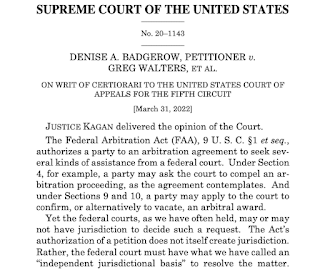
The Supreme Court of the United States yesterday issued an important ruling on federal court jurisdiction in matters governed by the Federal Arbitration Act (FAA) saying it does not allow federal courts to “look through” to the dispute underlying an arbitration to establish jurisdiction to confirm or vacate an arbitration award. The FAA authorizes a party to an arbitration agreement to petition a federal court for various forms of relief. The Act’s authorization of such petitions does not itself create the subject matter jurisdiction necessary for a federal court to resolve them. Previously, in Vaden v. Discover Bank, the Court assessed whether there was a jurisdictional basis to decide an FAA Section 4 petition to compel arbitration by means of examining the parties’ underlying dispute. Specific language in Section 4 instructed a federal court to “look through” the petition to the “underlying substantive controversy.” If the dispute underlying a Section 4 petition falls within the court’s jurisdiction for example, by presenting a federal question, then the court may rule on the petition to compel arbitration. In this case, Badgerow v. Walters, the question presented was whether that “look-through” approach to jurisdiction applies to applications to confirm or vacate arbitral awards under Sections 9 and 10 of the FAA. The majority ruled Congress chose to respect the capacity of state courts to properly enforce arbitral awards. Justice Kagan writes "the look-through rule is a highly unusual one: It locates jurisdiction not in the action actually before the court, but in another controversy neither there nor ever meant to be." This application in an employment termination case should go to state, rather than federal, court raising claims between non-diverse parties involving state law. See opinion here-- https://bit.ly/3DyArhT

Monday, June 21, 2021
No Prime Day For Amazon and Arbitration
The U.S. Supreme Court decided today not to consider whether drivers for Amazon’s Flex delivery service are interstate transportation workers who can avoid arbitration as part of a proposed class claim. Amazon.com Inc. had urged the high Court to review a federal appellate decision allowing a Flex driver to avoid arbitrating proposed class claims that he and others are misclassified as independent contractors because they’re interstate transportation workers exempt from the Federal Arbitration Act (FAA). The First Circuit Court of Appeals held last summer that those workers making local deliveries to Amazon customers qualify for the FAA exemption, even though they don’t cross state lines, because their work involves transporting goods in the flow of interstate commerce. Flex drivers, therefore, aren’t bound by arbitration agreements that would prevent them from litigating their state law wage claims. In recent years, Amazon used independent contractors to deliver goods through its Flex smartphone app. Flex contractors could sign up for shifts and use their own car while adhering to Amazon’s standards to deliver packages. However, if a contractor takes longer than their shift to complete their deliveries, they are not compensated for extra time, nor reimbursed for gas, vehicle maintenance, or cell phone data costs for the job. Working with Flex, an individual agrees to its terms of service, which requires settling disputes through arbitration governed by the FAA. Interestingly, earlier this month, the company changed its terms allowing people to bring individual or class action lawsuits against it. Amazon made the change in response to more than 75,000 pending arbitration demands on behalf of its Echo device users that would have required it to ante up tens of millions of dollars in filing fees in those cases. It now faces several class actions, including one alleging that it improperly recorded and preserved conversations through its Echo Dot Kids devices. See more here-- https://bit.ly/3vRYhzW and https://bit.ly/3qgc95x and https://bit.ly/2SKw54w


Monday, November 2, 2020
ADR Arbitration Advocacy Institute 11/13!
Please join me this month at the ADR Section of The Florida Bar's inaugural Arbitration Advocacy Institute. This innovative program is a one-day, online workshop for attorney-arbitrators that will provide coaching on mechanics, technology and professionalism to help Florida attorneys boost their arbitration advocacy skills. Attendees will increase their knowledge of the arbitration process from beginning to end-- distinct from mediation and litigation-- and participate in virtual clinics for diverse arbitration practice areas. A prestigious faculty of over 30 presenters will demonstrate effective and ethical techniques that will enable participants to reach the highest levels of advocacy in arbitration. Login on Friday, November 13, 2020 from 8:45 a.m. to 6 p.m. with an optional virtual networking hour on November 12 at 5:30 p.m. This course has been approved for 8.5 General CLE credits in Florida 1.0 of which may be applied toward Professionalism, and 1.0 Technology credit. Participants earn 1.5 additional General CLE credits for participation in a Virtual Clinic. Section members $185, non-section members $230 and law students just $60 (includes ADR Section membership). See more information and registration details here-- https://flabaradr.com/arbitration-advocacy-institute and https://bit.ly/3kRtgaz

Friday, January 10, 2020
Judge Blocks CA Arb Ban
Today, there's a hearing on a Temporary Restraining Order (TRO) against the State of California where a federal district judge is blocking implementation of the state’s new ban on arbitration of cases involving sexual harassment. The court will hear a request by the California Chamber of Commerce and other business groups for a preliminary injunction. This is a big test that will have national impact. The ban was signed into law in October 2019. It prohibits California employers from requiring employees to waive any right to or opt out of any legal forum or procedure established by the California Fair Employment or Labor Code. The new law applies to contracts for employment entered into, modified or extended on or after January 1, 2020-- the effective date of the new law. If an employer violates the act by forcing arbitration, they would commit a misdemeanor. The National Retail Federation filed suit in federal court seeking to prevent the law from going into effect by arguing the Federal Arbitration Act (FAA) and recent U.S. Supreme Court cases created a federal policy of using arbitration as a legitimate alternative to court litigation. Further, the FAA preempts state law to the contrary. A final ruling regarding primacy of the FAA over state law will serve as a bellwether on employer use of arbitration and may thwart other states from passing similar laws. See more here-- https://bit.ly/2R1oWrz and https://bit.ly/2RafHWa UPDATE: Following oral argument during which recent SCOTUS cases involving the FAA such as Epic Systems and Kindred Nursing were cited, the court requested supplemental briefing regarding the state's suggestion that the court lacks jurisdiction. The TRO will remain in effect until January 31, 2020.
Wednesday, October 30, 2019
California's Arbitration Ban
This month, a California bill prohibiting workplace arbitration was signed into law. Effective January 1, 2020, the new law criminalizes the use of mandatory arbitration agreements by making such a practice a misdemeanor offense. It prevents allegations of discrimination, harassment, and retaliation arising under that state’s Fair Employment and Housing Act from being subject to mandatory arbitration. This action sets up a direct conflict with the Federal Arbitration Act (FAA) and clear federal policy favoring arbitration. Challenges to constitutionality of this and other states' laws of this nature are coming. In recent terms, the U.S. Supreme Court reminded states of the predominance of federal policy regarding arbitration, striking down efforts to undermine the use of arbitration. States will likely argue that an arbitration agreement covering such claims is effectively a contract that is void as a matter of public policy. It will be argued such provisions fall within the FAA’s savings language, which preserves traditional state law defenses to arbitration agreements arising out of contract formation. At least one attorney commentator recognizes the problem with this argument-- that the underlying state policy established by the statute appears to directly conflict with the FAA’s underlying purposes, making the policy itself unconstitutional. As such, an unconstitutional policy should not void a contract whose terms are consistent with federal policy regarding dispute resolution. See more here-- https://tinyurl.com/y5yld9x4 and https://tinyurl.com/y37n4pxn
Wednesday, January 9, 2019
SCOTUS: Arbitrability is for Arbitrator not Court
This week, in what happened to be Justice Kavanaugh's first opinion on the U.S. Supreme Court, an arbitration ruling in a case centered on whether courts can prevent arbitrators from deciding if an issue can be arbitrated at all. Many parties prefer to arbitrate claims because the process is sometimes cheaper and faster than traditional litigation in court which also carries a greater risk of large damages awards by juries. This case arose in a contract dispute between a dental equipment distributor and a manufacturer. Their contract provided that disputes arising from the agreement would be resolved in arbitration, except in instances where one party sought an injunction. The Supreme Court found unanimously in Henry Schein, Inc. v. Archer & White Sales, Inc., that under the Federal Arbitration Act (FAA), a lower court must enforce an arbitration agreement that requires the arbitrator to decide whether a dispute should be decided in arbitration, regardless of the court’s view of the merits of the request for arbitration. When a contract allows arbitrators to decide whether a dispute can be resolved through arbitration, “a court may not override the contract." The holding states the “wholly groundless” exception to arbitrability is inconsistent with the FAA and Court precedent. Under the Act, arbitration is a matter of contract, and courts must enforce arbitration contracts according to their terms. The Supreme Court has long held that the FAA allows the parties to a contract to decide whether an arbitration agreement will extend to those gateway questions, explaining that courts must compel arbitration of the gateway questions whenever the agreement includes “clear and unmistakable evidence” that the parties delegated the decision of those questions to the arbitrator. See stories here-- https://bit.ly/2FqySH1 and https://fxn.ws/2M2c41x and opinion here-- https://bit.ly/2CXAgPw
Monday, October 29, 2018
More Arbitration Argument Before SCOTUS
Today, the U.S. Supreme Court (SCOTUS) has oral arguments in two arbitration cases. In the first matter, Henry Schein, Inc. v. Archer & White Sales, Inc., the justices consider if a judge or an arbitrator should decide if a particular dispute should be resolved in arbitration rather than in court. In the second case, Lamps Plus Inc. v. Varela, the issue is whether the Federal Arbitration Act (FAA) precludes state law interpretation of arbitration contracts allowing for class arbitration and who decides whether a particular dispute should be decided in arbitration rather than a court. SCOTUS has already recognized that arbitrators decide issues of arbitrability if the parties clearly and unmistakably agree the arbitrator can assess whether any particular dispute is sufficiently related to the contract to warrant arbitration. Apparently, the U.S. Court of Appeals for the 5th Circuit will not send a case to the arbitrator decide the question of arbitrability, even if the parties have agreed that the arbitrator should decide such questions, if the court finds the claim of arbitrability wholly groundless. The contract in the first case mentioned above provided for arbitration of any dispute arising under or related to the contract, except for actions seeking injunctive relief. The complaint sought damages for Sherman Act violations, as well as injunctive relief. The defendants sought arbitration, arguing the thrust of the complaint was to seek damages, and that injunctive relief could issue after the arbitrator ruled on the merits. Lower courts refused to send the matter to arbitration, finding the request for arbitration groundless because of the inclusion in the complaint of a count for injunctive relief. Because SCOTUS already decided parties can delegate issues of arbitrability to an arbitrator in precedents that do not include exceptions for cases in which courts regard the request for arbitration as groundless, a reversal is likely given recent trends in favor of arbitration. The second case hinges on whether the U.S. Court of Appeals for the 9th Circuit correctly held that an employer did consent to class arbitration when it included language in the arbitration contract that committed the parties to use arbitration in lieu of any and all lawsuits or other civil legal proceedings. This case too may find itself going back, but on procedural grounds as the FAA dictates that an appeal may not be taken from an interlocutory order directing arbitration to proceed. See more here-- https://bit.ly/2AzcN6e and https://bit.ly/2JodgdX and https://bit.ly/2w5K2O8
Sunday, September 30, 2018
SCOTUS of Just 8 Consider Arbitrability
This week, a U.S. Supreme Court of just eight justices will hear New Prime Inc. v. Oliveira including the matter of whether a dispute over applicability of the Federal Arbitration Act's (FAA) Section 1 exemption is an arbitrability issue that must be resolved in arbitration pursuant to a valid delegation clause. Importantly, this case may resolve whether such applicability of the FAA is a question for the arbitrator or the judge. Several of the Supreme Court’s recent cases suggest that an arbitrator’s authority includes not only resolving of the dispute, but also determining the extent to which any particular dispute falls within our authority as arbitrators. Interestingly, retired Justice Kennedy was one of five justices commonly in the majority when arbitration cases were decided by a 5-4 vote. An even panel of justices must now decide how activity in this case, which involves an exception from the FAA for “contracts of employment of seamen, railroad employees, or any other class of workers engaged in foreign or interstate commerce," will be determined. The underlying facts concern individuals who drive the trucks carrying goods consigned to trucking companies documenting drivers as independent contractors rather than employees. For example, if that exception does not apply, then long-haul truck drivers are back in the conventional domain of the FAA. The actual text of the FAA, however, does not exempt all transportation “employees.” Rather, it exempts “contracts of employment” of transportation employees. Oral argument is scheduled October 3rd. See more here-- https://bit.ly/2OZyZec and https://bit.ly/2HVjWiB and https://bit.ly/2OteZDM
Thursday, May 31, 2018
SCOTUS Upholds Employer Arbitration Requirement
This month, in a 5-4 decision, the U.S. Supreme Court ruled that an employer can lawfully require employees to arbitrate as a condition of employment any related disputes on an individual basis and to waive their right to participate in a class action suit or class arbitration. The case involved an effort by workers to file a class action suit against an employer for violating the federal minimum wage law. The employer sought to dismiss the case because it insisted as a condition of employment that the employees waive their ability to go to court or be part of any class action. Rather, any dispute had to be resolved out of court in a private arbitration. The case, Epic Systems v. Lewis, arose from the U.S. Court of Appeals for the Seventh Circuit. Companion cases, Ernst & Young v. Morris, from the Ninth Circuit and National Labor Relations Board v. Murphy Oil, from the Fifth Circuit were argued as a trio before the Supreme Court which decided they differed only in detail, not substance. The Federal Arbitration Act (FAA) requires courts to enforce arbitration agreements between employers and employees according to their terms, even when the agreements provide only for arbitration through “individualized proceedings” rather than a class. In this holding, the Court refused to read the National Labor Relations Act (NLRA) to prohibit arbitration agreements requiring individualized arbitration as an impermissible restriction on employee rights under the NLRA to “engage in … concerted activities for the purpose of … mutual aid or protection,” 29 U.S.C. § 157, holding that Section 7 of the act “focuses on the right to organize unions and bargain collectively” and “does not even hint at a wish to displace" the FAA. The Court stated the FAA and the NLRA have long coexisted (since 1925 and 1935 respectively) and found the suggestion they might conflict something quite new. The Court reasoned that the employees’ theory ran “afoul of the usual rule that Congress does not alter the fundamental details of a regulatory scheme in vague terms or ancillary provisions..." See more in article here-- https://bit.ly/2Jk3e04 and read full opinion here-- https://bit.ly/2rWzAE8
Sunday, January 14, 2018
SCOTUS Denies Cert on 5th DCA Ruling Against Arb
The U.S. Supreme Court declined last week to review an appellate ruling by Florida's Fifth District Court of Appeal (5th DCA) that found a patient arbitration agreement unenforceable because it ran afoul of state law, despite the health care provider’s warnings that the ruling could render other health care arbitration agreements here unenforceable. The U.S. Supreme Court refused to grant Kindred Hospital East LLC's certiorari petition, just the latest in a series of long-running battles over the enforceability of health care arbitration agreements. Kindred asked the U.S. Supreme Court to review the state appeals court’s refusal to force the arbitration of medical malpractice claims, saying the decision violates the Federal Arbitration Act. The fundamental dispute lies between state courts and the high court over the scope of the Federal Arbitration Act, as both sides in the dispute argue in their briefs. Kindred asserted if the ruling below was permitted to stand, every contractual agreement to arbitrate healthcare disputes in Florida would be unenforceable. The underlying Plaintiff had sued Kindred and several doctors for medical malpractice in state court after she suffered unspecified injuries during a 2012 stay at an Ocala hospital, a move Kindred argued was prohibited by an arbitration agreement signed by both parties. Florida's 5th DCA sided with the Plaintiff in the summer of 2016 and overturned a trial court’s ruling that compelled the parties to go to arbitration, per the terms of the contract. The appeals court found that the arbitration agreement was invalid because it selectively incorporated provisions from Florida’s own Medical Malpractice Act (MMA) that were favorable to Kindred and left out provisions favorable to patients. Specifically, public policy prohibits the enforcement of an arbitration provision that incorporates some, but not all, of the MMA's arbitration provisions. See more here-- http://bit.ly/2mw6Nmf and http://bit.ly/2EG8ipq and http://bit.ly/2FDvSoj
Monday, March 27, 2017
Ham4Arb
Who knew Hamilton was a fan of arbitration? Ron Chernow's best-seller Alexander Hamilton, upon which the new musical is based, chronicles drafting the Constitution, forming the first political parties, and Hamilton's early career as a lawyer achieving amicable settlements through Alternative Dispute Resolution. Apparently, Hamilton was reported to prefer arbitration over litigation. Chernow recounts matters that Hamilton resolved by arbitration, such as shipping disputes. As arbitration figures prominently in the area of consumer agreements, it seems relatively modern, but arbitration has deep roots in our country. Hamilton's busy legal practice made him New York's premier lawyer, with an elite clientele that included the State of New York. Chernow states Hamilton was not alone in his preference for arbitration, as many practitioners of that era preferred it to litigation. In the early years of our nation, arbitration reached a high level of utilization, particularly in commercial disputes, and that continued until a time when the ebb and flow of opinions once again pushed litigation to the forefront and created what was perceived as a judicial hostility toward arbitration-- particularly by allowing the revocation of agreements to arbitrate. The enactment of the Federal Arbitration Act in 1925 established arbitration agreements as valid, irrevocable and enforceable over the last century. Throughout this time, arbitration has been a pivotal part of our dispute resolution mechanisms. While arbitration is by no means a major thread in the overall fabric of Chernow's biography of Hamilton, the references to it are of importance and instructive to all ADR practitioners. The fundamental reasons for its heavy utilization at the time of our nation's formation continue today, particularly in the commercial context. In light of Hamilton's support for arbitration, it's ironic that his final controversy in life was resolved by a duel, a lethal form of dispute resolution says Professor Mazadoorian who analyzes this biography through an ADR lens more here-- http://bit.ly/2n8y1hX
Tuesday, October 18, 2016
Pushback By Nursing Homes On CMS Arbitration Ban
This week, the nursing home industry, consisting of the American Health Care Association (AHCA) and others, filed suit against the Centers for Medicare & Medicaid Services (CMS) within the Department of Health and Human Services (HHS), alleging CMS exceeded its authority and claiming the agency has no authority to regulate the use of arbitration. CMS recently promulgated a rule that prohibits Medicare participating skilled nursing facilities (SNF) from entering into arbitration agreements with residents at their facilities upon admission, no matter how fair or beneficial those agreements may be to residents. The complaint states that the new arbitration ban violates the Federal Arbitration Act (FAA) and exceeds the statutory authority of CMS and HHS under the Medicare and Medicaid Acts, neither of which vests the agencies with the power to regulate alternative dispute resolution procedures. The complaint argues, even if the rule is allowed by law, it is arbitrary and capricious because it would deprive nursing homes and their residents of the benefits of arbitration and result in the siphoning of resources toward litigation costs and away from resident care. The new rule does not prevent residents of a SNF from choosing to enter into arbitration-- it just means the SNF can no longer force the dispute out of the courtroom. However, the complaint contends that parties almost never agree to arbitration in a particular case after a dispute has arisen. See complaint here-- American Health Care Association, et al. v. Sylvia Burwell and Andrew Slavitt Case No. 3:16-cv-00233 http://bit.ly/2dMdKu9 and press release-- http://bit.ly/2ed140y
Friday, May 6, 2016
Arbitration Attacked
The right of parties to avoid court and arbitrate contractual disputes comes from the Federal Arbitration Act of 1925. It provides that agreements to arbitrate disputes are enforceable. Decades after becoming a standard form of alternative dispute resolution, arbitration clauses were employed as a method to defeat class action lawsuits. Where parties agreed to arbitrate disputes, claims could still be brought, but on an individual basis in arbitration. New rules being promulgated by the Consumer Financial Protection Bureau or CFPB would allow class-action lawsuits, setting up the latest clash between the banking industry and consumers. The CFPB aims to prohibit financial companies from using mandatory arbitration clauses as a way to block class-action lawsuits, in which a large number of plaintiffs with similar complaints band together. Companies still would be able to require consumers to enter arbitration to resolve individual disputes. Critics maintain this will result in higher litigation costs for banks, which they will offset either by raising the costs of consumer loan products or reducing services. Arbitration clauses have become widespread in recent years, aided by a string of court rulings that have limited the ability of consumers to file lawsuits. The agency’s proposal would be the first significant check on arbitration since recent U.S. Supreme Court decisions that affirmed its widespread use. The landmark Supreme Court case, AT&T Mobility v. Concepcion, allowed businesses to enforce class-action waivers in contracts. The new rule is expected to take effect next year after a 90-day public comment period to federalregistercomments@cfpb.gov and drafting of the final rule. See more here-- http://on.wsj.com/24Cl284 and http://nyti.ms/1QSVNF0 and http://files.consumerfinance.gov/f/documents/CFPB_Arbitration_Agreements_Notice_of_Proposed_Rulemaking.pdf
Tuesday, February 16, 2016
Congress Considers Arbitration
This month, U.S. Senator Patrick Leahy introduced the Restoring Statutory Rights Act and Interests of the States Act of 2016. If it becomes law, it would exempt from the Federal Arbitration Act (FAA) claims brought by individuals or small businesses arising from violations of federal or state law, the U.S. Constitution or a state constitution. Accordingly, it would permit these claims to proceed in a court of law. Apparently, under the measure, arbitration is still an option if the parties voluntarily choose to arbitrate a dispute after it arises. The bill would also allow federal and state courts to apply their respective jurisdictional laws concerning contract interpretation to find arbitration provisions unconscionable or unenforceable, notwithstanding the FAA. Finally, courts, not arbitrators, would have the essential task of determining and enforcing arbitrability. Congress is also considering the Arbitration Fairness Act of 2015, introduced last year by Senator Al Franken, which would prohibit the use of forced arbitration in consumer and employment disputes. That bill is still in committee, as is a companion bill in the House of Representatives. These Members of Congress take issue with recent majority decisions by the U.S. Supreme Court upholding federal preemption under the FAA. Arbitration remains a worthy alternative to litigation and perhaps these efforts, which pertain mainly to consumer disputes, will stop the backlash that has seemingly taken place and given the whole process a bad name. See more on S. 2506 and S. 1133 here-- www.congress.gov
Subscribe to:
Posts (Atom)