
Sunday, November 5, 2023
SCOTUS to decide Coinbase Arbitrability
Last week, the U.S. Supreme Court granted cert and agreed to hear a cryptocurrency case that would move a dispute with users of a cryptocurrency exchange out of courts and into private arbitration. At issue is whether upon creating their Coinbase accounts, users agreed to resolve disputes through arbitration. A subsequent agreement related to a Dogecoin sweepstakes stipulated that any issues related to the contest must be addressed in state court. Users later accused Coinbase of violating California’s false advertising law by luring them into a sweepstakes offering Dogecoin prizes so they brought a class-action lawsuit in federal court. A federal district judge in California refused Coinbase's request to enforce arbitration, as the company argued its user agreements required. The Ninth Circuit Court of Appeals affirmed the trial judge's decision. In a related dispute last summer, the U.S. Supreme Court ruled 5-4 in favor of Coinbase. In that case, the justices supported Coinbase’s request to suspend customer lawsuits while seeking appeals to move disputes from courts to private arbitration. The review of the current case will likely impact the current status of arbitrability decisions by courts verus arbitrators and the utilization of arbitration clauses and enforcement of user agreements, especially in digital currency trading. When parties enter into successive contracts, and the first contains an arbitration agreement with a delegation clause but the second does not, who decides whether the first contract’s arbitration agreement governs any later disputes? This may finally resolve a regional circuit split. See more here-- https://tinyurl.com/ycy8xr67 and https://tinyurl.com/32s87z6t and https://tinyurl.com/2z57nbez


Wednesday, October 11, 2023
Mediation Week 2023 Mixers
The American Bar Association recognizes the third week in October as Mediation Week to educate the public about mediation. During Mediation Week, the ABA encourages all to recognize the importance of the work of neutrals, advocates, and policy makers and celebrate the strides we have made in institutionalizing mediation as a dispute resolution process. October 15-21, 2023 is Mediation Week in Florida under a proclamation of the Supreme Court of Florida. Mediation has been used by Florida courts for more than 30 years. Online Dispute Resolution now serves as an official option following the pandemic through sessions conducted with readily available remote attendance technology. Florida's Dispute Resolution Center continues to require specific standards set by the Florida Supreme Court in the areas of county, family, circuit, dependency, and appellate mediation during these virtual sessions. Mediation week brings annual focus on our dispute resolution work and highlights how individuals, administrative agencies, and businesses can use mediation to develop efficient and customized solutions to conflicts. Next week there are several mixers around the state hosted by members of the Alternative Dispute Resolution Section of The Florida Bar. We enjoy camraderie and hope to see you there! See more here-- https://flabaradr.com/mediation-mixers


Monday, October 2, 2023
Now Available as AAA Panelist
Orlando Mediator Lawrence Kolin is now available as a panel neutral for the American Arbitration Asoociation (AAA). Though Lawrence was a party-selected AAA arbitrator and mediator in the past, and has even presented educational programs in conjunction with AAA, he has officially become a member for purposes of resolving cases under the auspices of AAA. As a reminder, Mediation is used to resolve a broad range of conflicts within a variety of settings. Mediation is a process in which an impartial third party facilitates communication and negotiation and promotes voluntary decision making by the parties to the dispute. Mediation agreements may be included as part of a contract that specifies what procedures will govern the mediation process. Alternatively, parties frequently agree to mediate following the onset of a dispute regardless of whether their contract stipulates mediation as a means of resolution, or when there is no contract between the parties. Mediation serves various purposes, including providing the opportunity for parties to define and clarify issues, understand different perspectives, identify interests, explore and assess possible solutions, and reach mutually satisfactory agreements, when desired.
See more here-- https://tinyurl.com/bdzj99bw


Saturday, September 2, 2023
Join us for AI in Mediation 9/7 at noon!
We'll be giving a free CLE/CME online September 7th at noon in conjunction with the University of Florida Levin College of Law Institute for Dispute Resolution looking at the current state of artificial intelligence as used by legal professionals. We will also discuss the reaction AI is garnering and how it is not necessarily all good or all bad news for the 3,000 plus-year-old tradition of mediation. Mediation is almost as old as conflict itself. The best mediators can resolve disputes discreetly, effectively, and, most importantly, with fairness to both parties, but there is no doubt AI is a negotiation-changing and career-changing tool in the law. Along with my colleague at UWWM, mediator Michelle Jernigan, with whom I serve as Emertius Member of The Florida Bar ADR Section Executive Council and our guests Christy Foley and Christina Magee (current and former chairs of the ADR Section), we also survey the pros and cons of AI in the legal field and ethical issues associated with the use of AI. Panel members will draw conclusions and make recommendations based on their research and personal experience. The Florida Bar has accredited the Webinar 1.0 hours of Technology Continuing Legal Education (CLE). You may submit questions in advance and register here-- https://register.gotowebinar.com/register/3125289667036333659 Replay available here-- https://www.youtube.com/watch?v=UYjgRL4UUA8


Tuesday, August 1, 2023
MDFL Seeks Comment on Mediation Rules
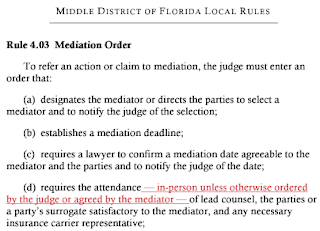
The U.S. District Court for the Middle District of Florida has put forth local rule amendments for comment including Mediation. The federal court proposal requires the attendance in-person unless otherwise ordered by the judge or agreed by the mediator — of lead counsel, the parties or a party’s surrogate satisfactory to the mediator, and any necessary insurance carrier representative. This default has been a feature of other courts' rules in recent times since Covid has mostly waned, though many have made the exception to be through stipulation or agreement by the parties, not the mediator. By way of example, the Florida Rule of Civil Procedure 1.700 now states that mediation must be conducted in person, unless the referral order directs, the state court or party moves, or the parties stipulate othewise and also permits a combination of in-person and use of commuication technology. The federal court seeks comment on this change and these can be submitted by by mailing them to Elizabeth Warren, Clerk of Court, Attention: Local Rules Comments, 401 W. Central Blvd, Ste. 2100, Orlando, FL 32801-0201 or submitting through a link here-- https://www.flmd.uscourts.gov/webforms/comment-proposed-amendments-local-rules All comments must be received by 5:00 p.m. EST on August 21, 2023. See the proposed amendments linked to public notice posted here-- https://www.flmd.uscourts.gov/announcements/public-notice-and-opportunity-comment-proposed-amendments-local-rules

Saturday, July 1, 2023
SCOTUS Stays Cases during Arb Appeals
The U.S. Supreme Court held last week that non-final appeals on arbitrability would stay litigation automatically while decided. This case arose from a class action between the cryptocurrency platform Coinbase and its users. The terms and conditions of the site required users to submit disputes to mandatory arbitration. The named plaintiff sued in federal court, arguing that the arbitration agreement was unenforceable. When the district court agreed, Coinbase appealed that decision to the Ninth Circuit seeking an interlocutory order that would stay the lawsuit until the appeal on arbitration could be heard. In conflict with decisions from other federal appellate courts, the Ninth Circuit rejected that position. In a 5-4 decision, the Supreme Court reversed the Ninth Circuit, finding a right to an interlocutory appeal of a decision not to enforce a mandatory arbitration agreement. The Court noted requiring cases to proceed to trial before hearing such appeals would defeat the purpose of using arbitration in the first place. As a result, an appeal of a district court’s decision to invalidate or enforce and arbitration agreement will be given an automatic stay of the matter pending the appeal. The Court opined it makes sense that absent an automatic stay of district court proceedings, Congress’s decision to afford a right to an interlocutory appeal in Section 16 of the Federal Arbitration Act (FAA) would be largely nullified. Beyond this reasoning, the majority also noted the purposes of arbitration and explained that automatic stays will preserve those objectives of efficiency, reduced litigation cost, and reduced discovery burdens on the parties. See more on Case No. 22-105 here-- https://tinyurl.com/546zn456 and https://tinyurl.com/2r5snu79


Friday, June 9, 2023
Comments Sought for Non-Binding Arb Changes
The Supreme Court of Florida governed Florida Dispute Resolution Center (DRC) Committee on Alternative Dispute Resolution (ADR) Rules and Policy has put forth proposals in Case No. SC2023-0810. The court is now considering amendments to Florida Rule of Civil Procedure 1.820 (Hearing Procedures for Non-Binding Arbitration) that would provide a non-exclusive list of factors for a judge to consider when deciding whether to refer a contested civil action to non-binding arbitration. The amendments would also provide minimum hearing procedures that must be included in an order of referral to non-binding arbitration, absent agreement of the parties, among other things. The court has placed the proposals online and any comments should be filed with the Florida Supreme Court on or before July 31, 2023. If filed by an attorney in good standing with The Florida Bar, the comment must be electronically filed via the Florida Courts E-Filing Portal. If filed by a nonlawyer or a lawyer not licensed to practice, the comment may be, but is not required to be, filed via the Portal. Any person unable to submit a comment electronically must mail or hand-deliver the originally signed comment to the Florida Supreme Court, Office of the Clerk, 500 South Duval Street, Tallahassee, Florida 32399-1927 See more here-- https://www.floridasupremecourt.org/Case-Information/Rules-Cases-Proposed-Amendments and https://acis.flcourts.gov/portal/search/case


Subscribe to:
Posts (Atom)