Showing posts with label court appointed masters. Show all posts
Showing posts with label court appointed masters. Show all posts
Thursday, September 1, 2022
What is a Special Master anyway?
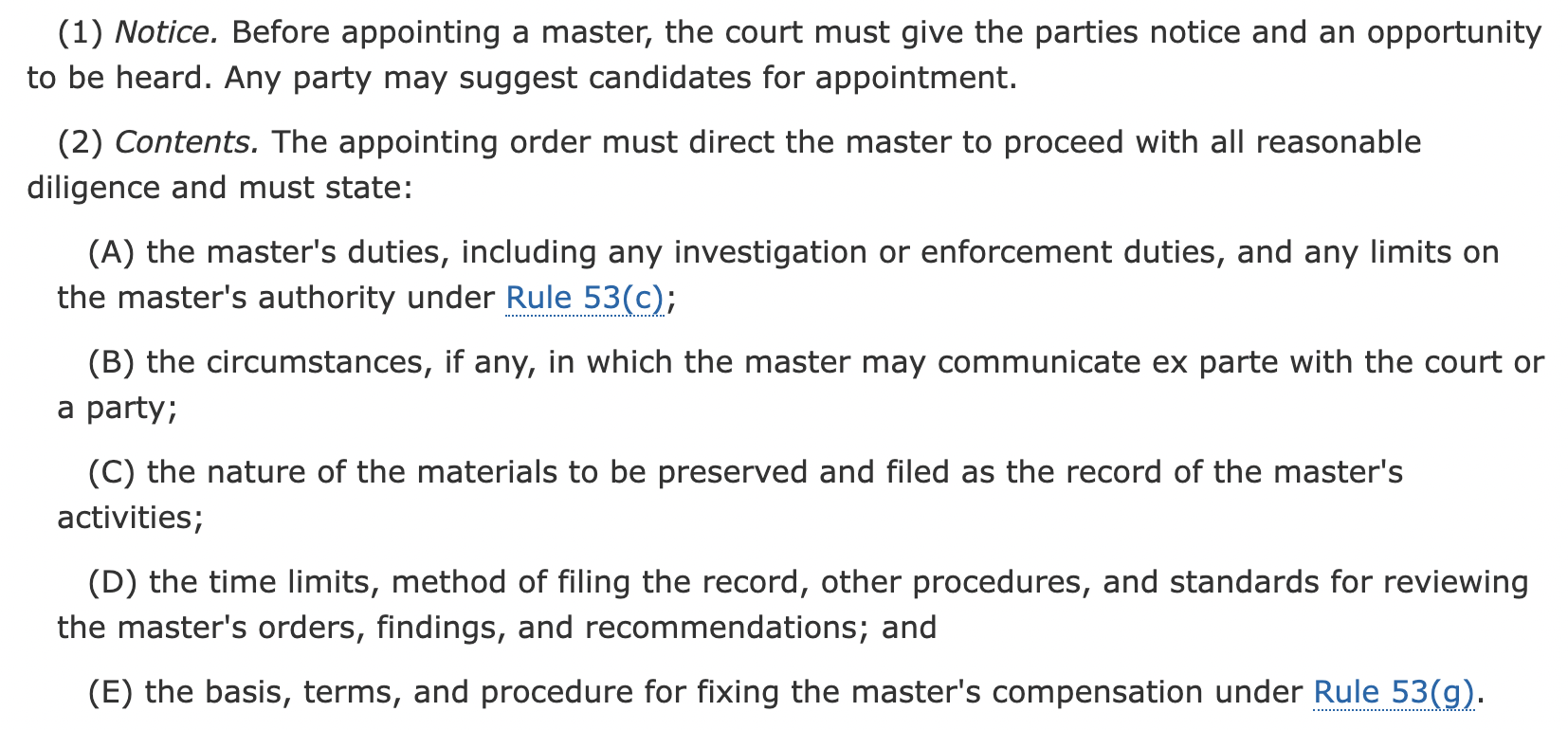
All federal courts have the power to appoint a Special Master (or as it is known in Florida state courts Special Magistrate) to assist with reviewing and deciding discovery in contentious cases. Rule 53 of the Federal Rules of Civil Procedure governs the appointment of masters in federal court usually, but not always, with consent of the parties. In our state court, it is found in various procedural rules and Florida Statutes that empower judges, as well as bodies like county commissions, to obtain assistance in deciding matters. Many federal and state court judges use masters and likely more will do so in the future. Because of their substantial caseloads, many federal district judges and their assigned magistrate judges do not have sufficient time for the tasks inherent in the administration of complex, multi-party, and class action cases. Judges need to conserve and preserve their time to rule on pretrial matters and to try cases. With demanding dockets and tight court budgets, judges turn to skilled neutrals for help in getting the parties relief. These special court appointees usually come with specialized knowledge and are ordered to perform a broad or limited scope of duties such as monitoring discovery, resolving time-consuming disputes, helping with complex E-discovery problems involving electronically stored information (ESI) (typically in high-stakes cases involving employment, intellectual property, products and technology), and coordinating multi-party and multi-district litigation (MDL) cases. A Special Master can markedly reduce the burden on a judge and the court’s administrative staff. When assigned to a case, I routinely review the potentially relevant discovery in camera and provide the court with findings or recommendations regarding the legal status and factual nature of the information. Parties and lawyers recognize that the appointment of a master can save them substantial fees and costs, and can lead to a much quicker resolution of their disputes. Sophisticated parties who regularly use professional and experienced masters know how valuable we can be to expedited case handling and in getting quicker resolution. See more here-- https://bit.ly/3AJ6j2r 


Friday, August 10, 2018
SCOTUS Subs Special Master in Water Wars
This week, the U.S. Supreme Court suddenly substituted a court-appointed Special Master after recently rejecting his ruling recommending Florida had not proven its case “by clear and convincing evidence” that imposing a cap on Georgia’s water use would benefit Florida water systems and remanding because he “applied too strict a standard” in rejecting Florida’s claim. The rejected recommended ruling in the decades-long Water Wars case favored Georgia and was just sent back to Special Master, Ralph I. Lancaster, Jr., of Maine who presided over and tried the original jurisdiction case back in 2016. Now, the Court has discharged him, swapping for Special Master Honorable Paul J. Kelly, Jr., a Senior Judge on the U.S. Court of Appeals for the Tenth Circuit from New Mexico, to make further findings regarding Florida's claim it suffered harm from the overconsumption of water by Georgia. Florida still seeks the cap on consumption that would alleviate past damage allegedly caused by Georgia. Traditionally, states as parties pay legal fees of lawyers acting as special masters, though reportedly the high court foots the bill for some administrative and clerical costs. According to the court’s docket, the 88-year-old Lancaster was paid almost a half-million dollars between 2014 and 2017. By contrast, senior judges who become special masters are on the government payroll, relieving the states of having to pay special masters’ fees. Future proceedings will weigh Georgia’s claims that any limits on its water use would undermine its economy, including the growth of the Atlanta area and the state’s agriculture industry in southwestern Georgia. This blog has followed the Water Wars for years in other entries. Florida ultimately seeks to limit Georgia’s water consumption from the Apalachicola-Chattahoochee-Flint River Basin, including Lake Lanier, to 1992 levels and to get reparations for alleged economic and environmental harm to Apalachicola's oyster fisheries from drought. See news story here-- https://bit.ly/2vBQeKZ and SCOTUS Order here-- https://bit.ly/2B6Q9nI
Subscribe to:
Posts (Atom)