
Showing posts with label Florida Court-Appointed Neutrals. Show all posts
Showing posts with label Florida Court-Appointed Neutrals. Show all posts
Friday, October 4, 2024
Join us 10/30 as we reflect on 10 years!
Join us later this month on 10/30 at noon ET for a free CLE webinar as my esteemed colleague and I celebrate our 10th anniversary with ADR pioneers, Upchurch Watson White & Max Mediation Group. We thought we would share our combined wisdom gained from helping lawyers and participants of the process get to yes over the past decade. As the registration blast indicates, veteran circuit-civi mediators of the firm, Jeff Fleming and Lawrence Kolin, will take our attendees on a journey through a decade of lessons learned from serving as full-time professional neutrals, including:
- How their perceptions of mediation have changed
- Comparing Zoom with in-person mediations
- Preparation and mediation summaries
- Opening statement by the parties
- Best timing for a mediation
- How long mediations should last
- Why some caucuses take so long
- Using brackets effectively
- Asynchronous negotiation
- Managing expectations
The Florida Bar has accredited this webinar for 1.0 hours of General Continuing Legal Education (CLE) and of course you may, as always, self-report Continuing Mediator Education (CME) credit to DRC. Register here-- https://us02web.zoom.us/webinar/register/WN_aMDTyUADSYG38xPgFZCGIg#/registration


Thursday, September 1, 2022
What is a Special Master anyway?
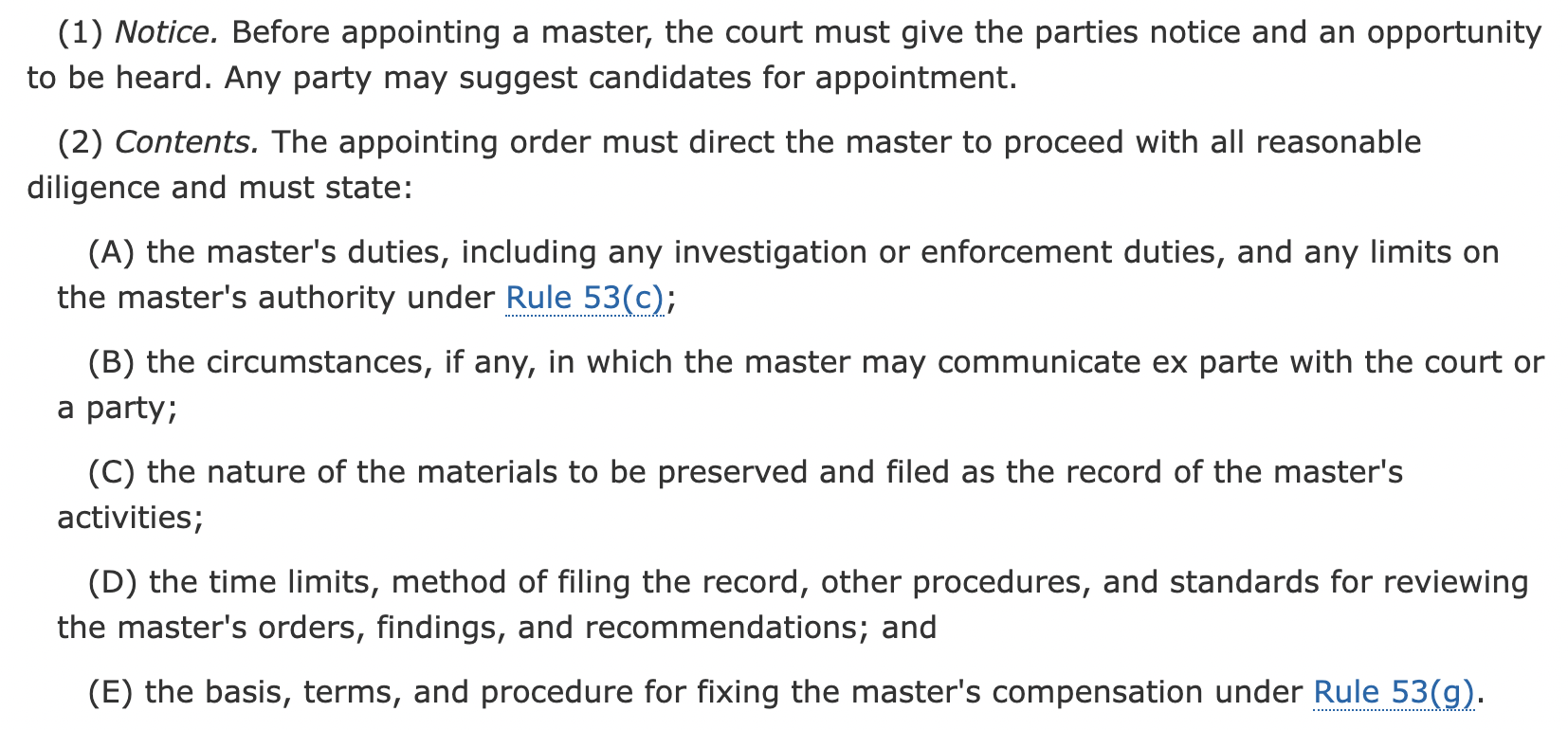
All federal courts have the power to appoint a Special Master (or as it is known in Florida state courts Special Magistrate) to assist with reviewing and deciding discovery in contentious cases. Rule 53 of the Federal Rules of Civil Procedure governs the appointment of masters in federal court usually, but not always, with consent of the parties. In our state court, it is found in various procedural rules and Florida Statutes that empower judges, as well as bodies like county commissions, to obtain assistance in deciding matters. Many federal and state court judges use masters and likely more will do so in the future. Because of their substantial caseloads, many federal district judges and their assigned magistrate judges do not have sufficient time for the tasks inherent in the administration of complex, multi-party, and class action cases. Judges need to conserve and preserve their time to rule on pretrial matters and to try cases. With demanding dockets and tight court budgets, judges turn to skilled neutrals for help in getting the parties relief. These special court appointees usually come with specialized knowledge and are ordered to perform a broad or limited scope of duties such as monitoring discovery, resolving time-consuming disputes, helping with complex E-discovery problems involving electronically stored information (ESI) (typically in high-stakes cases involving employment, intellectual property, products and technology), and coordinating multi-party and multi-district litigation (MDL) cases. A Special Master can markedly reduce the burden on a judge and the court’s administrative staff. When assigned to a case, I routinely review the potentially relevant discovery in camera and provide the court with findings or recommendations regarding the legal status and factual nature of the information. Parties and lawyers recognize that the appointment of a master can save them substantial fees and costs, and can lead to a much quicker resolution of their disputes. Sophisticated parties who regularly use professional and experienced masters know how valuable we can be to expedited case handling and in getting quicker resolution. See more here-- https://bit.ly/3AJ6j2r 
Sunday, July 22, 2018
No More Business Court? Use a Special Magistrate!
This month in Orange County, we saw the demise of the state's first "Business Court" due to lack of adequate funding from the state legislature which allocates less than one percent of Florida's budget to the judiciary. Known as the Complex Business Litigation Division of Circuit-Civil, this specialized court helped determine thousands of cases in its 15 year history through the use of its own rules and active case management by its presiding judges. Mediators with commercial experience also helped dispose of many a case upon referral. Now that these cases have been reassigned to the General Civil Division, they will likely have to wait to be decided among thousands more general cases already on those dockets. Ninth Judicial Circuit Chief Judge Fred Lauten spoke on this at our recent Orange County Bar Association Judicial Relations Committee meeting and is in the midst of a public relations campaign to encourage citizens to ask their elected officials to secure more funding next session. Judge Lauten has commented that "with a growing population and a base constituency of 1.7 million people, the Ninth Judicial Circuit has been operating at maximum effort with minimum resources for years. Despite a caseload that has qualified the circuit for additional judges every year since 2006, no new judgeships have been allocated. While an ever expanding workload coupled with chronically insufficient resources would spell a reduction in services for most agencies and businesses-- the judiciary is not afforded that option, nor should it be." As such, the business judges were moved to the fill a bigger need in the growing Family Division. Still, there remains an option to litigants to have their cases heard before a skilled neutral or Special Magistrate, by consent. Special Magistrates in state court (formerly known as Special Masters which they are still called in federal court) can timely assist burdened trial judges in the disposition of complex cases. Carefully drafted orders of referral under Rule 1.490 of the Florida Rules of Civil Procedure that anticipate the scope of issues to be decided, such as discovery disputes, can do much to make the utilization of Special Magistrates effective and cost-efficient. Having served the Circuit-Civil Division in culling cases during 2013 as a General Magistrate, I recently offered to serve as a hired Special Magistrate where parties so desire. See more in newspaper opinion piece here-- https://bit.ly/2mykykR


Subscribe to:
Posts (Atom)