Showing posts with label Special Master. Show all posts
Showing posts with label Special Master. Show all posts
Thursday, September 1, 2022
What is a Special Master anyway?
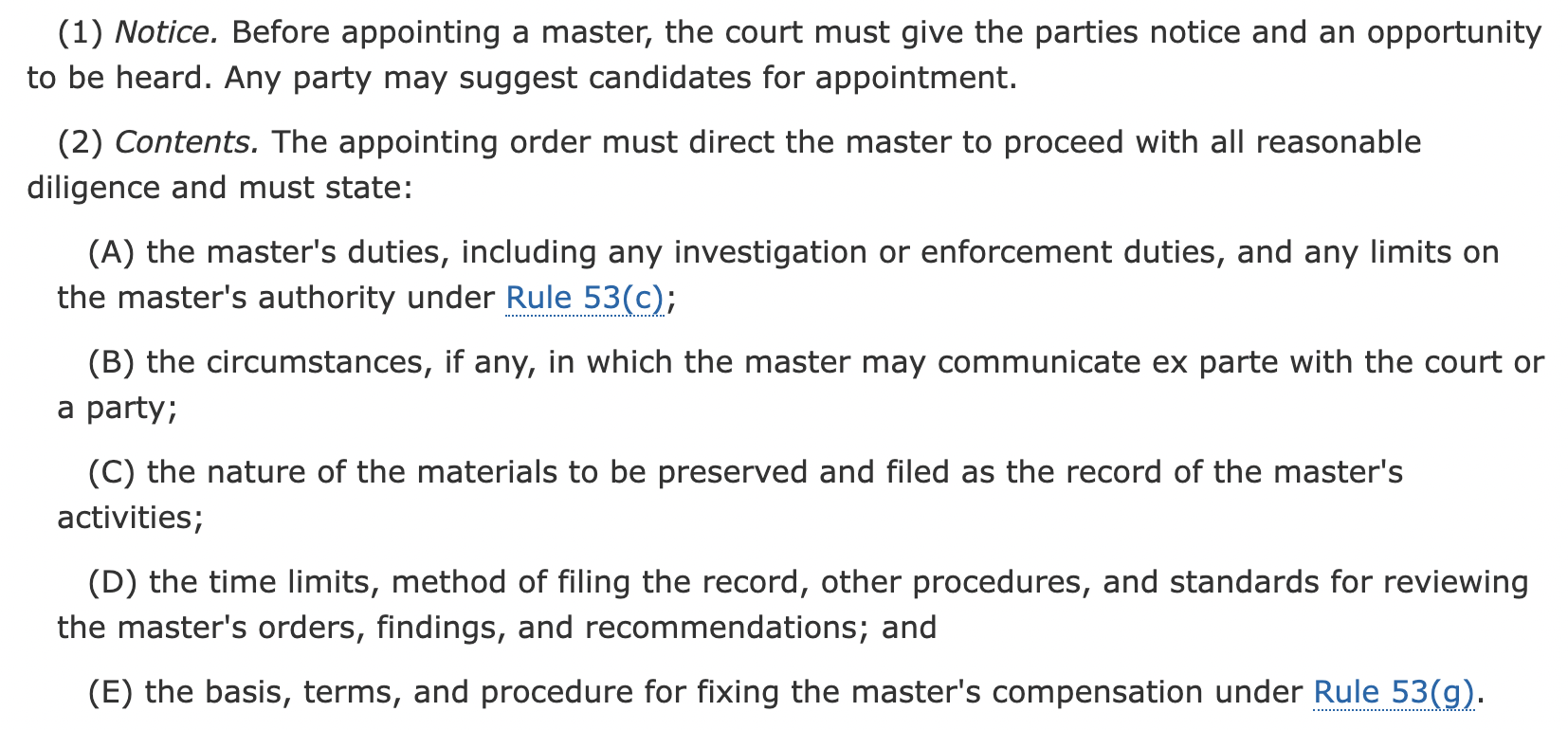
All federal courts have the power to appoint a Special Master (or as it is known in Florida state courts Special Magistrate) to assist with reviewing and deciding discovery in contentious cases. Rule 53 of the Federal Rules of Civil Procedure governs the appointment of masters in federal court usually, but not always, with consent of the parties. In our state court, it is found in various procedural rules and Florida Statutes that empower judges, as well as bodies like county commissions, to obtain assistance in deciding matters. Many federal and state court judges use masters and likely more will do so in the future. Because of their substantial caseloads, many federal district judges and their assigned magistrate judges do not have sufficient time for the tasks inherent in the administration of complex, multi-party, and class action cases. Judges need to conserve and preserve their time to rule on pretrial matters and to try cases. With demanding dockets and tight court budgets, judges turn to skilled neutrals for help in getting the parties relief. These special court appointees usually come with specialized knowledge and are ordered to perform a broad or limited scope of duties such as monitoring discovery, resolving time-consuming disputes, helping with complex E-discovery problems involving electronically stored information (ESI) (typically in high-stakes cases involving employment, intellectual property, products and technology), and coordinating multi-party and multi-district litigation (MDL) cases. A Special Master can markedly reduce the burden on a judge and the court’s administrative staff. When assigned to a case, I routinely review the potentially relevant discovery in camera and provide the court with findings or recommendations regarding the legal status and factual nature of the information. Parties and lawyers recognize that the appointment of a master can save them substantial fees and costs, and can lead to a much quicker resolution of their disputes. Sophisticated parties who regularly use professional and experienced masters know how valuable we can be to expedited case handling and in getting quicker resolution. See more here-- https://bit.ly/3AJ6j2r 


Friday, April 2, 2021
Final loss for FL in Water War with GA
Because of the rare use of special masters by the U.S. Supreme Court, this blog has followed the FL-GA Water Wars for years. Now, because this was always a case of original jurisdiction, SCOTUS unanimously rejected Florida's exceptions taken and dismissed the case, essentially finding for GA. This comes even after rejecting a now deceased special master's ruling in favor of Florida and remanding to a new special master to make further findings regarding Florida's claim it suffered harm from the overconsumption of water by Georgia. The second master's recommendation was not to grant Florida’s request for a decree equitably apportioning the waters of the Apalachicola-Chattahoochee-Flint River Basin. The master found the evidence did not show harm to Florida caused by Georgia and that Georgia’s water use is reasonable. Additionally, the evidence did not show that the benefits of apportionment would substantially outweigh the potential harms. Florida asserted the first Special Master found that Georgia’s upstream water use was unreasonable and that the Supreme Court already rejected an additional finding that nothing could be done because the U.S. Army Corps of Engineers (which manages the reservoirs in the river system) was not a party to the case. Florida sought a cap to alleviate past damage allegedly caused by Georgia. Georgia maintained any limits on its water use would undermine its economy, including the growth of the Atlanta area and the state’s agriculture industry. Florida wanted to limit Georgia’s water consumption from the basin, including Lake Lanier, to 1992 levels and to get reparations for economic and environmental harm to Apalachicola's oyster fisheries from drought. Georgia claimed Florida failed to prove harm to aquatic species and the high court yesterday agreed. The opinion finding Florida has not met the exacting standard necessary to warrant the exercise of this Court’s extraordinary authority to control the conduct of a coequal sovereign was authored by Justice Barrett and can be found here- https://www.supremecourt.gov/opinions/20pdf/22o142_m648.pdf

Thursday, July 11, 2019
Water Wars Persist
Last summer, the U.S. Supreme Court substituted a court-appointed Special Master (since deceased) after rejecting his ruling recommending Florida had not proven its case “by clear and convincing evidence” that imposing a cap on Georgia’s water use would benefit Florida water systems and remanding because he “applied too strict a standard” in rejecting Florida’s claim. The rejected recommended ruling in the decades-long Water Wars favored Georgia. In the year after swapping for Special Master Honorable Paul J. Kelly, Jr., a Senior Judge on the U.S. Court of Appeals for the Tenth Circuit, to make further findings regarding Florida's claim it suffered harm from the overconsumption of water by Georgia, not much has transpired. This past spring, Florida submitted a motion for oral argument which remains pending. Florida asserts the first Special Master found that Georgia’s upstream water use was unreasonable and that the Supreme Court already rejected an additional finding that nothing could be done because the U.S. Army Corps of Engineers, which manages the reservoirs in the river system, is not a party to the case. Florida seeks a cap on consumption that would alleviate past damage allegedly caused by Georgia. Georgia’s still claims any limits on its water use would undermine its economy, including the growth of the Atlanta area and the state’s agriculture industry in southwestern Georgia. Florida wants to limit Georgia’s water consumption from the Apalachicola-Chattahoochee-Flint River Basin, including Lake Lanier, to 1992 levels and to get reparations for alleged economic and environmental harm to Apalachicola's oyster fisheries from drought. Georgia maintains Florida has failed to prove harm to the aquatic species. This blog has followed the Water Wars for years in other entries. Hopefully, a resolution will occur this year. See more detail in docket here-- https://bit.ly/32i39AN
Friday, August 10, 2018
SCOTUS Subs Special Master in Water Wars
This week, the U.S. Supreme Court suddenly substituted a court-appointed Special Master after recently rejecting his ruling recommending Florida had not proven its case “by clear and convincing evidence” that imposing a cap on Georgia’s water use would benefit Florida water systems and remanding because he “applied too strict a standard” in rejecting Florida’s claim. The rejected recommended ruling in the decades-long Water Wars case favored Georgia and was just sent back to Special Master, Ralph I. Lancaster, Jr., of Maine who presided over and tried the original jurisdiction case back in 2016. Now, the Court has discharged him, swapping for Special Master Honorable Paul J. Kelly, Jr., a Senior Judge on the U.S. Court of Appeals for the Tenth Circuit from New Mexico, to make further findings regarding Florida's claim it suffered harm from the overconsumption of water by Georgia. Florida still seeks the cap on consumption that would alleviate past damage allegedly caused by Georgia. Traditionally, states as parties pay legal fees of lawyers acting as special masters, though reportedly the high court foots the bill for some administrative and clerical costs. According to the court’s docket, the 88-year-old Lancaster was paid almost a half-million dollars between 2014 and 2017. By contrast, senior judges who become special masters are on the government payroll, relieving the states of having to pay special masters’ fees. Future proceedings will weigh Georgia’s claims that any limits on its water use would undermine its economy, including the growth of the Atlanta area and the state’s agriculture industry in southwestern Georgia. This blog has followed the Water Wars for years in other entries. Florida ultimately seeks to limit Georgia’s water consumption from the Apalachicola-Chattahoochee-Flint River Basin, including Lake Lanier, to 1992 levels and to get reparations for alleged economic and environmental harm to Apalachicola's oyster fisheries from drought. See news story here-- https://bit.ly/2vBQeKZ and SCOTUS Order here-- https://bit.ly/2B6Q9nI
Sunday, July 22, 2018
No More Business Court? Use a Special Magistrate!
This month in Orange County, we saw the demise of the state's first "Business Court" due to lack of adequate funding from the state legislature which allocates less than one percent of Florida's budget to the judiciary. Known as the Complex Business Litigation Division of Circuit-Civil, this specialized court helped determine thousands of cases in its 15 year history through the use of its own rules and active case management by its presiding judges. Mediators with commercial experience also helped dispose of many a case upon referral. Now that these cases have been reassigned to the General Civil Division, they will likely have to wait to be decided among thousands more general cases already on those dockets. Ninth Judicial Circuit Chief Judge Fred Lauten spoke on this at our recent Orange County Bar Association Judicial Relations Committee meeting and is in the midst of a public relations campaign to encourage citizens to ask their elected officials to secure more funding next session. Judge Lauten has commented that "with a growing population and a base constituency of 1.7 million people, the Ninth Judicial Circuit has been operating at maximum effort with minimum resources for years. Despite a caseload that has qualified the circuit for additional judges every year since 2006, no new judgeships have been allocated. While an ever expanding workload coupled with chronically insufficient resources would spell a reduction in services for most agencies and businesses-- the judiciary is not afforded that option, nor should it be." As such, the business judges were moved to the fill a bigger need in the growing Family Division. Still, there remains an option to litigants to have their cases heard before a skilled neutral or Special Magistrate, by consent. Special Magistrates in state court (formerly known as Special Masters which they are still called in federal court) can timely assist burdened trial judges in the disposition of complex cases. Carefully drafted orders of referral under Rule 1.490 of the Florida Rules of Civil Procedure that anticipate the scope of issues to be decided, such as discovery disputes, can do much to make the utilization of Special Magistrates effective and cost-efficient. Having served the Circuit-Civil Division in culling cases during 2013 as a General Magistrate, I recently offered to serve as a hired Special Magistrate where parties so desire. See more in newspaper opinion piece here-- https://bit.ly/2mykykR


Friday, June 29, 2018
Finding for FL, SCOTUS Sends Water Wars back to Special Master
This week, the U.S. Supreme Court found in favor of Florida in a 5-4 decision written by Justice Breyer on exceptions filed to a 2017 recommendation by a court-appointed Special Master ruling Florida had not proven its case “by clear and convincing evidence” that imposing a cap on Georgia’s water use would benefit Florida water systems, including oyster-rich Apalachicola Bay and had “applied too strict a standard” in rejecting Florida’s claim. The rejected recommended ruling in the decades-long "Water Wars" case favored Georgia and must now go back to Special Master, Ralph I. Lancaster, Jr., oddly enough a Maine lawyer appointed by the Supreme Court to oversee a claim Florida filed in 2013, on remand. The dispute focuses on the river basin which drains almost 20,000 square miles in western Georgia, eastern Alabama and the Florida Panhandle. The Chattahoochee and Flint rivers meet at the Georgia-Florida border to form the Apalachicola, which flows into the bay and the Gulf of Mexico beyond. Attorneys for Florida and Georgia appeared for oral argument earlier this year in this original jurisdiction case previously tried before the Special Master back in 2016. The Court reserved judgment as to the ultimate disposition of this case, addressing here only the narrow “threshold” question of whether an “equity-based cap” on Georgia’s water consumption in the Apalachicola-Chattahoochee-Flint system would increase the water flow into the Apalachicola River and whether the amount of that extra water would “significantly redress the economic and ecological harm that Florida has suffered." The Special Master could also make further findings that Florida suffered harm from the overconsumption of water by Georgia. Florida still seeks the cap on consumption that would alleviate past damage allegedly caused by Georgia. Future proceedings will weigh Georgia’s claims that any limits on its water use would undermine its economy, including the growth of the Atlanta area and the state’s agriculture industry in southwestern Georgia. Florida ultimately seeks to limit Georgia’s water consumption from the Apalachicola-Chattahoochee-Flint River Basin, including Lake Lanier, to 1992 levels and to get reparations for alleged economic and environmental harm to Apalachicola's oyster fisheries from drought. See story here-- https://bit.ly/2Najjo5 and opinion here-- https://bit.ly/2yJVrod
Monday, April 16, 2018
Judge Kimba Wood Considers Special Master
U.S. District Judge Kimba Wood rejected President Trump’s request to unilaterally determine what material seized last week from his personal lawyer, Michael Cohen, is privileged. However, she may appoint a Special Master in the form of an outside attorney or retired judge to assess the records in an effort to carefully navigate the case, and asked each side for four names. Under Federal Rule 53, consent is not necessary. Subsection (a)(1) provides that non-consensual referrals may be justified by exceptional conditions that cannot be addressed effectively and timely by an available District Judge or Magistrate Judge. Notwithstanding Article III of the U.S. Constitution, non-consensual referrals to Special Masters have been sustained against constitutional attack where duties were performed under the total control and jurisdiction of the District Court. Lawyers for Cohen and Trump argued the seizure could lead to violations of attorney-client privilege. The investigation of Cohen, pitting the President against his own Justice Department, took another unexpected turn today with the courtroom revelation that one of Cohen’s legal clients was Fox News commentator, Sean Hannity. In considering appointing a Special Master, Judge Wood commented that it was not because of legal precedent, but in the interest of avoiding the appearance of bias in the politically charged case. Judge Wood said she wanted more information before ruling. Reportedly, to address concerns about “fairness” raised by Trump and Cohen’s attorneys, she said “a Special Master might have a role here. Maybe not the complete role, but some role.” It is unusual but not unprecedented for criminal investigators to seize documents from a lawyer, and there is a policy in place designed to shield information covered by attorney-client privilege using a “taint team” to review all the material and separate what is covered by the privilege. A lawyer’s communications with a client are not covered by the privilege if they did not involve legal advice or were used to further a crime or fraud. Judge Wood asked the government to make digital copies of all the material it had seized and share those files with Cohen’s lawyers, who would in turn share relevant information with lawyers for Trump. The goal, Judge Wood said, would be to have a sense of how much work would be required of a Special Master and, therefore, how long that process might take. Cohen, who is under criminal investigation for possible bank fraud and campaign finance violations, has come under scrutiny by federal prosecutors for his efforts to tamp down negative stories about Trump. In late 2016, he paid porn star Stormy Daniels $130,000 in exchange for her agreement not to discuss an alleged sexual encounter with Trump. Last week, it was revealed that Cohen had helped RNC Finance Chair, Elliott Broidy, negotiate a $1.6 million settlement with a former Playboy model who got pregnant after they had an affair. See full article here-- https://wapo.st/2HDe3qz
Friday, January 19, 2018
Water Wars Reach U.S. Supreme Court
This month, attorneys for Florida and Georgia appeared for oral argument before the U.S. Supreme Court in an original jurisdiction case previously tried before an assigned Special Master back in 2016. A ruling in the decades-long "Water Wars" case came in the form of a recommendation favoring Georgia following the filing of post-trial briefs of each state. Florida seeks to limit Georgia’s water consumption from the Apalachicola-Chattahoochee-Flint River Basin, including Lake Lanier, to 1992 levels and to get reparations for alleged economic and environmental harm to Apalachicola's oyster fisheries from drought. The dispute focuses on the river basin which drains almost 20,000 square miles in western Georgia, eastern Alabama and the Florida Panhandle. The Chattahoochee and Flint rivers meet at the Georgia-Florida border to form the Apalachicola, which flows into the bay and the Gulf of Mexico beyond. Special Master, Ralph I. Lancaster, Jr., had strongly advised the states to settle out of court rather than live with a costly decision neither will like. The states mediated the case and even had a post-trial mediation. Florida still seeks a cap on consumption that would alleviate past damage allegedly caused by Georgia. The Sunshine State reportedly gleaned a ray of hope from the high court proceedings. “It’s common sense that that water, if left unattended, would flow down stream,” a testifying riverkeeper in Florida said, a sentiment that appeared to resonate with some of the justices. Justice Elena Kagan acknowledged that Florida had “common sense” on its side. “Can we agree that a cap at the very least would prevent the situation in Florida from getting worse?” Justice Ruth Bader Ginsburg asked. Chief Justice John Roberts also weighed in when confronted with the role of the Army Corps of Engineers, “It seems to me it's asking an awful lot of Florida to have to say: We know that the Corps is going to change things the way it benefits us.” A final ruling may not come for months. See more in stories here-- https://usat.ly/2rlbS6J and http://fxn.ws/2Dj8n5j
Thursday, August 10, 2017
Army Corps Addresses Water Wars
A Special Master appointed by the U.S. Supreme Court previously recommended Florida’s claim for relief in the decades-long Water Wars case against Georgia be denied because the Army Corps of Engineers, which controls water flow through the region in a series of dams and reservoirs, was not directly involved in the lawsuit. In its brief, the Army Corps said this week it was possible the Court could impose a water-use cap on Georgia without requiring a change to its policies for handling the dams and reservoirs in the Apalachicola-Chattahoochee-Flint river system. As such, it may be possible to design a consumption cap that would provide Florida with additional water at some points without any alteration of the operations. Attorneys for Florida and Georgia tried the case before the Special Master late last year. Florida wants to limit Georgia’s water consumption from the Apalachicola-Chattahoochee-Flint River Basin, including Lake Lanier, to 1992 levels and to get reparations for alleged economic and environmental harm to Apalachicola's oyster fisheries from drought. The dispute focuses on the river basin which drains almost 20,000 square miles in western Georgia, eastern Alabama and the Florida Panhandle. The Chattahoochee and Flint rivers meet at the Georgia-Florida border to form the Apalachicola, which flows into the bay and the Gulf of Mexico beyond. The states were advised to settle out of court rather than live with a costly decision neither will like, and the Special Master has many times encouraged the sides meet in a good faith effort to reach a framework for settlement. This latest development could be the impetus for a deal. See more here-- http://bit.ly/2utNOfa
Thursday, May 4, 2017
Meet the Mediator
Our mediation and arbitration firm, Upchurch Watson White & Max Mediation group, based in Central Florida with offices throughout the state, has been profiling our neutral panel members and this month is my turn: "Lawrence has a distinguished career in Alternative Dispute Resolution. He has been a professional neutral for sixteen years. In that capacity he has served as an arbitrator, mediator, and as a general magistrate. Through his bar association work he chaired the effort to modernize Florida Civil Procedure Rules to include E-Discovery. He has also been a member of the faculty at the Advanced Judicial College, Bench Bar conference, and The Masters Conference for Legal Professionals. You may have seen his articles in the Orange County Bar Association Briefs. He is also the author of the officially listed ABA Journal "Blawg" Orlando Mediator (www.abajournal.com/blawg/Orlando_Mediator). Lawrence is AV® rated and has been recognized as a Florida Trend Legal Elite in Arbitration & Mediation, selected as Mediator of the Month™ in Attorney at Law magazine, and identified as a SuperLawyer™. He serves on the Executive Council of The Florida Bar ADR Section (www.fladr.org). He was even named a Litigation Trailblazer and Pioneer™ by the National Law Journal for his innovative work in alternative dispute resolution practice. Needless to say, he has been a very welcome addition to UWWM’s panel of professional neutrals. He brings a scholarly and informed perspective to the firm and to his clients. Given his impressive resume, I thought it might be interesting to discover something about Lawrence that we didn’t know." Aw-shucks! Read my colleague's interview of me here-- http://www.uww-adr.com/Meet-Our-Mediators--Lawrence-Kolin-1-817.html
Wednesday, February 15, 2017
Water Wars: Special Master Finds Against Florida
Florida and Georgia tried the decades-long Water Wars case between them before a U.S. Supreme Court (SCOTUS) assigned Special Master late last year. A ruling in the form of a report and recommendation to SCOTUS, finding Florida did not meet its burden, has now been issued following the filing of post-trial briefs of each state. Florida sought to limit Georgia’s water consumption from the Apalachicola-Chattahoochee-Flint River Basin, including Lake Lanier, to 1992 levels and to get reparations for alleged economic and environmental harm to Apalachicola's oyster fisheries from drought. The dispute focused on the river basin which drains almost 20,000 square miles in western Georgia, eastern Alabama and the Florida Panhandle. The Chattahoochee and Flint rivers meet at the Georgia-Florida border to form the Apalachicola, which flows into the bay and the Gulf of Mexico beyond. Maine resident and Special Master, Ralph I. Lancaster, Jr., previously implored the states to settle out of court rather than live with a costly decision. Strangley, the states initially mediated the case with a mediator whose name was kept secret by an order. Except to hear progress reports, Master Lancaster wanted no part of the mediation process, but did command the parties to try a post-trial mediation. Florida still sought a cap on consumption that would alleviate past damage allegedly caused by Georgia. Despite the Special Master's efforts in getting the sides to meet in a good faith effort to reach a framework for settlement of this equitable apportionment proceeding, he was forced to issue a ruling. He even cited a precedent for controversies between states, quoting a 1942 case for the proposition that "The Supreme Court has 'often expressed' its 'preference' that, where possible, states settle their controversies by ‘mutual accommodation and agreement.’” Florida officials didn’t immediately comment, but the findings did appear to leave an opening to launch a separate legal complaint. The Special Master hinted throughout his Valentine's Day report to SCOTUS that Florida made a grievous tactical error by not including the U.S. Army Corps of Engineers as a party to the lawsuit. "Florida’s asserted harms are imaginary, self-inflicted, or inflicted by the operations of the United States Army Corps of Engineers... but in any event cannot be traced to Georgia’s water use." See article here-- http://bit.ly/2lhts7p and docket with report and recommendation to SCOTUS here-- http://bit.ly/2kuh2V6
Sunday, January 15, 2017
Takata Deal Parties Ask for Special Master
Last week, the U.S. Attorney in Detroit announced Takata Corporation agreed to plead guilty to wire fraud and pay $1 billion in penalties stemming from the company’s fraudulent conduct related to sales of defective air bag inflators. The federal prosecutor said automotive suppliers who sell products that are supposed to protect consumers from injury or death must put safety ahead of profits. Under the terms of the agreement, which is subject to court approval, Takata pleaded guilty for falsifying testing data and reports that were provided to automakers. Takata will pay a criminal fine of $25 million and establish a $125 million restitution fund for individuals who suffered or will suffer personal injury caused by the malfunction of a Takata airbag inflator, and who have not already resolved their claims. In addition, Takata will establish an $850 million restitution fund for the benefit of automakers who received falsified testing data and reports or who have purchased airbag inflators from Takata containing phase-stabilized ammonium nitrate. The deal includes appointment of an independent monitor, who will report to the Justice Department and monitor Takata’s compliance with its legal and ethical obligations. The parties asked the federal judge to appoint mediator Kenneth Feinberg as a special master to distribute restitution payments. He handled restitution funds in the General Motors ignition switch and BP oil spill cases, among others. Payments to individuals must be made soon and automakers must be paid within five days of Takata's anticipated sale or merger. Takata is expected to be sold to another auto supplier or investor sometime this year. See more in stories here-- http://detne.ws/2jUBC5x and http://trib.in/2jfzRPf and press release-- http://bit.ly/2jzi2YZ
Monday, January 9, 2017
Post-Trial Mediation Ordered For Water Wars
Attorneys for Florida and Georgia tried the decades-long Water Wars case between them before a U.S. Supreme Court assigned Special Master late last year. A ruling was expected following the filing of post-trial briefs of each state. Florida seeks to limit Georgia’s water consumption from the Apalachicola-Chattahoochee-Flint River Basin, including Lake Lanier, to 1992 levels and to get reparations for alleged economic and environmental harm to Apalachicola's oyster fisheries from drought. The dispute focuses on the river basin which drains almost 20,000 square miles in western Georgia, eastern Alabama and the Florida Panhandle. The Chattahoochee and Flint rivers meet at the Georgia-Florida border to form the Apalachicola, which flows into the bay and the Gulf of Mexico beyond. Maine resident and Special Master, Ralph I. Lancaster, Jr., previously advised the states to settle out of court rather than live with a costly decision he has stressed neither will like. The states already mediated the case with a mediator whose name was strangely kept secret by an order. Except to hear progress reports, Master Lancaster wanted no part of the mediation process, but now has ordered the parties back to a post-trial mediation this month. Florida still seeks a cap on consumption that would alleviate past damage allegedly caused by Georgia. The Special master has encouraged the sides meet in a good faith effort to reach a framework for settlement of this equitable apportionment proceeding. He cites a precedent for controversies between states, quoting a 1942 case for the proposition that "The Supreme Court has 'often expressed' its 'preference' that, where possible, states settle their controversies by ‘mutual accommodation and agreement.’” Counsel for the states are to submit a confidential memorandum to him by January 26, 2017,“setting forth a summary of the parties’ settlement efforts.” See article here-- http://bit.ly/2iVDc3K and docket with case management order here-- http://bit.ly/2aMQVJH
Thursday, December 1, 2016
Anniversary of E-Discovery Amendments
Today marks one year since significant changes were made in 2015 to the original 2006 federal rules on electronic discovery. Federal Rule of Civil Procedure 26(b)1 now emphasizes proportionality and seems to have influenced determining the expense or burden of proposed discovery in a more realistic way. The advent of technology assisted review has also brought costs down and is being employed more frequently by parties and is accepted and even encouraged by courts. My role remains as E-neutral, mediator or sometimes court-appointed special master to facilitate the electronic discovery process by helping parties to agree on the form in which they want information produced and the extent to which metadata will be produced. Mediation can feature private caucuses with retained experts or information technology liaisons that may help conduct discovery proportionally, minimizing motion practice, and avoiding sanctions and unpredictable judicial outcomes. Cooperation using alternative dispute resolution may also encompass settling procedures to be followed when discovering privileged information that has been inadvertently produced in the course of discovery, including clawbacks or agreed confidentiality orders. Rule 37(e) improved the safe harbor for mistakes in deletion, recognizing the volume of data generated is ever increasing and has made preservation more challenging. Sophistication of the parties is still taken into account in reasonable steps taken to initiate holds, but a lawyer's duty of competence in technology in more important than ever. Our E-Discovery & E-Neutral Services can help in that area, providing assistance by hosting Meet and Confer sessions, facilitating cost effective, mutually cooperative, and relevant ESI programs-- even in state court, with Mediated Case Management or Pretrial Stipulations under Florida Civil Rules 1.200 or 1.201. As Special Magsitrates, we are available to monitor E-discovery compliance or perform complex in-camera reviews for which judges don't have time. See more here-- http://www.uww-adr.com/services/e-discovery-and-e-neutral-services/index
Sunday, October 30, 2016
Water Wars Start On Halloween
Attorneys for the states of Florida and Georgia are to begin arguments on Halloween in the decades-long Water Wars between them. A Special Master whose ruling could influence an eventual U.S. Supreme Court decision to turn down Georgia’s water spigot will begin a trial tomorrow in his home state of Maine. Florida seeks to limit Georgia’s water consumption from the Apalachicola-Chattahoochee-Flint River Basin including Lake Lanier to 1992 levels and to get reparations for alleged economic and environmental harm to Apalachicola's oyster fisheries from drought. The dispute focuses on the river basin which drains almost 20,000 square miles in western Georgia, eastern Alabama and the Florida Panhandle. The Chattahoochee and Flint rivers meet at the Georgia-Florida border to form the Apalachicola, which flows into the bay and the Gulf of Mexico beyond. Ralph I. Lancaster, Jr., the octogenarian Supreme Court appointee, previously advised the states to settle out of court rather than live with a costly decision he stressed neither will like. The states initially tried to mediate the case and chose a mediator whose name was strangely kept secret by Master Lancaster’s order. Status reports filed by the attorneys had indicated meetings between the mystery mediator and high level state officials were continuing before trial, but the parties seem to have reached an impasse. The parties reportedly participated in multiple mediation caucuses to no avail. Except to hear progress reports, Master Lancaster wanted no part of the mediation process, but now will have to try the case himself. In its brief, Florida still seeks a cap on consumption that would alleviate past damage allegedly caused by Georgia. Experts will argue the remedy is reasonable water use reduction mechanisms that would mitigate otherwise substantial future harm. After both sides present their evidence and arguments, Master Lancaster will his recommended ruling to the U.S. Supreme Court. The Justices then review his findings and any rebuttals by the states before issuing a final decision likely sometime next year. See news item here-- http://bit.ly/2eYcJ5J and docket here-- http://bit.ly/2aMQVJH
Tuesday, August 2, 2016
Secret Water Wars Mediator
A Special Master whose ruling could influence an eventual U.S. Supreme Court decision to turn down Georgia’s water spigot has set a trial in his home state of Maine, where attorneys for Georgia and Florida agreed to begin arguments on Halloween. In the meantime, each side stated they continue to pursue settlement of the federal lawsuit Florida filed under the Supreme Court's original jurisdiction, seeking to push Georgia’s water consumption from the Apalachicola-Chattahoochee-Flint River Basin including Lake Lanier, back to 1992 levels and to get reparations for alleged economic and environmental harm to Apalachicola's oyster fisheries from drought. Ralph I. Lancaster, Jr., the 86-year-old veteran Supreme Court appointee, has repeatedly advised the states to settle out of court rather than live with a costly decision he stresses neither will like. The states chose a nationally known mediator whose name, oddly enough, has been kept secret by Master Lancaster’s order. Recent status reports filed by the attorneys indicate meetings between the mediator and high level state officials were continuing before trial. The parties reportedly participated in multiple one-on-one telephonic discussions with the mediator; exchanged further confidential mediation proposals; and met face-to-face in Atlanta with the mediator. Except to hear progress reports, Master Lancaster wants no part of the mediation process. He denied Florida’s suggestion to talk with the mediator, saying “'I have no intention of invading (the process) or influencing or discussing with the mediator anything that's going on.'" See news item here-- http://bit.ly/2apC4l5 and docket here-- http://bit.ly/2aMQVJH
Saturday, June 18, 2016
Special Master Services Streamline Discovery
Having chaired the effort to amend the Florida Rules of Civil Procedure to include Electronically Stored Information (ESI), I often remind courts, counsel and litigants that neutrals are now an available avenue to resolve electronic discovery disputes. We are prepared to serve as Special Masters (Special Magistrates under the Florida Rules of Civil Procedure) to assist in e-discovery issues in state and federal matters, including: hosting federal Rule 26 “Meet and Confer” sessions; facilitating cost effective, mutually cooperative, and relevant e-discovery programs; procuring Mediated Case Management or Pretrial Stipulations under Florida Rules 1.200 or 1.201; monitoring discovery compliance and outcomes, and adjudicating legal or technical disputes if necessary. In given cases, by agreement, we neutrals can also serve as “e-discovery mediators” or E-Neutrals to conduct negotiated settlement discussions to resolve issues relating to identification, preservation, collection, review, and production of ESI. Early, proactive involvement of an e-discovery special master or mediator educated in the realm of electronic discovery may yield immediate benefits in both the efficiency and economy of litigation, keeping the discovery process on track to producing the best information available for trial or settlement. Our firm just finished a team in camera review of multiple thousands of documents hosted on kCura's Relativity 9 platform for the Complex Business Litigation Division of the Ninth Judicial Circuit Court in Florida, where I once served as a General Magistrate under Chief Judge Belvin Perry. These efforts are cost effective and can save time, as well as aggravation of the judicial officer who will later rule on dispositive motions and preside over the case. See more here-- http://www.uww-adr.com/services/e-discovery-services
Tuesday, March 29, 2016
Special Master Scolds in Water Wars
A 25-year water war between Florida and Georgia continues as Special master, Ralph Lancaster, previously appointed by the U.S. Supreme Court to help resolve the dispute, expressed dismay this month at the lack of progress toward settlement. Lancaster already urged attorneys for each state to settle the water wars case amongst themselves, rather than risk an unsatisfactory outcome for all involved. The federal lawsuit features Florida’s ailing oyster industry against Georgia’s right to use Chattahoochee River water across metro Atlanta. Florida states that Georgia’s overconsumption of water in the Apalachicola-Chattahoochee-Flint River Basin, which includes Lake Lanier, is creating economic hardship, particularly on the oyster industry in the Florida Panhandle region's Apalachicola Bay. Georgia also seeks to maintain full use of the Flint River and its tributaries for farmers in southwest Georgia. The rivers join at the Florida border, becoming the Apalachicola River. Crucial to Florida's seafood folks is a fresh water-salt water balance for oysters to survive in the Apalachicola Bay. There's been no material progress on a global settlement since last year and the Special Master declined to extend this marathon by pushing pre-trial expert deadlines. He accused legal teams of ignoring earlier suggestions to pare down discovery evidence to basic, hardcore issues and instead plunging “even deeper into discovery of hundreds, perhaps thousands, of complex issues that will ultimately be left on the wayside, millions of pages of hard copies and hundreds of gigabytes of electronic files.” Since agreeing on a mediator, the states have only reported forming a basic mediation framework. Lancaster said in a teleconference of the parties, “Let me suggest...that if you had invested up to 10 percent of the effort and time and expense you have used in discovery on mediation, we would not be here spinning our wheels.” See more here-- bit.ly/1USyRNo
Wednesday, November 18, 2015
Water Wars
A settlement in an ongoing 25-year water war between Florida and Georgia has not yet been attained, but a move towards compromise was just announced. Special master, Ralph Lancaster, who was previously appointed by the U.S. Supreme Court to help resolve the dispute, said he was delighted to see both the word ‘settlement’ and the word ‘mediator’ in recent status reports, indicating a move to the formal ADR process of mediation. Lancaster already urged attorneys for each state to settle the water wars case amongst themselves, rather than risk an unsatisfactory outcome for all involved. Georgia's Governor set aside $20 million for the latest legal battle pitting Florida’s ailing oyster industry against Georgia’s right to use Chattahoochee River water across metro Atlanta. Florida states that Georgia’s overconsumption of water in the Apalachicola-Chattahoochee-Flint River Basin, which includes Lake Lanier, is creating economic hardship, particularly on the oyster industry in the Florida Panhandle region's Apalachicola Bay. Georgia also seeks to maintain full use of the Flint River and its tributaries for farmers in southwest Georgia. The rivers join at the Florida border, becoming the Apalachicola River. Crucial to Florida's seafood folks is a fresh water-salt water balance for oysters to survive in the Apalachicola Bay. While there's been no material progress on a global settlement since last summer, Georgia now reportedly believes the best way to advance the process is "to engage a mediator acceptable to both sides who can create a framework for formal in-person discussions and periodic exchanges of information specifically directed to settlement.” Florida apparently welcomed the suggestion, along with the special master. See news stories here-- http://on-ajc.com/1NcbBY7 and http://bit.ly/213eZsn
Thursday, July 9, 2015
Join me for the Masters Conference NYC
Please join me this month as I've been invited to speak about streamlining electronic discovery at the Masters Conference for Legal Professionals on Tuesday, July 21, in New York City. Having chaired the recent effort to amend Florida Civil Procedure Rules to include e-discovery and previously taught for the state’s Advanced Judicial College, I'll join other industry experts in taking attendees through the life cycle of a complex case. We'll be focusing on fixing problem areas for a more cost-effective approach in a panel discussion titled “How to Streamline E-Discovery,” which runs from 11 am to noon. All eight of the conference’s sessions will take place at New York’s famed Harvard Club. The conference will concentrate on e-discovery, data protection, records management and related topics. “Whether you’re dealing with e-discovery in a new, socially networked world, find your company expanding globally and thus facing international discovery issues, or planning for the future of e-discovery in your firm or company, you know there’s a divide between what is in practice today and where your firm needs to be in the near future,” according to conference organizers. “Legal professionals must develop strategies for spanning this e-discovery divide before it expands further across traditional borders, whether physical or technical.” My emphasis will be on avoiding discovery disputes in the courts through the use of E-Neutrals, Mediated Case Management and Special Masters in culling the universe of information available to parties, in order to let them focus back on the merits of the claims and defenses. For more information about our panel at the Masters Conference, please visit-- http://themastersconference.com/agenda/how-streamline-ediscovery and for the full agenda in New York, see-- http://themastersconference.com/events/new-york-city
Subscribe to:
Posts (Atom)