Showing posts with label E-Neutrals. Show all posts
Showing posts with label E-Neutrals. Show all posts
Thursday, September 1, 2022
What is a Special Master anyway?
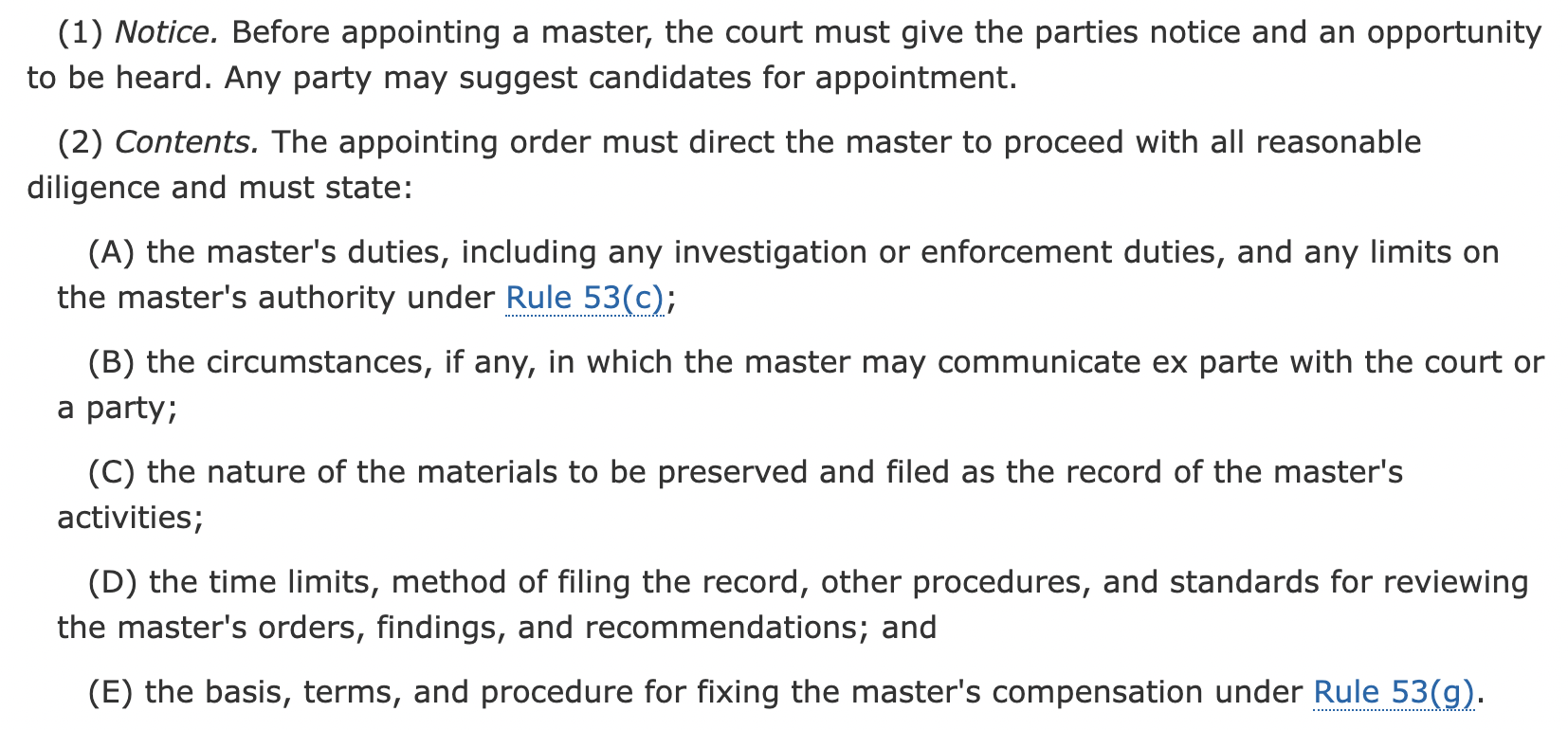
All federal courts have the power to appoint a Special Master (or as it is known in Florida state courts Special Magistrate) to assist with reviewing and deciding discovery in contentious cases. Rule 53 of the Federal Rules of Civil Procedure governs the appointment of masters in federal court usually, but not always, with consent of the parties. In our state court, it is found in various procedural rules and Florida Statutes that empower judges, as well as bodies like county commissions, to obtain assistance in deciding matters. Many federal and state court judges use masters and likely more will do so in the future. Because of their substantial caseloads, many federal district judges and their assigned magistrate judges do not have sufficient time for the tasks inherent in the administration of complex, multi-party, and class action cases. Judges need to conserve and preserve their time to rule on pretrial matters and to try cases. With demanding dockets and tight court budgets, judges turn to skilled neutrals for help in getting the parties relief. These special court appointees usually come with specialized knowledge and are ordered to perform a broad or limited scope of duties such as monitoring discovery, resolving time-consuming disputes, helping with complex E-discovery problems involving electronically stored information (ESI) (typically in high-stakes cases involving employment, intellectual property, products and technology), and coordinating multi-party and multi-district litigation (MDL) cases. A Special Master can markedly reduce the burden on a judge and the court’s administrative staff. When assigned to a case, I routinely review the potentially relevant discovery in camera and provide the court with findings or recommendations regarding the legal status and factual nature of the information. Parties and lawyers recognize that the appointment of a master can save them substantial fees and costs, and can lead to a much quicker resolution of their disputes. Sophisticated parties who regularly use professional and experienced masters know how valuable we can be to expedited case handling and in getting quicker resolution. See more here-- https://bit.ly/3AJ6j2r 


Thursday, December 1, 2016
Anniversary of E-Discovery Amendments
Today marks one year since significant changes were made in 2015 to the original 2006 federal rules on electronic discovery. Federal Rule of Civil Procedure 26(b)1 now emphasizes proportionality and seems to have influenced determining the expense or burden of proposed discovery in a more realistic way. The advent of technology assisted review has also brought costs down and is being employed more frequently by parties and is accepted and even encouraged by courts. My role remains as E-neutral, mediator or sometimes court-appointed special master to facilitate the electronic discovery process by helping parties to agree on the form in which they want information produced and the extent to which metadata will be produced. Mediation can feature private caucuses with retained experts or information technology liaisons that may help conduct discovery proportionally, minimizing motion practice, and avoiding sanctions and unpredictable judicial outcomes. Cooperation using alternative dispute resolution may also encompass settling procedures to be followed when discovering privileged information that has been inadvertently produced in the course of discovery, including clawbacks or agreed confidentiality orders. Rule 37(e) improved the safe harbor for mistakes in deletion, recognizing the volume of data generated is ever increasing and has made preservation more challenging. Sophistication of the parties is still taken into account in reasonable steps taken to initiate holds, but a lawyer's duty of competence in technology in more important than ever. Our E-Discovery & E-Neutral Services can help in that area, providing assistance by hosting Meet and Confer sessions, facilitating cost effective, mutually cooperative, and relevant ESI programs-- even in state court, with Mediated Case Management or Pretrial Stipulations under Florida Civil Rules 1.200 or 1.201. As Special Magsitrates, we are available to monitor E-discovery compliance or perform complex in-camera reviews for which judges don't have time. See more here-- http://www.uww-adr.com/services/e-discovery-and-e-neutral-services/index
Saturday, June 18, 2016
Special Master Services Streamline Discovery
Having chaired the effort to amend the Florida Rules of Civil Procedure to include Electronically Stored Information (ESI), I often remind courts, counsel and litigants that neutrals are now an available avenue to resolve electronic discovery disputes. We are prepared to serve as Special Masters (Special Magistrates under the Florida Rules of Civil Procedure) to assist in e-discovery issues in state and federal matters, including: hosting federal Rule 26 “Meet and Confer” sessions; facilitating cost effective, mutually cooperative, and relevant e-discovery programs; procuring Mediated Case Management or Pretrial Stipulations under Florida Rules 1.200 or 1.201; monitoring discovery compliance and outcomes, and adjudicating legal or technical disputes if necessary. In given cases, by agreement, we neutrals can also serve as “e-discovery mediators” or E-Neutrals to conduct negotiated settlement discussions to resolve issues relating to identification, preservation, collection, review, and production of ESI. Early, proactive involvement of an e-discovery special master or mediator educated in the realm of electronic discovery may yield immediate benefits in both the efficiency and economy of litigation, keeping the discovery process on track to producing the best information available for trial or settlement. Our firm just finished a team in camera review of multiple thousands of documents hosted on kCura's Relativity 9 platform for the Complex Business Litigation Division of the Ninth Judicial Circuit Court in Florida, where I once served as a General Magistrate under Chief Judge Belvin Perry. These efforts are cost effective and can save time, as well as aggravation of the judicial officer who will later rule on dispositive motions and preside over the case. See more here-- http://www.uww-adr.com/services/e-discovery-services
Friday, December 11, 2015
Orlando Mediator Named NLJ Trailblazer
I'm pleased to announce that I've been named as one of only 50 attorneys to be honored as The National Law Journal’s 2015 Litigation Trailblazers. I'll be accepting this award at the inaugural reception of all distinguished recipients in New York City next week. “The National Law Journal proudly recognizes the people who have truly ‘moved the needle’ in facilitating the changing ways that law firms conduct business,” says Kenneth A. Gary, the journal’s vice president and group publisher. “Whether it be technological developments, operational efficiencies, marketing and business development breakthroughs or research – we think this list embodies the spirit that will shepherd and shape modern law firms as a business going into 2016 and beyond.” Only in their second year, the litigation awards recognize top legal professionals who have promoted significant change in the way cases are resolved, using inventive techniques or technologies, bringing unique types of cases to court, or executing novel approaches, according to ALM Media Publisher Tom Larranaga. “They have raised the bar in several meaningful ways and are establishing important new standards as the legal landscape continues to evolve,” he said.
Winners last year included David Boies, one of Time magazine’s 100 Most Influential People in 2010, and Ted Olson, who was Boies’ opposing counsel in the Supreme Court case Bush v. Gore and a former U.S. solicitor general. This year’s group includes Barry Richard, also of the 2000 presidential election case, and famed national trial lawyer Billy Gunn.
I attribute this win to chairing of pioneering efforts to modernize Florida’s civil procedure rules to include electronically stored information and to my innovative work in ADR, specifically promoting the use of E-Neutrals through this blog and other legal publications. My colleague at Upchurch Watson White & Max Mediation Group, Richard Lord, remarked it is "a great honor reflecting Lawrence Kolin’s serious, deliberate and long-term experience and thought leadership in ADR.” See this week's special Litigation Trailblazer publication from The National Law Journal here-- http://pdfserver.amlaw.com/nlj/flipbook/Litigation_TP2015/Litigation_TP2015.html and a full list of all 2015 Trailblazer & Pioneer category winners here-- https://www.eiseverywhere.com/ehome/150001/342183/ Thanks for your continuing support and readership!
Sunday, December 6, 2015
New Federal Rules Amendments Now Effective
Last week, the long-awaited Federal Rules of Civil Procedure amendments became effective without changes to the proposed language by Congress. These rules importantly pertain to discovery of Electronically Stored Information or ESI-- a concept first introduced into the FRCP in 2006. The changes are essentially outlined as follows:
Rule 1: The very first rule now specifies that both the court and the parties should interpret the rules to secure just, speedy and inexpensive outcomes.
Rule 4: Plaintiffs now have only 90 days to serve a defendant after filing the complaint. Of course, courts may still extend the time for service upon a showing of good cause.
Rule 16: Conferences set under this rule are now 90 days after service or 60 days after an appearance by a defendant, whichever is earlier.
Rule 26: Scope of discovery substantially changes, requiring that discovery requests be proportional to the needs of the case, as opposed to just reasonably calculated to lead to the discovery of admissible evidence. Courts may now allocate discovery costs. Parties are to discuss preservation of evidence in their discovery plan and may serve document requests before the scheduling conference, having been considered served at the first Rule 26(f) conference.
Rule 34: Responses to production requests now must state with specificity the grounds for objecting and whether any responsive materials are being withheld on the basis of that objection.
Rule 37: The proverbial Safe Harbor relating to preservation obligations now lessens a court's power to impose sanctions for failure to preserve information, merely allowing ordering so-called curative measures based on a finding that a party is prejudiced from spoliation of evidence. More severe sanctions, such giving an adverse inference or entering default judgment, are permitted under proposed Rule 37(e)(2), but only after finding a party acted with intent to deprive another party of the information’s use in the litigation.
Of course, despite a new emphasis on cooperation and proportionality, continuing E-Discovery skirmishes are expected. The use of confidential mediation for the resolution of such disputes by E-Neutrals is encouraged if the parties and counsel cannot settle the entire matter. E-Neutrals are mediators specializing in complex cases involving electronic evidence who can shape discovery plans, allocate costs and suggest and create efficiencies. The mediation process may focus a confidential conference solely on managing ESI, or the neutral may broaden the discussion, reminding parties of risks and perhaps dissuading them from merely using E-Discovery as a sword or shield. Mediation is an avenue that can present parties with significant cost-savings in ESI cases, if performed early enough in the litigation. Getting back to the merits is the goal of this process and these new discovery rules. Until there are orders applying these amendments and some new FRDs reported, it remains to be seen how they will impact litigation in the federal courts. See more on this development here-- http://www.bna.com/new-rules-civil-n57982064088/ and https://www.law.cornell.edu/rules/frcp
Monday, July 20, 2015
Masters Conference for Legal Professionals
Please join me tomorrow as I speak about streamlining electronic discovery at the Masters Conference for Legal Professionals on Tuesday, July 21, in New York City. Having chaired the recent effort to amend Florida Civil Procedure Rules to include e-discovery and previously taught for the state’s Advanced Judicial College, I'll join other industry experts in taking attendees through the life cycle of a complex case. We'll be focusing on fixing problem areas for a more cost-effective approach in a panel discussion titled “How to Streamline E-Discovery,” which runs from 11 am to noon. All eight of the conference’s sessions will take place at New York’s famed Harvard Club. The conference will concentrate on e-discovery, data protection, records management and related topics. My emphasis will be on avoiding discovery disputes in the courts through the use of E-Neutrals, Mediated Case Management and Special Masters by culling the universe of information available to parties, in order to let them focus back on the merits of the claims and defenses. E-Neutrals or mediators specializing in complex cases involving electronic evidence can shape discovery plans, allocate costs and suggest and create efficiencies. The mediation process may focus a confidential conference solely on managing ESI, or the neutral may broaden the discussion, perhaps dissuading parties and counsel from merely using e-discovery as a sword or shield. Mediation is an avenue that can present parties with significant cost-savings in ESI cases, if performed early enough in the litigation. For more information about our panel at the Masters Conference, please visit-- http://themastersconference.com/agenda/how-streamline-ediscovery and for the full agenda tomorrow, see-- http://themastersconference.com/events/new-york-city
Subscribe to:
Posts (Atom)