
Wednesday, April 20, 2022
Comments on Non-Binding Arbitration due 5/6
The Supreme Court of Florida's Standing Committee on Alternative Dispute Resolution Rules and Policy is charged with monitoring and making recommendations to improve and expand the use of court-connected Alternative Dispute Resolution (ADR) not limited to mediation through the recommendation of the adoption of statutes, rules, policies, and procedures. This Committee is seeking feedback on two proposed amendments related to statutory non-binding arbitration. Specifically, they are considering revisions to Rule 1.820, Florida Rules of Civil Procedure (Hearing Procedures for Non-Binding Arbitration) and Section 44.103, Florida Statutes (Court-ordered, nonbinding arbitration). While the ADR Section of the Florida Bar whose Executive Council on which I serve will be commenting on behalf of its almost one thousand members, please consider individually responding to these proposals. The Florida State Court System consists of 20 judicial circuits that encompass Florida’s 67 counties and so practice in this area of ADR varies widely under local administrative orders. Comments are due to the Florida Dispute Resolution Center on or before Friday, May 6, 2022, via drcmail@flcourts.org. The proposed revisions can be found here-- https://tinyurl.com/3r986y25 and https://tinyurl.com/4w2tfuje


Friday, April 1, 2022
FAA Jurisdiction Case Decided by SCOTUS
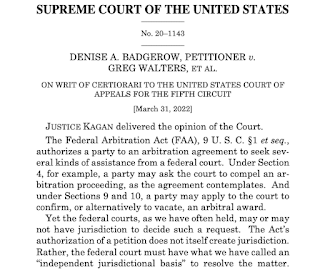
The Supreme Court of the United States yesterday issued an important ruling on federal court jurisdiction in matters governed by the Federal Arbitration Act (FAA) saying it does not allow federal courts to “look through” to the dispute underlying an arbitration to establish jurisdiction to confirm or vacate an arbitration award. The FAA authorizes a party to an arbitration agreement to petition a federal court for various forms of relief. The Act’s authorization of such petitions does not itself create the subject matter jurisdiction necessary for a federal court to resolve them. Previously, in Vaden v. Discover Bank, the Court assessed whether there was a jurisdictional basis to decide an FAA Section 4 petition to compel arbitration by means of examining the parties’ underlying dispute. Specific language in Section 4 instructed a federal court to “look through” the petition to the “underlying substantive controversy.” If the dispute underlying a Section 4 petition falls within the court’s jurisdiction for example, by presenting a federal question, then the court may rule on the petition to compel arbitration. In this case, Badgerow v. Walters, the question presented was whether that “look-through” approach to jurisdiction applies to applications to confirm or vacate arbitral awards under Sections 9 and 10 of the FAA. The majority ruled Congress chose to respect the capacity of state courts to properly enforce arbitral awards. Justice Kagan writes "the look-through rule is a highly unusual one: It locates jurisdiction not in the action actually before the court, but in another controversy neither there nor ever meant to be." This application in an employment termination case should go to state, rather than federal, court raising claims between non-diverse parties involving state law. See opinion here-- https://bit.ly/3DyArhT

Tuesday, March 1, 2022
Free Online Mediation CLE/CME 3/18
Join us March 18th at 1:00 pm EST for Mediator’s Notebook = Attorney’s Toolbox, a free CLE/CME Webinar with 1.5 credits of CLE from The Florida Bar, but that's not all you'll gain by attending. Whether you are representing plaintiffs or defendants, you'll gain valuable insights on helping your mediator to put everyone's focus on the path to reasonable resolution. Attorneys can often help a mediator to assess what barriers to settlement may exist. We will address what pre-mediation preparation to consider. Additionally, we will cover laying the groundwork for ongoing discussions through messaging. It is often said a case is not worth a penny more than someone is willing to pay or a penny less than someone is willing to accept. We'll discuss how those most patient at mediation have the most to gain. More information and registration details here-- https://bit.ly/3toGkd3

Tuesday, February 8, 2022
Oral Argument On FL Remote Proceedings Rules
Today, the Supreme Court of Florida heard from various commenters, interest groups and bar sections on the changes proposed to multiple procedural rules to include attendance by remote technology, including mediation. The Workgroup on the Continuity of Court Operations and Proceedings During and After COVID-19 filed a comprehensive petition to amend the Florida Rules of Civil Procedure, the Florida Rules of General Practice and Judicial Administration, the Florida Rules of Criminal Procedure, the Florida Probate Rules, the Florida Rules of Traffic Court, the Florida Small Claims Rules, and the Florida Rules of Appellate Procedure. The proposed amendments would provide permanent, broader authorization for the remote conduct of court proceedings. The justices seemed largely receptive to the package and had few questions for those appearing at oral argument, indicating the new rules package will most likely be accepted as proposed. See more in docket here-- https://bit.ly/3st7kYa and oral argument here-- https://wfsu.org/gavel2gavel/


Saturday, January 29, 2022
Call for 30th DRC Conference Proposals
The Florida Dispute Resolution Center (DRC) 30th Annual Conference will be held at the Rosen Centre Hotel in Orlando on August 11-13, 2022. DRC is asking for submissions for workshop proposals and to become part of the conference faculty. Alternative Dispute Resolution (ADR) professionals play a major part in enhancing access to justice by offering parties an opportunity to minimize the time and money they spend interacting with the court system and by modernizing the facilitation process by using technology. Mediators also promote public trust and confidence in the court system by maintaining education on high standards of professionalism and ethical behavior when assisting parties in settling their disputes. This conference, now in its third decade, provides an annual forum for enhancing your skills and knowledge regarding ADR, especially as our world continues to demonstrate a need for professionals who can promote civil discourse when presenting options to resolve disputes. Consider training your fellow mediators by sharing the latest in your experience. I have presented here in the past and encourage you to do the same. If your workshop submission is selected, you will be asked to present twice during the conference. The deadline for submission is February 25th and workshop selections will be confirmed in early April 2022. You will receive a full conference registration waiver, and if applicable, a second presenter will receive $50 off registration fees. You will receive a confirmation email after you submit the form. If you do not receive a confirmation email, the form was not successfully submitted. The DRC recommends gathering all information required prior to beginning to filling out the form located at here-- https://bit.ly/3ufyqob

Wednesday, December 22, 2021
Fla. S. Ct. Extends Previous Covid Mediator Measures
The Supreme Court of Florida issued an Administrative Order (AO) relating to several Alternative Dispute Resolution (ADR) items that continue addressing operational issues from the pandemic and allowing for things like mediation training by remote electronic means. The order extends a limited number of provisions that were first authorized in April 2020 and December 2020 due to the impact of COVID-19 on the judicial system. Highlights of the order include suspending the Rules for Certified and Court-Appointed Mediators by eliminating the required points for mentorship activities through June 30, 2022. According to the Dispute Resolution Center which just advised of this new order, there are few important items to note in the AO: mentoring activities may still be needed for applicants to reach the required points for mediator certification (except for county); extending the ability of parenting coordination training to be conducted online through December 31, 2022; and waiving certain disciplinary requirements for certified mediators and qualified parenting coordinators. See more in AOSC20-24 Amendment 2 here-- https://bit.ly/3qgLaar

Saturday, November 6, 2021
Mediator Rules Comments Due 1/1
The Committee on Alternative Dispute Resolution Rules and Policy has undertaken the revision of Part I, Mediator Qualifications, and Part II, Standards of Professional Conduct, of the Rules for Certified and Court-Appointed Mediators. Committee members are seeking feedback on the revisions at the link below on Amendments to Rules for Certified and Court-Appointed Mediators. Most involve the certification criteria, but other proposed changes include enhancements to impartiality, conflicts and social networking. Confidentiality of the caucus is also addressed in that with the express consent of the parties and counsel, a mediator may establish as a ground rule for the mediation that information disclosed during caucus may be disclosed to the other mediation participants unless a party expressly tells the mediator to keep the information confidential. Additionally, regarding reporting mediation outcomes to courts, mediators must not include comments reflecting a mediator's opinions regarding whether a party or counsel mediated in "good faith" as sometimes seen in referral orders. Send any comments to the Dispute Resolution Center by email to DRCmail@flcourts.org, on or before January 1, 2022. See more here-- https://bit.ly/3EPGfD5


Subscribe to:
Posts (Atom)