
Thursday, November 3, 2022
SDFL Rules Favor Remote Attendance
Next month, new mediation rules take effect in the United States District Court for the Southern District of Florida. After hearing from the bar on format and giving the public an opportunity to comment, the federal court decided in favor of remote attendance. Unless the court orders otherwise, under Local Rule 16.2, Court Annexed Mediation, the parties shall decide whether their mediation conference will be conducted in person or by video-conference and, if the parties cannot agree, the mediation conference shall be held by video-conference. Additionally, unless excused in writing by the court, all parties and required claims professionals (e.g., insurance adjusters) must participate in the mediation conference with full authority to negotiate a settlement which includes connecting and participating by video and audio. Lately, we've seen some parties appear with black screens, muted on Zoom. This change seems to attempt to address that trend and level the playing field, alleviating the need for mediators to compromise their neutrality in acting as policemen for the process. See more here for rules that take effect December 1, 2022-- https://www.flsd.uscourts.gov/sites/flsd/files/adminorders/2022-88.pdf


Monday, October 17, 2022
Mediation Week 2022
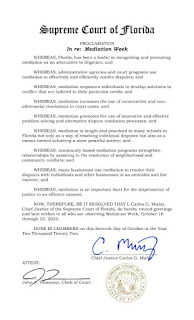
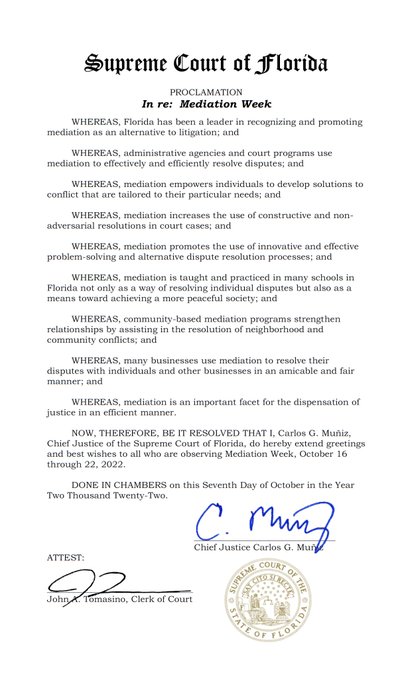
Every October, we celebrate the impact of the mediation process and its professionals on the many disputes in the world. Mediation Week in Florida and elsewhere marks the importance of dispute resolution as an effective substitute to litigation. In fact, mediation has helped litigants get through our recent challenges, evolving to widely accepted remote attendance allowing parties to resolve disputes without trial in a still backed-up court system. Alternative Dispute Resolution (ADR) has been used by Florida courts for more than 30 years. Online Dispute Resolution (ODR) will now serve as an official option following the pandemic through sessions conducted with readily available technology. Florida's Dispute Resolution Center continues to require specific standards set by the Florida Supreme Court in the areas of county, family, circuit, dependency, and appellate mediation during these virtual sessions. Mediation week brings annual focus on ADR work and highlights how individuals, administrative agencies, and businesses can use mediation to develop efficient and customized solutions to conflicts. Just by searching #mediationweek online, you may find a variety of resources from venerable organizations like the American Bar Association (ABA) or the Federal Mediation and Concilliation Service (FMCS) which is celebrating its 75th anniversary with free programs on cutting-edge topics, practices, and examinations on conflict prevention, management, and resolution this week. See more here-- https://fmcs.zoomgov.com/webinar/register/WN_b03eGSkmQ_uK2CiCk0U1vQ
Thursday, September 1, 2022
What is a Special Master anyway?
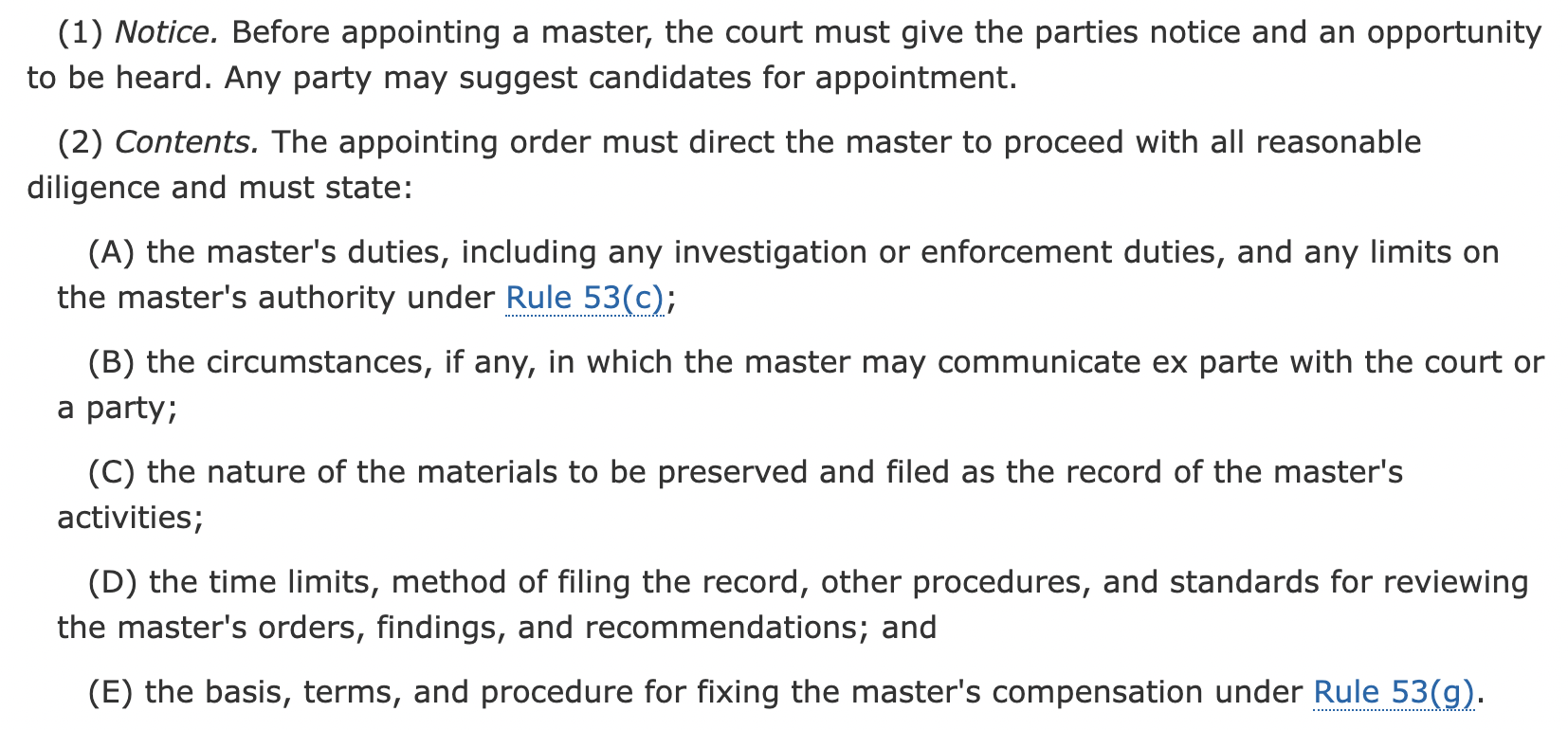
All federal courts have the power to appoint a Special Master (or as it is known in Florida state courts Special Magistrate) to assist with reviewing and deciding discovery in contentious cases. Rule 53 of the Federal Rules of Civil Procedure governs the appointment of masters in federal court usually, but not always, with consent of the parties. In our state court, it is found in various procedural rules and Florida Statutes that empower judges, as well as bodies like county commissions, to obtain assistance in deciding matters. Many federal and state court judges use masters and likely more will do so in the future. Because of their substantial caseloads, many federal district judges and their assigned magistrate judges do not have sufficient time for the tasks inherent in the administration of complex, multi-party, and class action cases. Judges need to conserve and preserve their time to rule on pretrial matters and to try cases. With demanding dockets and tight court budgets, judges turn to skilled neutrals for help in getting the parties relief. These special court appointees usually come with specialized knowledge and are ordered to perform a broad or limited scope of duties such as monitoring discovery, resolving time-consuming disputes, helping with complex E-discovery problems involving electronically stored information (ESI) (typically in high-stakes cases involving employment, intellectual property, products and technology), and coordinating multi-party and multi-district litigation (MDL) cases. A Special Master can markedly reduce the burden on a judge and the court’s administrative staff. When assigned to a case, I routinely review the potentially relevant discovery in camera and provide the court with findings or recommendations regarding the legal status and factual nature of the information. Parties and lawyers recognize that the appointment of a master can save them substantial fees and costs, and can lead to a much quicker resolution of their disputes. Sophisticated parties who regularly use professional and experienced masters know how valuable we can be to expedited case handling and in getting quicker resolution. See more here-- https://bit.ly/3AJ6j2r 
Monday, August 1, 2022
Permanent Remote Mediation Authorized By Fla. S. Ct.
This summer, the Florida Supreme Court provided permanent civil rule changes authorizing the remote conduct of certain court proceedings including mediation, appellate mediation and arbitration. The court's Workgroup on Continuity of Court Operations and Proceedings During and After COVID-19 was directed to identify whether certain proceedings, due to efficiencies beneficial to stakeholders, could continue to be conducted remotely when COVID-19 no longer presents a significant risk to public health and safety. The Workgroup determined that permanent, broader authorization for remote proceedings was warranted based on the positive outcomes and efficiencies observed during the pandemic. Beginning with Rule 1.700, Florida Rules of Civil Procedure, common to mediation and arbitration, the amended language now provides for use of communication technology (as that term is defined in Florida Rule of General Practice and Judicial Administration 2.530) authorized in mediation and arbitration by stipulation of the parties or by court order. Absent direction in the order of referral, mediation or arbitration must be conducted in person, unless the parties stipulate or the court, on its own motion or on motion by a party, otherwise orders that the proceeding be conducted by communication technology or by a combination of communication technology and in-person participation. Also of note, is that Rule 1.720 now states a party is deemed to appear at a mediation conference if physically present or, if authorized, participating through the use of communication technology. Please note under Rule 1.730, if an agreement is reached, it must be reduced to writing and signed by the parties and their counsel, by original signature, electronic signature, or facsimile and may be in counterparts. Importantly, the parties may not object to the enforceability of an agreement on the ground that communication technology was used for participation in the mediation conference if such use was authorized. Similar language is found in Rule 1.750 in regard to county court mediation. The communication technology provisions also apply to appellate mediation and are found in revised Florida Rules of Appellate Procedure 9.700, 9.720 and 9.740. These amendments become effective October 1, 2022 and recognize the sea change that took place during court closures. The shift to remote proceedings helped ease a backlog of cases by litigants being able to access hearings and alternative dispute resolution though Zoom and other available online platforms to resolve matters. See complete opinion here-- https://www.floridasupremecourt.org/content/download/843197/opinion/sc21-990.pdf


Friday, July 1, 2022
SCOTUS Arbitration Decisions
As this tumultous term comes to a close, a pair of recent employment case rulings has given some to insight into the future of the U.S. Supreme Court's direction on arbitration which has been pretty firm as of late. Traditionally, the Court has relied upon precendent and the Federal Arbitration Act (FAA) in enforcing the right to arbitrate as contractual in nature and upholding those agreements. More recently, the Court is reversing decisions that apply even-handed rules to the FAA. In Morgan v. Sundance, a unanimous Court rejected the two-part test applied by most federal circuits in evaluating whether a party has waived its right to compel enforcement of an arbitration agreement. Under that test, waiver would be found only if a party acted in a manner inconsistent with its arbitration rights and that inconsistency caused prejudice to the other side. The principal justification for requiring prejudice was federal policy favoring arbitration. Finding that the usual test for contractual waiver typically requires only inconsistent conduct, the Court held it improper to add a prejudice requirement onto the waiver analysis just for arbitration agreements. The text of the FAA makes clear that courts are not to create arbitration-specific procedural rules. In Viking River Cruises v. Moriana, eight of nine justices agreed with the result relying in part on a severability provision in the arbitration agreement to narrow an otherwise invalid wholesale waiver of state Private Attorneys General Act (PAGA) claims. This suggests that whether courts will compel arbitration of individual PAGA claims may turn on the specific language of the arbitration agreement at issue. The lone dissent came from Justice Thomas, who long has viewed the Federal Arbitration Act does not apply to cases in state courts. The FAA also can preempt rules “that are generally applicable as a formal matter” but have the effect of making arbitration agreements ineffective because they are inherently inconsistent with arbitration. Such rules would include those that would require a party to arbitrate on a class basis or not at all. See decisions-- http://tinyurl.com/3e6hbek9 and http://tinyurl.com/57r87jzc and more here-- http://tinyurl.com/yeaw7sdd and http://tinyurl.com/yc4ktrmv


Wednesday, June 1, 2022
Join me at Lawyer/Mediator Forum at Florida Bar President’s Showcase!
In order to improve the mediation process, The Florida Bar’s Trial Lawyers and Alternative Dispute Resolution Sections are engaging in a unique collaboration to co-host the first “Litigator-Mediator Forum” at the President's Showcase during our Annual Convention in Orlando on June 23, 2022 from 1-4 pm. This two-part CLE presentation will provide trial lawyers and mediators a direct platform to discuss how to make mediation more effective and efficient. The purpose of the Forum is not just to provide continuing legal education to trial lawyers and mediators on ethical rules and mediation advocacy skills, but to exchange ideas for improving the mediation process in all areas. Mediation has never been a more critical and timely topic in Florida due to the over one million case backlog created by the pandemic that continues challenging our courts and delaying access to justice for Florida litigants. As nearly all cases are now settled before trial, and most cases are settled at mediation, effective mediation advocacy and negotiating skills are essential to achieving justice. This topic is also timely because the Florida Supreme Court is presently considering several significant changes to the ethical rules governing mediation as well as case management restructuring and these rule changes will be discussed during the Forum. I am honored to have been selected as one of the Table Leaders who will facilitate discussion between trial lawyers and mediators regarding three topics designed to encourage recommendations by the audience on how trial lawyers and mediators can partner better together to improve mediation within the ethical rules governing dispute resolution. See more about this exciting program here-- https://tinyurl.com/w54a3je9


Tuesday, May 3, 2022
Breach of Confidence at SCOTUS
Somewhat overshadowed by yesterday's news of Roe's imminent demise was the unprecedented nature of the leak to the press of an unpublished and confidential draft opinion in a pending case. After such a breach of trust committed by someone with access at U.S. Supreme Court, there is no telling what will happen going forward in terms of perceptions of integrity and legitimacy of this institution. The environment inside the building is sure to be tense. Outside the courthouse, erosion of public confidence in the third branch of government continues. As the Court states, its Justices circulate draft opinions internally as a routine and essential part of the Court’s confidential deliberative work. Chief Justice Roberts in directing an investigation by the Marshal has revealed the draft to be authentic, but cautions it does not represent a decision by the Court or the final position of any member on the issues in the case. He also states, "to the extent this betrayal of the confidences of the Court was intended to undermine the integrity of our operations, it will not succeed. The work of the Court will not be affected in any way." Imagine what damage could be done to parties or their interests if the results of votes to any future case were routinely leaked. What if people traded on information from what was once considered kept a sacred place before justice was rendered? How about the rest of the federal and even state judiciary? For now, the Chief Justice still believes the Court has intensely loyal employees who remain dedicated to the rule of law. "Court employees have an exemplary and important tradition of respecting the confidentiality of the judicial process and upholding the trust of the Court. This was a singular and egregious breach of that trust that is an affront to the Court and the community of public servants who work here." See Court press release here-- https://www.supremecourt.gov/publicinfo/press/pressreleases/pr_05-03-22


Subscribe to:
Posts (Atom)